Watch: how it's done
How to Install Blinds and Shades — The Home Depot — embedded from YouTube
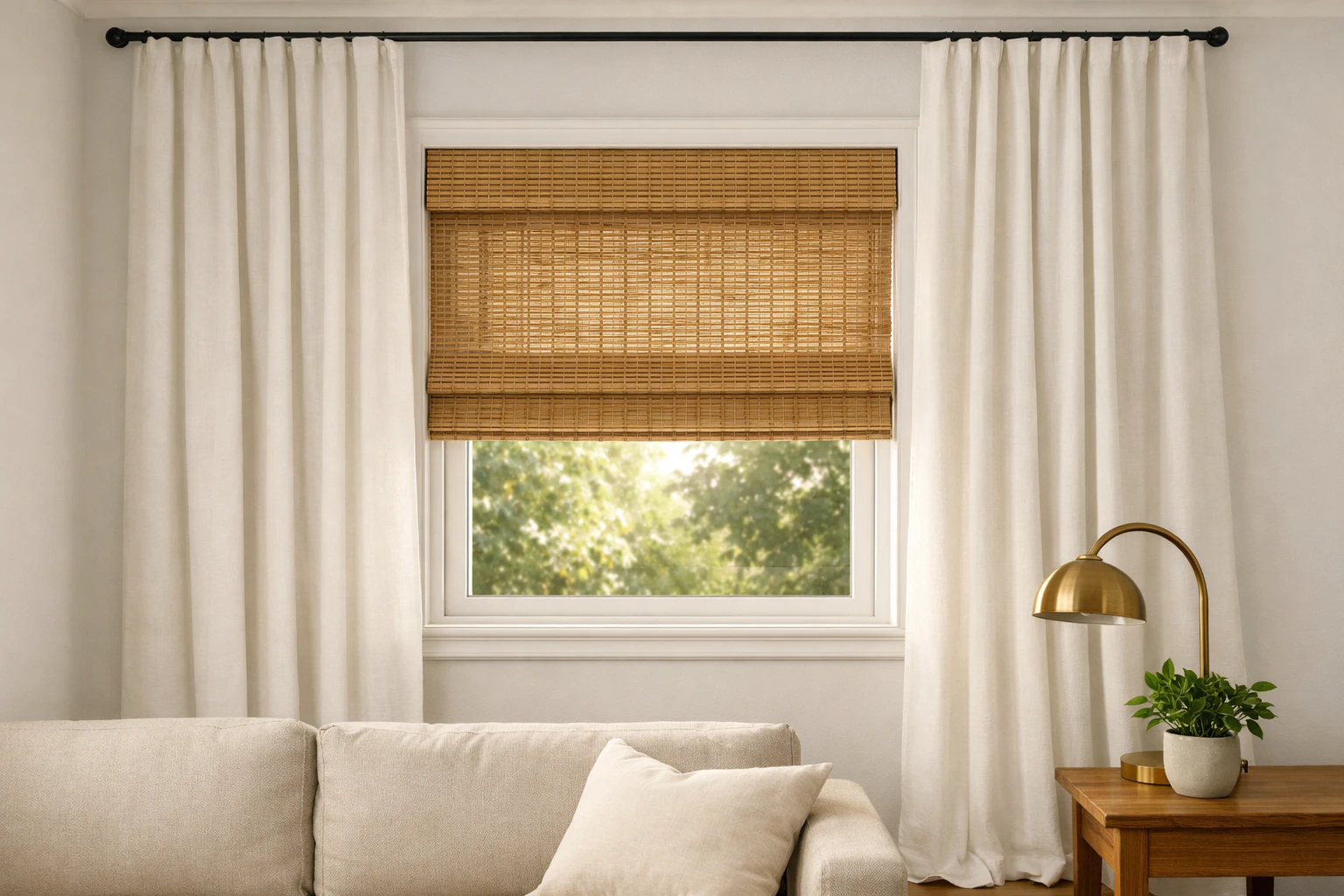
Tension rod curtains, blackout panels, no-tool pleated shades and bamboo roman shades. Real prices for renter-friendly window treatments in every room.
Why this pick: Amazon Basics tension rods wedge inside the window frame without drilling. Best choice for renters with strict landlord rules. Limited to windows under ~5 ft wide — heavy curtains can sag and pop the rod loose on wider spans.
Why this pick: NICETOWN's triple-weave blackout fabric blocks 99% of light vs cheaper double-weave brands. Worth the extra $10 if you sleep light or have a west-facing bedroom — the difference is dramatic.
Why this pick: Redi Shade's adhesive-back pleated shades install in 5 minutes, no drilling. The paper-like material isn't as premium as fabric but provides solid privacy and light filtering for renters who can't damage window frames.
Why this pick: Lewis Hyman's bamboo roman shades use real bamboo slats woven with cotton thread. Pricier than synthetic alternatives but actually biodegradable, and the natural texture photographs beautifully on Pinterest.
Prices verified July 2026 · US market · subject to change
How to Install Blinds and Shades — The Home Depot — embedded from YouTube
Curtains and shades are the single piece of decor that ties a room together — they soften light, define color palette, hide ugly window frames, and provide privacy. Yet most renters and budget-conscious owners default to either no treatments at all (harsh light, exposed view) or whatever was already hanging there. Even cheap window treatments dramatically upgrade a room. The question is which type.
The two main approaches to window treatments. If you're choosing between these two specifically, here's the short version before the full breakdown of every option below.
| Curtains | Roman shades | |
|---|---|---|
| Cost per window | $30–100 | $40–150 |
| Install | 20-30 min (rod + brackets) | 5-15 min (inside-frame tension) |
| Daytime light control | All or nothing | Adjustable height |
| Blackout for sleep | Best — true blackout possible | Good — perimeter gap leaks light |
| Sound dampening | Significant fabric mass | Minimal |
| Best for | Bedrooms, large windows, blackout needs | Small windows, kitchen, bathroom |
Pick curtains if you need blackout, sound dampening, or your window is large. Pick roman shades if the window is small, you want partial daytime light control, or the window is in a kitchen/bathroom where fabric is impractical. Best move for most apartments: layer both — roman shade inside the frame for daytime work, curtains on top for evening blackout. The "designed window" look.
Still deciding between these two? Read the full Curtains vs Roman Shades comparison → — the layered-approach logic that most designers use, blackout sealing rules, kid/pet safety on cordless lifts, and 6 FAQs specific to this pair.
The mechanism decision — slats that tilt to redirect light direction, or continuous fabric that adjusts only height. The right answer is mostly about whether you need privacy-at-partial-open (offices, kitchens) or measurable insulation (hot climates, energy bills).
| Blinds (horizontal slat) | Shades (continuous fabric) | |
|---|---|---|
| Cost per window | $15–50 | $30–150 |
| Light direction control | Tilt redirects at any angle | Height only — no direction |
| Insulation R-value | R-0.5 (none) | R-2 to R-5 (cellular) |
| Annual cleaning time | 1-1.5 hr per window | 12-24 min per window |
| Best for | Offices, kitchens, humid rooms | Living rooms, hot climates, allergy households |
Pick blinds if you want light-while-private (office Zoom calls, kitchen prep), the window is humid (faux wood blinds survive where fabric shades grow mildew), or your budget is under $50/window. Pick cellular shades if you're in a hot climate (R-4-5 insulation cuts AC bills 10-25%), allergies make blind dust a problem, or the window is in a primary living space where aesthetic matters. For high-use windows, the blinds-plus-cellular-shade hybrid at $80-180 gets both mechanisms' benefits.
Still deciding between these two? Read the full Blinds vs Shades comparison → — the light-direction-vs-height mechanism that decides it, cellular shade R-value math that pays back AC bills, the dust accumulation factor for allergy households, and 6 FAQs specific to this pair.
Spring-loaded tension rods wedge inside the window frame without drilling — perfect for renters or anyone who hates patching screw holes. Amazon Basics and Cambria sell them for $8-20 each, supporting curtains up to 5 ft wide and moderate weight. The trade-off — they pop loose if loaded with heavy fabric or if anyone pulls hard on the curtains (kids, pets, heavy gusts of wind through open windows).
If you sleep light or have a west-facing bedroom, blackout curtains aren't optional. NICETOWN's triple-weave fabric blocks 99% of light — measurably different from cheaper double-weave brands which only block 70-90%. The difference is the room going from "dim" to "actually dark" at sunrise. Bonus: thermal lining cuts AC bills 5-10% in summer.
Redi Shade's adhesive-back pleated shades stick to the inside of the window frame with foam adhesive. Cut to fit with scissors, peel-and-stick, raise/lower with a cord. Paper-like material isn't as premium as fabric, but it provides solid privacy and light filtering for $10-15 per window. Best for renters who can't drill into window frames at all.
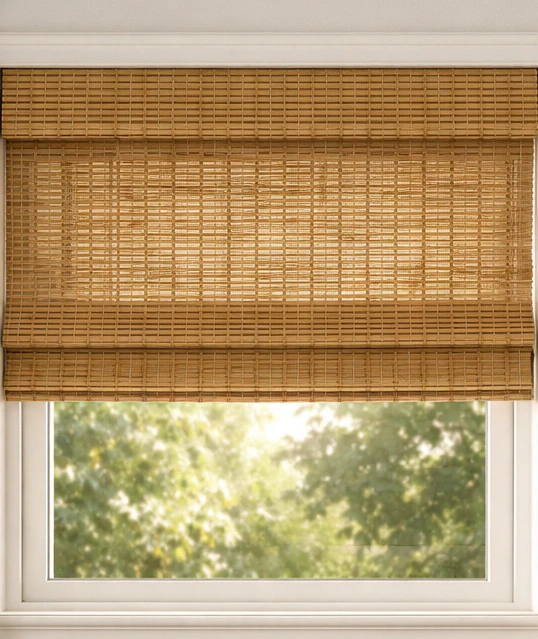
Lewis Hyman's bamboo roman shades use real bamboo slats woven with cotton thread. They mount inside or outside the window frame and roll up via a chain pull. At $40-80 per window, they're not cheap, but the natural texture photographs beautifully and lasts 8-12 years. Particularly good in living rooms and bedrooms with neutral palettes.
Most people buy curtains too narrow. The rule: curtain panel width should be at least 1.5-2× the window width. A 3 ft window needs 5-6 ft of curtain panel (or two 3 ft panels). This is what makes curtains look intentional and full versus skimpy and apartment-grade. Cheap NICETOWN panels at the right width beat expensive panels at the wrong width every time.
Mount the curtain rod 4-6 inches above the window frame, not directly on the frame. This makes the window appear taller and the ceiling appear higher. For renters with rules against drilling, this is one reason tension rods inside the frame are a compromise — they don't get the "tall ceiling" effect.
For light-to-medium-weight fabric (cotton, polyester blends, sheers) — yes, totally fine. For blackout curtains with thermal lining (which are surprisingly heavy at 4-6 lbs per panel) — borderline. Use a heavy-duty tension rod rated to 3 lbs+ per linear foot. Avoid the cheapest tension rods under $5 — they sag in the middle within weeks. Amazon Basics and Cambria are the reliable brands.
NICETOWN's triple-weave blackout fabric is the standard recommendation — it actually blocks 99% of light, verified by reviewers in dark-room tests. Solid colors hide wrinkles better than patterns. Get them long enough to puddle slightly on the floor (curtains that stop short of the floor look unfinished). Width should be 1.5-2× the window width for full coverage when closed.
Yes — Redi Shade's no-tool pleated shades use foam adhesive that holds for 5-7 years and peels off cleanly. Tension-mount blinds (Levolor and Bali sell these) wedge inside the window frame using spring tension, same principle as tension rods but designed for blinds specifically. Both are renter-safe and work without any tools beyond scissors for cutting to fit.
Roman shades fold into horizontal pleats when raised, showing more visual texture and warmth. Roller shades disappear into a tube at the top, giving a cleaner minimalist look. For traditional or warm-modern rooms, roman shades. For modern-minimalist or office spaces, roller shades. Cost is similar at $30-80 per window depending on size and material. Both work as renter-safe options if you choose the inside-mount tension brackets.
Total curtain panel width should be 1.5-2× the window width for proper fullness. A 36-inch wide window needs 54-72 inches of curtain panel — either one 60-inch panel or two 36-inch panels. Cheap curtains at the right width look much better than expensive curtains at the wrong width. Length: curtains should at minimum touch the floor; for high-end look, let them puddle 1-2 inches on the floor.
New comparisons, renter hacks and Amazon finds — every Sunday.