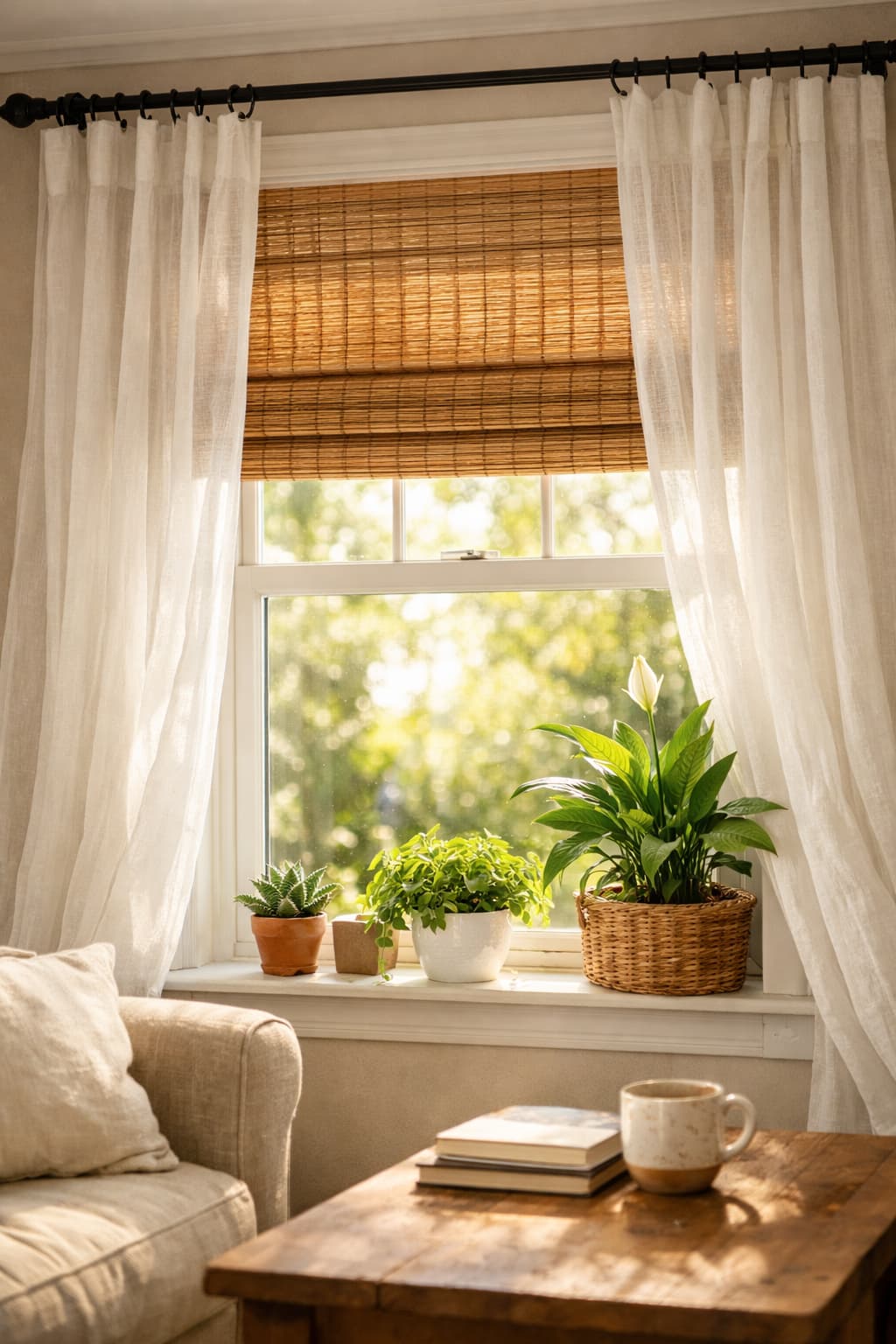
Treatments vs film: choosing the right tool
Most renters and budget-conscious homeowners default to curtains for every window. Window film does many of the same jobs at a fraction of the cost — privacy, UV protection, decorative effect — without any rod-and-fabric overhead. Often the right answer is both: film for privacy (always-on) plus curtains for full blackout (when needed for sleep).
Use cases for each
- Bathroom window: Frosted film ($15) — permanent privacy, lets light in. Skip curtains entirely.
- Ground-floor side windows: Frosted film or one-way mirror film for daytime privacy. Curtains optional.
- Bedrooms: Blackout curtains for sleep. Optional UV film if west-facing.
- Living room: Bamboo roman shades or flowing curtains for design. UV film if south-facing to protect furniture.
- Home office: Light-filtering shades for Zoom-friendly diffusion. UV film if direct sun causes monitor glare.
The renter constraint
Tension-rod curtains, no-tools pleated shades, and static-cling window film all install without drilling. Together they cover 80% of window treatment use cases for renters. Skip standard rod-mounted blinds and curtain rods that require screws — they're not worth the wall damage when you move out.
The width-and-height rule for curtains
Total curtain panel width should be 1.5-2× window width for proper fullness. Length should at minimum touch the floor. Rod mounted 4-6 inches above the window frame visually heightens the ceiling. These three rules separate curtains that look intentional from curtains that look like they came with the apartment.
The three head-to-heads behind these choices
Each recommendation above has a full comparison with prices. Curtains vs roman shades covers the soft-treatment decision — including why designers so often layer both (shade for the day, curtains for the night). Blinds vs shades is the harder-working question: tilt-slat light control against cellular insulation that measurably cuts AC bills in hot climates. And on the film side, static-cling vs adhesive film decides by room — cling peels off residue-free for renters but curls in 1-2 years, adhesive survives humid bathroom windows for 5-7.
One window, several jobs — layer by time of day
The mistake in most window setups is asking one product to do everything. Think in layers instead: film handles the always-on jobs (privacy, UV) at the glass itself; a shade or blinds handles the changes-during-the-day job (glare, afternoon sun); curtains handle the night jobs (blackout, insulation, softness). A bedroom window with $15 of UV film, a $40 cordless cellular shade and $50 blackout curtains outperforms any single $200 treatment — and every layer of it installs renter-safe.