Watch: how it's done
Choosing the Best Rug For Your Space — Bedroom — embedded from YouTube
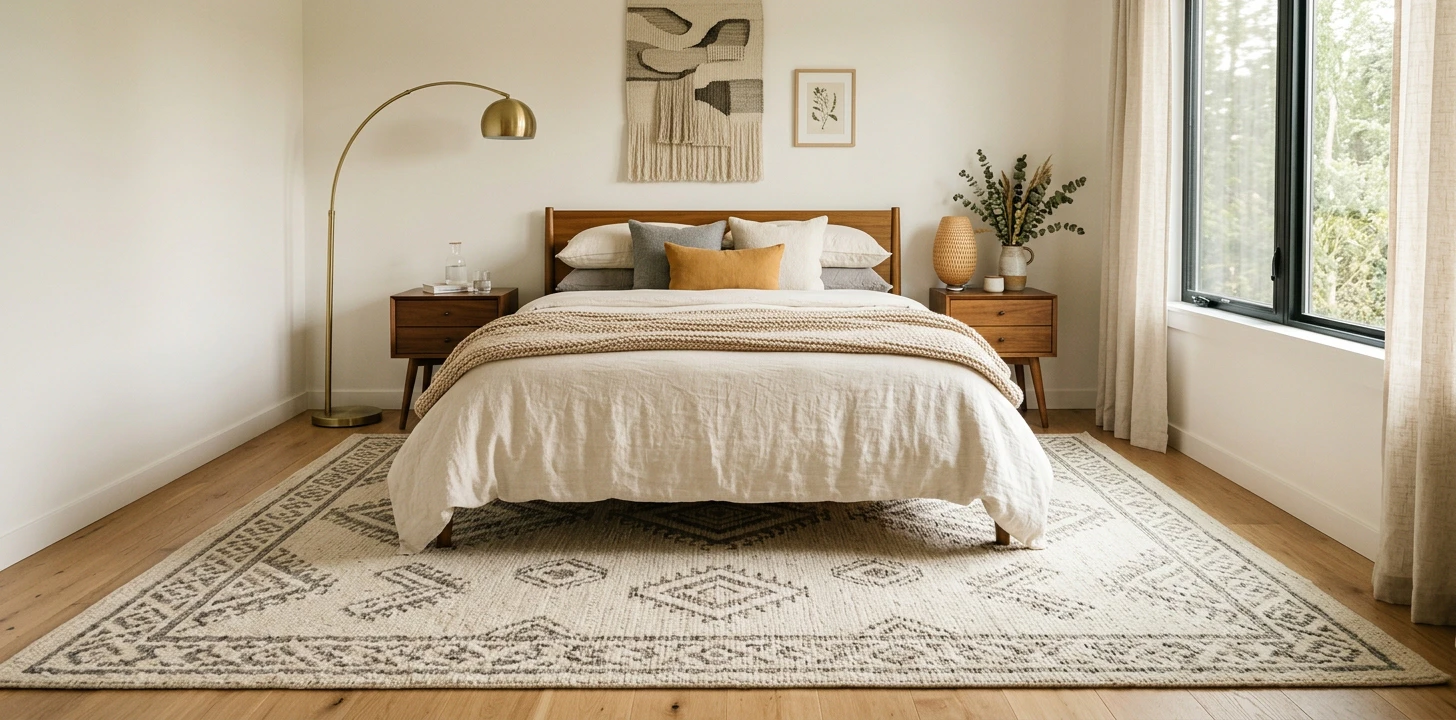
Area rugs vs vinyl plank vs peel-and-stick for bedroom floors. Find the best renter-friendly option for your budget.
Why this pick: Ruggable's washable construction (rug cover + reusable pad) is genuinely different from competitors. For pets or kids, this is the only major rug brand that survives accidents without permanent staining.
Why this pick: Art3d is the Amazon-native peel-and-stick brand that beats no-name competitors on adhesive quality. Their wood-look patterns are the most realistic at this price point.
Why this pick: Same Home Depot LVP as the wet rooms. In bedrooms, the float install is the safest choice because it doesn't damage hardwood underneath — important for renters.
Prices verified July 2026 · US market · subject to change
Choosing the Best Rug For Your Space — Bedroom — embedded from YouTube
For most bedrooms, you don't need to replace the floor — you need to cover the part you actually walk on. A large area rug under the bed extends past the sides and foot, defines the room visually, and costs a fraction of any full-floor replacement. At $120 for an 8×10 ft rug vs $450 for click-lock LVP across 150 sq ft, it's not even close on cost.
The two real bedroom floor approaches. If you're choosing between these two specifically, here's the short version before the full breakdown of every option below.
| 8x10 ft area rug + pad | Click-lock LVP (whole bedroom) | |
|---|---|---|
| Total cost | ~$160 | ~$450 |
| Install effort | 10 minutes | Full Saturday |
| Warmth in winter | Adds warmth with thick pad | Same as any hard floor |
| Allergen control | Traps some dust | Best for allergies |
| Resale signal | None | "Hardwood floors throughout" |
| Best for | Renters, short stays, acceptable floor | Owners 5+ yrs, failing floor, allergies |
Pick an area rug if you rent or the existing floor is acceptable — the smart-money math is decisive ($20/year vs $38/year for LVP). Pick LVP only if the existing floor is genuinely failing or allergies/resale matter. Best move for owners with budget: do both — LVP for the resale signal + rug on top for warmth and design flexibility.
Still deciding between these two? Read the full Area Rug vs Vinyl Plank comparison → — the smart-money cost-per-year math, the LVP+rug combined approach, rug pad importance, and 6 FAQs specific to this pair.

The most common sizing mistake is going too small. Rules:
A 5×7 ft rug under a queen bed will look like a postage stamp no matter how nice it is. Go big or skip the rug entirely.
Full floor replacement makes sense if:
For those cases, click-lock vinyl plank (LVP) is the renter-friendly upgrade. It floats over the existing floor with no glue, removes if needed, and lasts 10–15 years. $2.80 per square foot puts a typical bedroom at $400–500 in material.
Peel-and-stick wood-look vinyl is tempting at $1.80 per square foot. The adhesive almost always leaves residue on hardwood underneath, and removal often pulls up the top finish layer along with the vinyl. Use it only over old vinyl, concrete, or tile floors you don't care about. If you have hardwood, the choice is "leave it alone with a rug" or "click-lock LVP that floats over it."
Carpet and rugs are warmer and quieter than any hard floor. If you're in an upstairs apartment, the people downstairs will notice the day you switch from carpet to LVP. A thick rug pad (8 mm felt + rubber) under an area rug recovers most of the sound dampening while letting you keep the hard floor look around the perimeter.
An 8×10 ft rug at minimum. Position it so the bed sits about a third of the way onto the rug — the top of the rug at the foot of the bed, and roughly 18–24 inches extending past each side. This keeps the walking lanes on the sides of the bed on the rug, which is where the warmth and softness actually matter. A 9×12 ft rug works even better if your room can hold it.
Generally no. Click-lock LVP needs a flat, firm subfloor — carpet flexes under foot traffic and the planks will eventually pop apart at the seams. Low-pile commercial carpet is a borderline exception, but most residential carpet is too thick. Either pull the carpet (relatively easy, just staples and tack strip), or skip the LVP and use an area rug over the carpet you already have.
Less cold than bare hardwood or vinyl, and noticeably less cold with a good rug pad. A felt-and-rubber pad adds about a quarter inch of insulation and dampens sound at the same time. For very cold winter floors over an unheated basement or crawl space, layering a pad + rug + a smaller throw at the foot of the bed is the cheap fix; full radiant heat under the floor is the expensive one.
Often yes. Modern peel-and-stick vinyl uses pressure-sensitive adhesive that bonds tighter over time. On a hardwood floor with an aged finish, removal can pull tiny finish flakes off with each tile. If the floor has been recently refinished (under 2 years), damage is much less likely. If you don't know the floor's age, don't risk it — use a rug or click-lock LVP instead.
Noticeably louder, especially impact noise like footsteps. A pre-attached or separate underlayment helps but doesn't eliminate it. If you're upstairs from another unit, expect complaints in the first weeks unless your underlayment is rated IIC 50+ (impact insulation class). For peace of mind, an area rug on top of the LVP brings the noise back down close to carpet levels.
New comparisons, renter hacks and Amazon finds — every Sunday.