Watch: how it's done
Kitchen Cabinet Painting Start to Finish — Full DIY Process, Tools, Cost & Tips — embedded from YouTube
Compare Rust-Oleum cabinet kits, chalk paint and contact paper for kitchen cabinets. Full cost breakdown with Amazon links.
Why this pick: Amerock has been making cabinet hardware since 1928. Their 25-pack bar pulls are what most builder installs use, and the matte finishes hold up to daily kitchen grease without wearing off.
Why this pick: Same kit as bathroom cabinets. The kitchen-sized version covers up to 100 sq ft of cabinet surface — usually enough for an average kitchen with some leftover for touch-ups.
Why this pick: Same Annie Sloan chalk paint. For kitchens specifically, the wax topcoat is non-negotiable — chalk paint without sealer chips off cabinet doors within months from daily handling.
Prices verified July 2026 · US market · subject to change
Kitchen Cabinet Painting Start to Finish — Full DIY Process, Tools, Cost & Tips — embedded from YouTube
Updating kitchen cabinets is the single biggest visual upgrade in any kitchen — and the cheapest of the three options is just a screwdriver and a $30 pack of pulls. Below that quick win, the real decision is whether to paint or wrap. Each has a different lifespan, a different prep effort, and a different look. None of them are actually hard, but all of them are easy to mess up by skipping steps.
The two refresh options 90% of cabinet renovations come down to — and the choice splits almost perfectly along whether you rent or own. Here's the short version before the full breakdown of every option below.
| Contact paper wrap | Paint (Rust-Oleum kit) | |
|---|---|---|
| Total cost | $30–50 | $80–100 |
| Lifespan | 2–3 years | 5–7 years |
| Install | One afternoon | 3-day project |
| Removable? | Yes — renter-safe | No — permanent |
| Heat tolerance (stove) | Softens at 140°F | Heat-proof |
| Best for | Renters, low-cook kitchens | Owners staying 3+ yrs |
Pick contact paper if you rent, your budget is under $60, or you'll redo the kitchen in 2–3 years anyway. Pick paint if you own and stay 3+ years, you cook on the stovetop, or you want the finish to add modest resale value. Both fail the same way if you skip degreasing.
Still deciding between these two? Read the full Paint vs Contact Paper comparison → — the universal grease problem, the hybrid frames-painted-doors-wrapped approach, landlord etiquette, and 6 FAQs specific to this pair.
The single biggest reason DIY cabinet jobs fail is rushing the cleaning step. Kitchen cabinet doors are coated in years of cooking oil that you cannot see but absolutely can feel by running a finger across them. Paint applied over that oil will peel, often within months. The fix takes 20 minutes:
The all-in-one kit ($80–100 for an average kitchen) bundles deglosser, bond coat, decorative glaze, and top coat. It's marketed as "no sanding" — that's mostly true if your cabinets are clean factory laminate or melamine. For wood with an aged finish, a light sand with 220-grit gives noticeably better adhesion. Lifespan: 5–7 years on average. Worst part: drying time between coats means it's a 3-day project minimum.
Brands like Annie Sloan and Rust-Oleum Chalked sell themselves on "no priming needed." For decorative furniture in a bedroom, that's true. For kitchen cabinets that get grease and water daily, you'll need a wax sealer or polycrylic topcoat or the matte finish chips on every edge within a year. Plan on two coats of paint plus two coats of sealer.
Vinyl cabinet wrap (d-c-fix, Con-Tact, ROMMY) costs $0.40 per square foot, applies with a squeegee, and removes cleanly. Best results: cover only the front faces of doors and drawers — skip the cabinet frames where edges are most likely to peel. Marble, woodgrain, and matte black are the patterns that fake an upgrade most convincingly. Lifespan: 2–3 years, but renters won't be in the same place that long anyway.
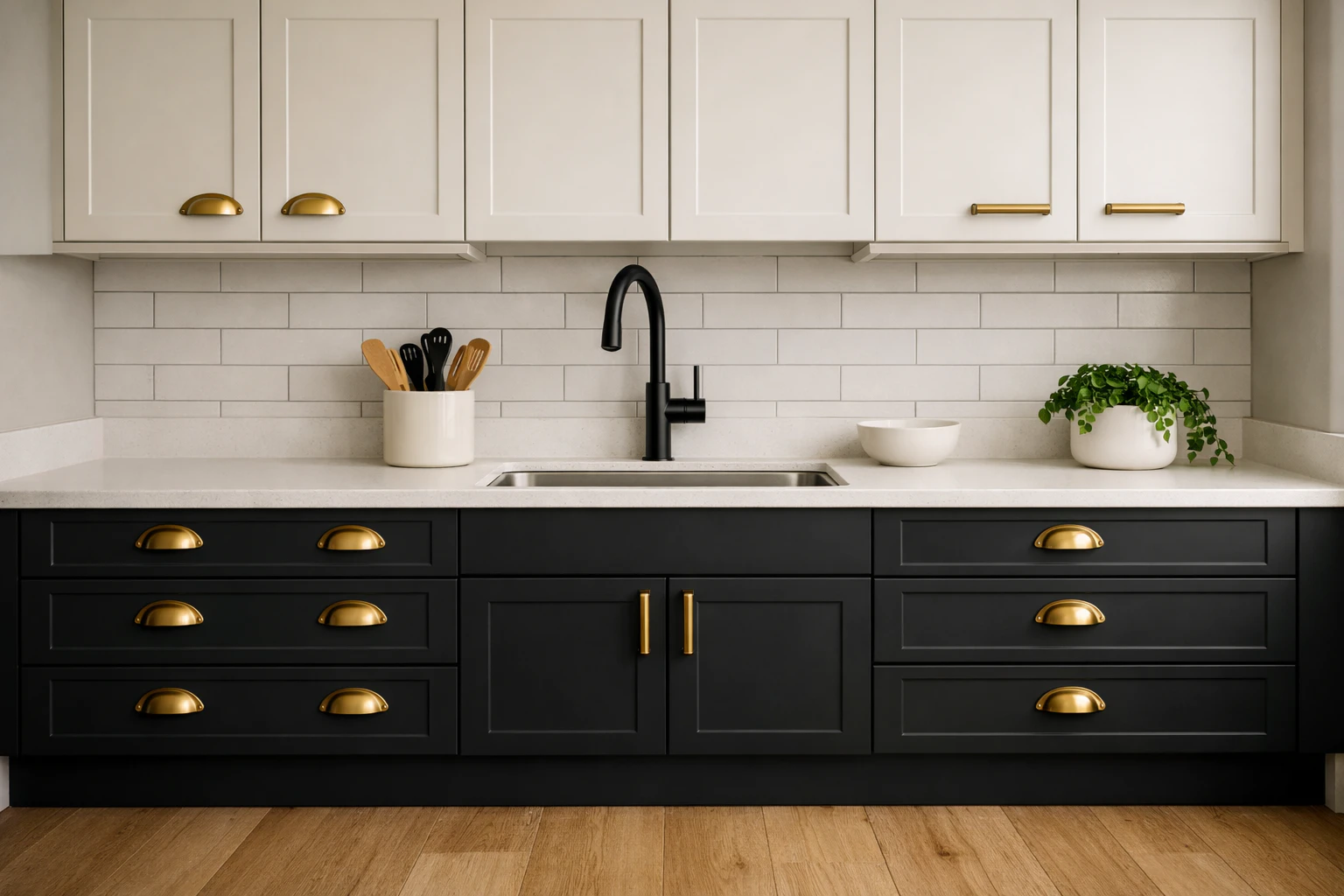
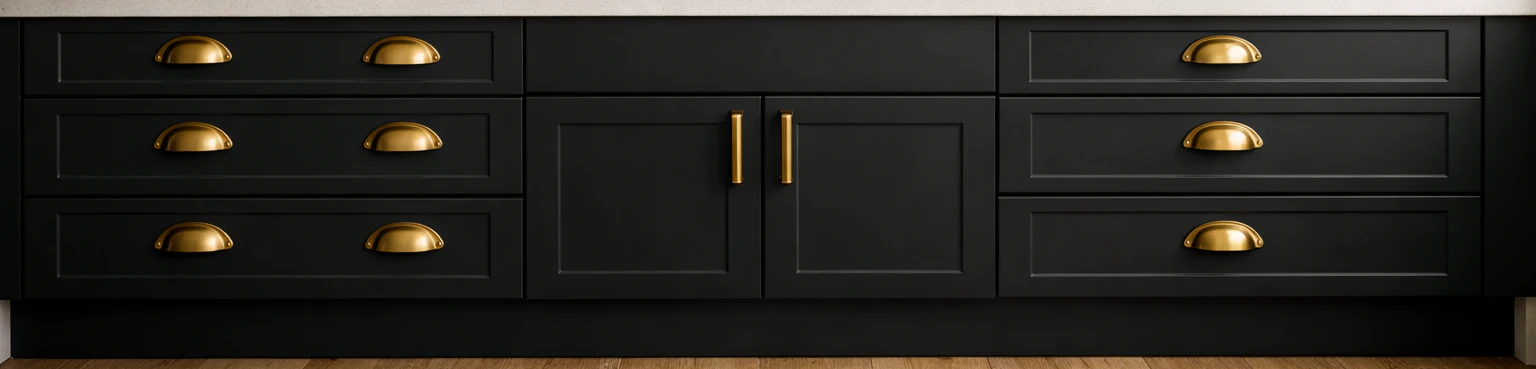
Whatever you do above, budget another $40–80 for new pulls and knobs. Old brass on freshly-painted cabinets defeats the whole point. Amazon has 25-pack matte black bar pulls for around $30, and modern brushed brass packs for $40. This is a $30 upgrade that visually carries a $300 paint job.
The kit's deglosser is meant to skip sanding, and it works on clean factory finishes. For older cabinets with a glossy varnish or 20-year-old polyurethane, deglosser alone is borderline. A light pass with 220-grit sandpaper after deglossing — 30 extra minutes total — dramatically improves adhesion and is worth doing. Skip sanding only if your cabinets are clean melamine, MDF, or laminate without an existing glossy topcoat.
With good prep and a quality kit, 5–7 years before noticeable wear on high-touch areas (around handles, sink area, oven door edges). Lower-prep paint jobs start showing wear in 2–3 years. The good news — paint is touch-up-able indefinitely. A small bottle of the original paint kept in a closet means you can spot-fix chips for the life of the kitchen.
Yes — this is one of the best renter moves available. Stick to the cabinet door fronts (skip the frame and inside edges where peeling starts). Use a credit card or squeegee to push out air bubbles as you go. d-c-fix is the most reliable brand for kitchens specifically. Test a small piece on the inside of a door before committing; if it bubbles on application, your cabinets need a quick clean first.
Benjamin Moore Advance or Sherwin-Williams ProClassic — both are alkyd/oil-modified enamels designed for cabinetry. They self-level (no brush strokes), cure to a hard durable finish, and resist kitchen grease. Plan on bonding primer underneath (Zinsser Bullseye 1-2-3 or Stix) and two thin topcoat coats. Total material cost runs $80–120 for a typical kitchen, similar to the kit but with much better long-term durability.
$30–80 for a typical kitchen with 15–25 pulls and knobs. Amazon's bulk packs (Amerock, Ravinte, RAVINTE) deliver decent quality at $1.50–3 per piece. Avoid the very cheapest packs — the finish can wear off in months. Don't go below $1.50 per pull, and don't bother spending above $5 unless you're sourcing solid brass from a specialty supplier.
New comparisons, renter hacks and Amazon finds — every Sunday.