Watch: how it's done
DIY Entryway Makeover On A Budget — Small Entryway Storage Idea and How to Install Beadboard Half-Wall — embedded from YouTube
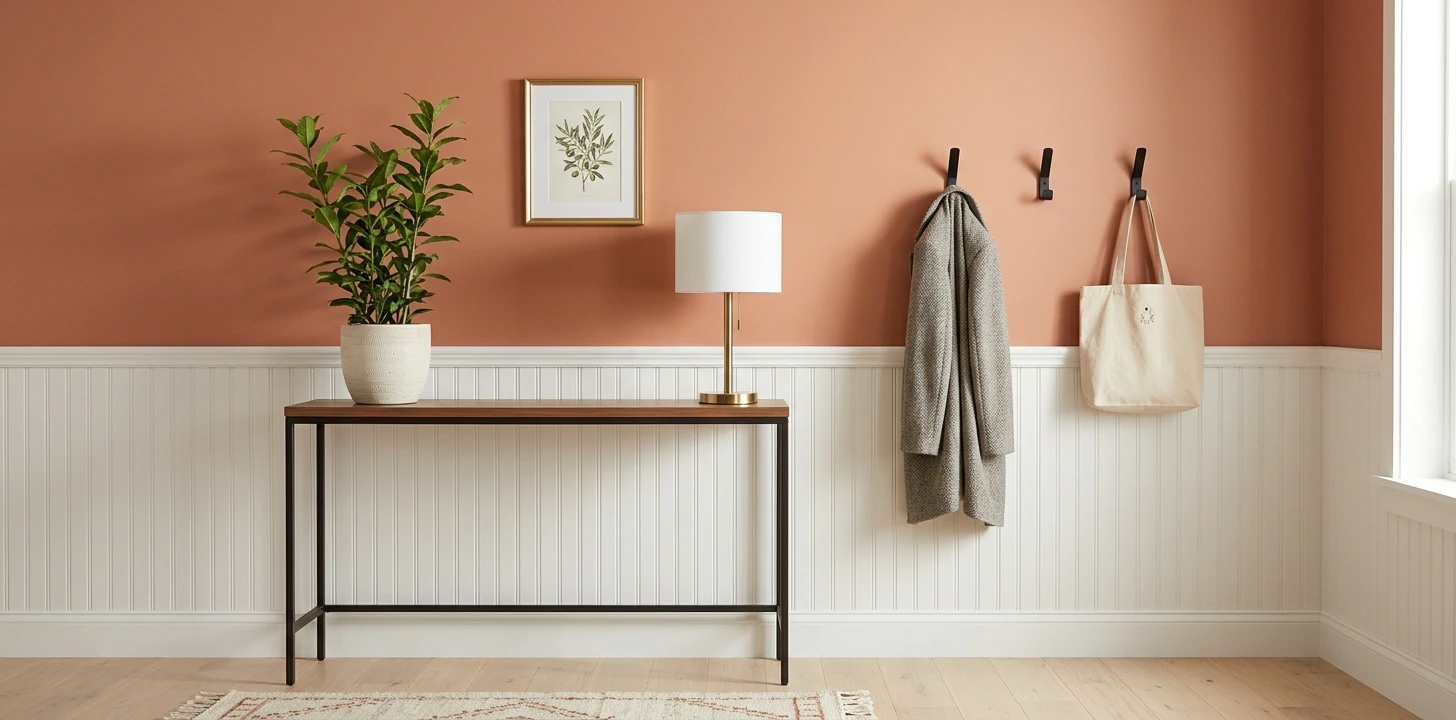
Compare paint, peel-and-stick wallpaper, beadboard wainscoting and gallery walls for entryways. Real prices and renter-friendly options for the first wall guests see.
Why this pick: Same Behr Premium Plus as the rest of the house. For entryways, eggshell finish is best — wipeable for the inevitable touch marks at fingertip height.
Why this pick: Command-strips approach with Americanflat or Frametory matte frames. Entryway gallery walls work best with consistent black or natural-wood frames — busy frame styles compete with the doorway's architectural lines.
Why this pick: Same NuWallpaper. Entryways are surprisingly good candidates for bold patterns — narrow space + bright light = visual punch without overwhelming a large room.
Why this pick: Pre-cut beadboard wainscoting (Style Selections at Lowe's, ELL panels on Amazon) adds custom-trimmed entryway look in a weekend. Adhesive-back versions are renter-removable; nailed versions are permanent but more durable.
Prices verified July 2026 · US market · subject to change
DIY Entryway Makeover On A Budget — Small Entryway Storage Idea and How to Install Beadboard Half-Wall — embedded from YouTube
The wall you see when you walk through the front door sets the tone for the whole house. Most renters leave it as builder-grade white, and most owners only repaint when something gets scuffed. Both are missed opportunities. A bold accent paint, wallpaper, or wainscoting on this single wall transforms the entryway from "transitional space" to "designed entrance" — and most options cost under $100.
The two finish materials most entryway makeovers come down to. The right answer is shaped specifically by how often you host guests and how much daily bag-and-fingerprint abuse the wall takes.
| Peel-stick wallpaper | Eggshell paint | |
|---|---|---|
| Cost (60 sq ft entry wall) | $80–120 | $30–50 |
| First-impression on guests | 1 sec — reads "designed entrance" | 3–5 sec — needs props to register |
| Bag-strap wear resistance | Seams can lift at shoulder height | Wipes clean indefinitely |
| Seasonal decor backdrop | Evergreen — wreaths/garlands work | Bold colors can clash with palettes |
| Best for | Renters, frequent hosts, seasonal swappers | High-touch family entries, long-term owners |
Pick wallpaper if you host frequently, you rent, your entry has wainscot below, or you change seasonal decor 4+ times a year. Pick paint if your entryway takes daily abuse from kids, dogs and muddy boots — eggshell wipes clean where wallpaper seams can lift over time. For most "designed entryway" Pinterest looks, do both — beadboard wainscot below for durability + wallpaper above for visual impact, $160-270 total.
Still deciding between these two? Read the full Wallpaper vs Paint comparison → — the 1-second first-impression test timing, the bag-strap and fingerprint wear factor unique to this room, the wainscot-plus-wallpaper recipe pros use, and 6 FAQs specific to entryway use.
Behr Premium Plus or similar mid-tier paint costs $30-50 for a typical entryway (which is rarely more than 80 sq ft of wall). Eggshell finish is best — wipeable for the fingerprint marks at hand height. Dark, warm colors (Hale Navy, Black Magic, terra-cotta) work surprisingly well in narrow entryways because they create depth perception rather than feeling cramped.
NuWallpaper at $2-3 per sq ft turns a 60 sq ft entryway wall into a Pinterest-worthy statement for $120-180. Patterns that work in entryways: bold florals, geometric tessellations, faux-tile patterns, vintage maps. Avoid stripes (visually narrow an already-narrow space). Pattern-matching at corners is the install challenge — work top-down and use a level constantly.
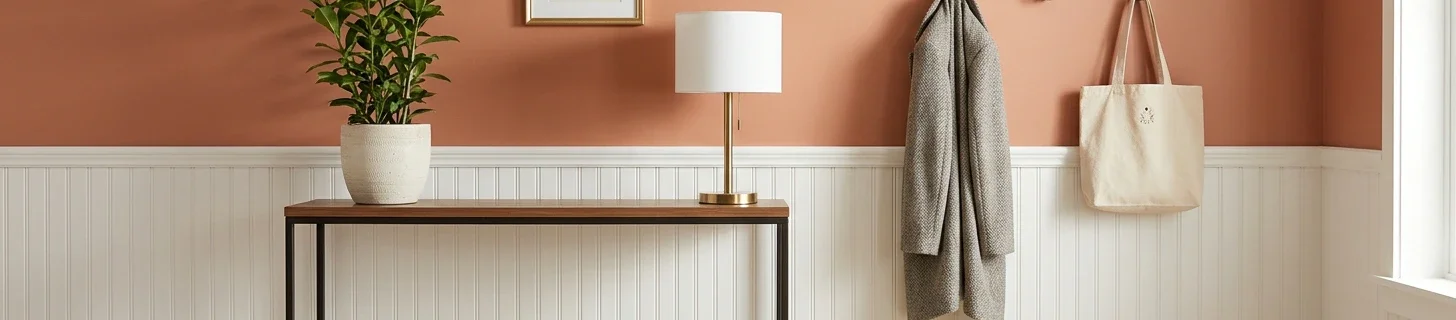
Pre-cut beadboard wainscoting panels add chair-rail height paneling that visually breaks up the wall. For a typical entryway, $80-150 of materials and an afternoon get you a custom-trimmed look. Adhesive-back versions are renter-removable (peel off with heat gun). Nailed versions are permanent but more durable.
For renters who can't do paint or wallpaper, a gallery wall of 6-10 framed prints over white walls is the path. Command strips ($10 for 20-pack) keep walls deposit-safe. Stick to one frame style (matte black or natural wood), mix print sizes, and arrange before hanging — paper template each frame and tape to the wall first to dial in spacing.
Functional hooks (coat, key, bag) doubling as wall decor is the underused entryway move. Match the finish to your hardware elsewhere (matte black, brushed brass) and the hooks themselves become part of the visual composition. Pricing: $30-50 for a set of 5-6 quality hooks vs $5-10 for cheap plastic ones — worth the upgrade for visible-from-the-front-door hardware.
Counter-intuitive but true — warm dark colors (navy, charcoal, deep green, terra-cotta) make small entryways feel intentional rather than cramped. Light colors on every wall just look washed out. A dark accent on one wall with white on the rest adds depth and makes the room feel bigger by tricking the eye. Test a 2×2 ft swatch and view under your actual evening light before committing.
Yes — adhesive-back beadboard wainscoting (look for "peel and stick wainscoting" on Amazon) uses construction-grade adhesive to mount. Renter-removable with a heat gun and patience. Permanent installs use finishing nails through panels into wall studs, which is more durable but obviously not removable.
For staircases or vaulted entryways with slanted ceilings, hang frames in a stair-step pattern that mirrors the ceiling angle. Start with the largest frame at the bottom or top, then descend with smaller frames in 2-3 inch increments. The bottom edges of each frame should follow a diagonal line that's roughly parallel to the floor.
Mostly yes, with caveats. The pattern layer is plastic-coated and wipes clean, but the adhesive can fail at edges if frequently touched (kids running fingers along the wall, dog noses). For high-traffic entry walls, apply a clear silicone caulk bead at the bottom edge above the baseboard to anchor it. Most failures start there.
Two coats minimum for any color, two-to-three for going light over a previous dark color. Skip primer when going color-to-similar-color with quality paint (Behr Marquee or Sherwin-Williams Emerald), but always prime when painting a previously bold color or new drywall. Patching/spackle spots always need a spot-primer or they'll flash through the paint.
New comparisons, renter hacks and Amazon finds — every Sunday.