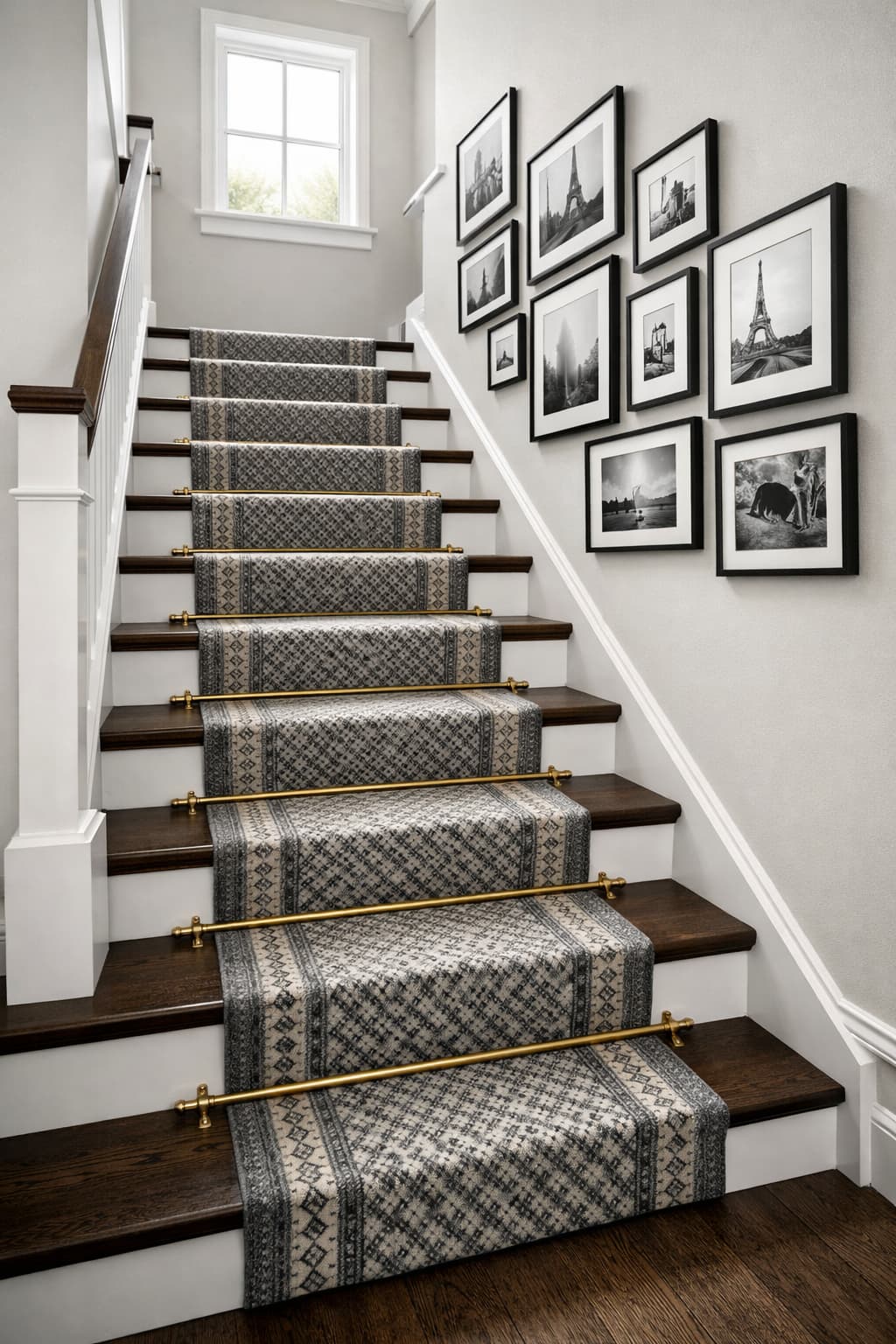
The staircase is your most-seen surface
You climb your staircase many times a day. The treads, the walls alongside, the railing — all of it gets seen constantly. Yet most staircases get zero design attention. A 21 ft polypropylene runner (Safavieh Marion, $95.46), a seven-frame stairway gallery set (Americanflat, $215) and an accent paint on the side wall transform the whole staircase for about $310 plus paint in a weekend.
The renter-friendly stair upgrade
Fewer stair upgrades are renter-safe than they look. Stick-on treads and removable wallpaper are the low-trace options. A runner is not: it has to be stapled or tacked to every step, and rod brackets are screwed into the stairs, so ask first. Gallery frames usually hang on nails, and painting the treads is permanent. Many landlords will accept "we'll repaint when we leave" for stair wall paint — get it in writing.
The safety-first reminder
Bare wood or painted stairs are slippery, especially in socks. Anti-slip grit mixed into the final paint coat, or a runner fastened over underlay, addresses this. Don't skip it — a study of US emergency-department data counted about 1.08 million stair-related injuries a year from 1990 to 2012 (American Journal of Emergency Medicine). Better materials + non-slip treatment beats a beautiful but dangerous staircase.
Pair the floor with the walls
The strongest stair refreshes don't treat the floor and wall as separate. A bold patterned runner pairs with neutral painted walls (the runner gets to be the star). Subdued natural wood treads pair with a busy gallery wall or wallpaper (the wall gets to be the star). Don't compete patterns — pick one to lead, support with the other.
Runner vs paint: the tread decision in full
The one stair choice with real trade-offs on both sides is what goes on the treads. A runner — about $95 for a 21 ft hall runner, or about $360 for a stair runner sold by the foot at Runrug — grips better than a smooth painted tread, provided it's stapled or gripped over underlay as its seller instructs (the rods are decorative, and staples leave holes). Painted treads (about $64 for a gallon of porch-and-floor paint and an anti-skid packet) are the budget path but are permanent, need anti-slip grit mixed into the topcoat (pick an additive whose label lists it for your paint and for wood surfaces, such as Rust-Oleum EpoxyShield Anti-Skid Additive), and need days of keeping traffic off the stairs while the paint cures — genuinely hard in a one-staircase house. Our runner vs painted stairs head-to-head runs the whole comparison, including the hybrid that wins for many homes: painted risers with runner-covered treads, about $150–415 in paint and runner.
Underlay and fasteners are not optional
Two hardware details decide whether a stair runner is a safety upgrade or a hazard. First, the underlay and fasteners: a runner laid loose on wood treads slides underfoot, so it goes over underlay and is stapled and/or gripped to every step — Runrug's advice for its stair runners. Second, the rods: they are decoration, not fastening. Runrug says its rods do not secure the runner, and House of Antique Hardware says its rods are not designed to be the sole means of holding one in place. Budget for them as a look — Runrug's Jubilee sets are $29 a step — and fasten the runner so it stays where your feet expect it at 2am.