Updated July 2026. Every dollar figure on this page carries a link to the source it came from, and we quote those sources as they wrote them rather than blending them into one tidy average. Where the sources disagree — and on wet rooms they disagree a lot — we show the disagreement instead of hiding it. This is a contractor-priced project, not a weekend material list, so unlike our DIY guides the headline numbers here include labor.
The 30-second answer
There is no single wet room cost, because the two kinds of sources that publish one are pricing two different products. National-average aggregators price the median job across the country; full-service renovation firms price a fixed-scope contract in the markets they operate in. Both numbers are real. Here they are side by side, unblended.
| What you're pricing | Figure | Source |
|---|---|---|
| Bathroom-to-wet-room conversion, national average | $17,000 | Fixr |
| Same, the range most homeowners pay | $11,000-$22,000 | Fixr |
| Per square foot, wet room | ~$150/sq ft | Fixr comparison |
| Worked 144 sq ft example | $21,600 | Fixr comparison |
| Smaller, straightforward project (full-service firm) | $15,000-$25,000 | Block Renovation |
| Mid-sized or higher-end wet room | $25,000-$40,000 | Block Renovation |
| Large, complex, premium tile or glass, extensive replumbing | $40,000 or more | Block Renovation |
| Premium over a comparable standard bathroom | 20-30% more | Fixr comparison |
The useful takeaway isn't a number, it's a shape: the cost of a wet room tracks a normal bathroom remodel plus a structural premium, and the premium buys waterproofing, a sloped floor and a drain relocation rather than anything you can see when it's finished. If your budget only works at the bottom of the range, the honest read is that a wet room is the wrong project for that budget — the savings would have to come out of the invisible half.
What a wet room actually is in a US house
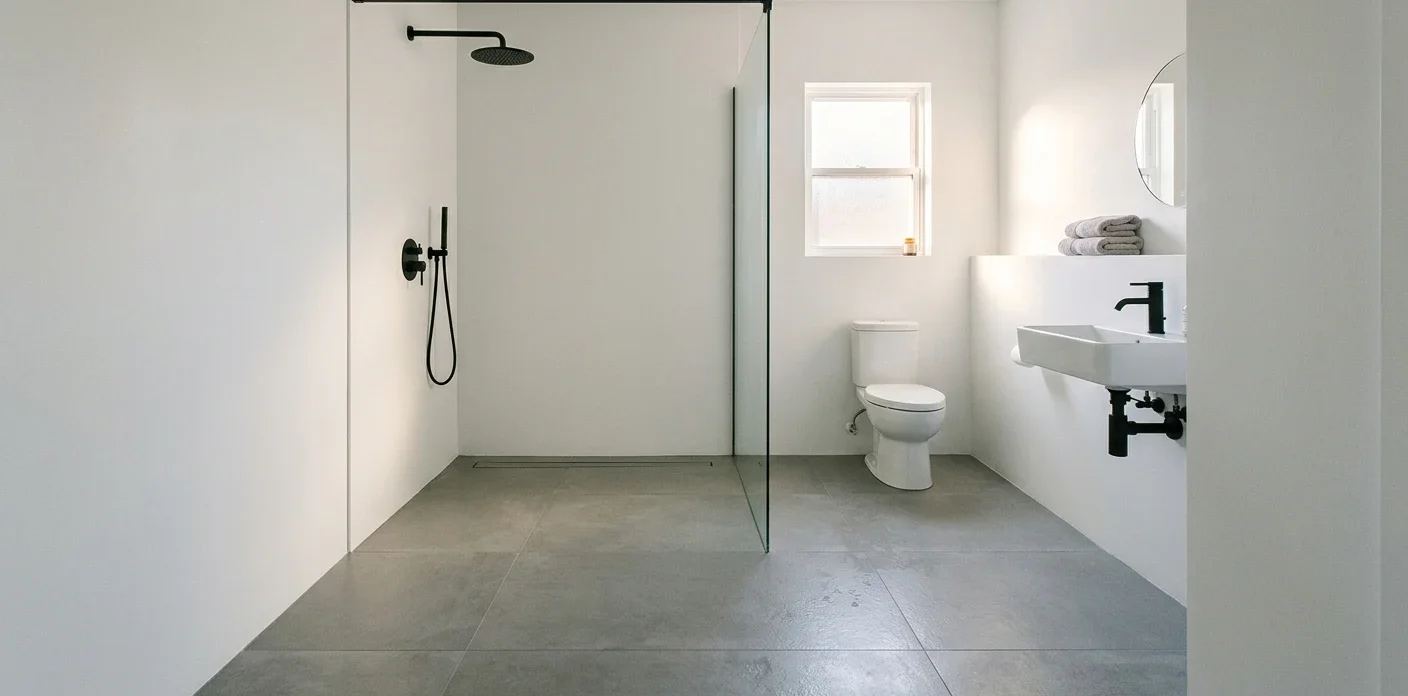
In American usage the term has drifted, which is a large part of why quotes vary so wildly. A wet room, strictly, is a bathroom where the room is the shower: there is no curb to step over, no shower pan with a lip, no tray edge where the waterproofing stops. The floor is built with a fall toward a drain, and the waterproof layer runs continuously across the floor, up the walls to a wet-rated height, around the drain flange and past every pipe penetration.
Compare that with the two things it gets confused with:
- A walk-in shower with a low-profile base. The base is a manufactured, already-waterproof tray. The waterproofing stops at its lip; the bathroom floor outside it is an ordinary floor. This is the cheaper project, and it's a different one — Fixr prices walk-in shower installation at $5,000 to $11,000, with an average cost of $8,000, well under the wet room figures above.
- A curbless shower zone. The step-over is gone and the tile is continuous, but the wet-rated build still ends a foot or two past the glass. It looks like a wet room in photos. It is not one in the assembly, and it doesn't carry the wet room's whole-floor waterproofing bill.
That distinction is the whole cost story. Fixr puts the premium at about 20 to 30% and says it is "due mostly to the preparation necessary to waterproof the area" — and in a wet room that preparation is the whole floor: a fall built toward a drain that usually has to move, and a membrane that runs under the floor and up the walls instead of stopping at a pan lip. Everything else on your quote — tile, fixtures, glass — you'd be buying for a conventional remodel too.
One consequence people don't anticipate until they live with it: in a true wet room, everything in the room gets damp. The toilet paper, the towels, the bath mat, the vanity's toe kick. Wet rooms in small footprints usually solve this with a fixed glass screen that blocks direct spray without enclosing anything — which is why that panel shows up on nearly every quote even though, structurally, a wet room doesn't need one.
Where the money goes, line by line
No source we could open publishes a clean per-component breakdown for a wet room specifically. What does exist is per-component pricing for the same trades doing the same work in any bathroom, and a wet room is those trades plus the structural premium. Here's the anatomy with sources attached to each piece.
| Line item | Published figure | Source |
|---|---|---|
| Demolition | $600-$2,300 | Fixr bathroom remodel |
| Bathroom plumbing, whole scope | $2,000-$10,000, average $5,302 | Fixr plumbing |
| Moving plumbing | $80-$200 per line, most fixtures requiring at least three | Fixr plumbing |
| Moving shower plumbing specifically | $240-$600 | Fixr plumbing |
| Plumber to move drain and supply lines (added to shower labor) | +$200-$500 | Fixr walk-in shower |
| Tiling a shower, whole job | $1,800-$5,000, average $2,700 | Fixr shower tiling |
| Porcelain tile, material | $3-$30 a sq.ft. | Fixr shower tiling |
| Tile labor and installation | $4-$15 a sq.ft. for most tile showers; its porcelain-specific table row says $14-$16 | Fixr shower tiling |
| Porcelain tile, installed | averages $17-$46 a sq.ft. | Fixr shower tiling |
| Exhaust fan installation | $250-$900, average $400 | Fixr exhaust fan |
| Permits | $100-$500 / or 4%, close to $500 | Fixr walk-in shower / Fixr remodel |
| Labor share of a bathroom project | an average of 50% of your total, or around $6,000 | Fixr bathroom remodel |
Demolition is the cheapest surprise on the list and the one most likely to grow. A wet room conversion doesn't stop at pulling the old tub — the subfloor comes up wherever the drain moves, and whatever the last renovation hid under it becomes your problem on day two. Budget the top of Fixr's $600-$2,300 band if the bathroom is older than you are.
The drain is the line item that decides whether this project is expensive or very expensive. A wet room drain rarely lands where the old shower drain was, and moving it means opening the subfloor and working within the joist bays — which either goes smoothly because the joists run the convenient way, or turns into blocking and rerouting because they don't. Fixr's $240-$600 to move shower plumbing is the tidy version; the ugly version is a slab foundation, where "moving the drain" means cutting concrete. If you're on a slab, ask about this before anything else on the quote.
Tile quantity, not tile price, is what inflates the tile line. A conventional bathroom tiles the shower's three walls and floor. A wet room tiles the whole floor plus wet-rated wall height around it, so the square footage climbs even if you pick the same tile. Run it yourself: at Fixr's installed porcelain figure of $17-$46 a sq.ft., a 40 sq ft floor alone is roughly $680-$1,840 before a single wall — our arithmetic on their number, not a published figure. Large-format tile reduces the grout lines but not the area, and it comes with its own constraint we'll get to below.
Ventilation stops being optional. A room designed to get wet all over needs the moisture to leave, or the drywall, paint and cabinetry above the tile line pay for it. If the bathroom already has a working fan on a duct to the outside, this is a cheap line; if it doesn't, Fixr's $250-$900 with an average of $400 covers a first-time install, and the variable is attic access, not the fan.
Waterproofing: the line you never cut
Everything else on the quote is a preference. This one isn't, and it's worth understanding why rather than being told to respect it.
In a normal bathroom, the waterproof layer is a box. It lines the shower and stops at the pan lip; if it fails, water runs onto a floor you can see, and you find out that week. In a wet room, the waterproof layer is a continuous bonded surface — floor, up the walls, around the drain flange, sealed at the mixing valve and every pipe penetration, with each seam and inside corner banded. The tile on top is not the waterproofing. Tile and grout are the wear surface; water passes through grout routinely, and the membrane underneath is what actually keeps the house dry.
That changes the failure mode completely. A wet room leak doesn't announce itself. One unsealed corner, one drain flange that wasn't bonded to the membrane, one penetration left open, and water doesn't pool in the room — it drains into the subfloor and along the joist bay, where it stays wet, stays dark and stays warm. The first thing anyone notices is a stain on the ceiling below or a soft patch underfoot, and by then it has been wet for months. Mold doesn't need a dramatic flood; it needs a small, permanent supply of water and no air movement, which is exactly what a joist bay under a failed membrane provides.
Then the cost math turns brutal. The material that failed is cheap. The material sitting on top of it isn't: on Fixr's numbers, installed porcelain averages $17 to $46 a sq.ft., and every square foot of it has to come off to reach the problem — plus the demolition, plus the subfloor repair, plus the remediation of whatever grew. There is no other line item on a wet room quote where saving a few hundred dollars can cost five figures, which is the entire reason this is the section that says don't.
The practical protections are simple and worth insisting on. Ask which waterproofing system is being used and whether the whole assembly comes from one manufacturer — mixing a membrane from one brand with a drain flange from another puts the most failure-prone joint in the room at a spot nobody warranties. Ask for a flood test before tile: the drain gets plugged, the floor gets filled, and it sits overnight while someone checks the ceiling below. It costs a day. It is the only time in the project's life when finding a leak is cheap.
See sheet waterproofing membranes on Amazon →
What's DIY here, and what isn't
This site's default answer is usually "do it yourself and keep the labor." A wet room is the case where that answer changes shape — not because the work is beyond a competent DIYer's hands, but because the risk is concentrated in one step and the consequences of getting it wrong are hidden.
Genuinely DIY-able:
- Demolition, if you know what's behind the wall you're opening. This is real money — it's the $600-$2,300 line above — and it's the least skilled hour in the project.
- Sourcing your own tile and fixtures. Tile material is $3-$30 a sq.ft. for porcelain on Fixr's numbers, and where you buy it is entirely your call. Buying it yourself doesn't complicate the install the way supplying your own waterproofing would.
- Painting, trim and the fan swap, if a fan and duct already exist. Replacing an existing unit is the cheap end of the range; running a new duct through an attic is the expensive end.
Hire out, and don't negotiate on it:
- The waterproof assembly. For the reasons in the section above: the failure is invisible, delayed, and sits under the most expensive surface in the room.
- Moving the drain. Not because cutting a subfloor is hard, but because the answer to "can this drain go there" depends on joist direction, venting and fall, and getting it wrong produces a shower that drains slowly forever.
- The glass panel. Wet room screens are usually cut to the opening, and a panel measured 3/8" wrong is a panel you buy twice.
There's a middle path worth knowing about: prefabricated sloped trays and bonded-membrane kits exist precisely because building a sloped mortar bed by hand is the skilled part. A foam tray arrives with the fall already molded in and the membrane bonds to it, which converts the hardest step into an assembly job. It doesn't make the project DIY by itself — the drain tie-in and the flood test still decide whether it works — but it's the reason a lot of curbless showers get built by small crews rather than specialists.
See curbless shower pan and tray kits on Amazon →
Small wet room cost
The small bathroom is where a wet room makes the most design sense and the least budget sense, and it's worth being clear about both halves.
The design case is strong. In a 5x8 bathroom, a shower enclosure eats a quarter of the floor and a swinging door eats the rest. Take out the curb, the tray and the door, run one continuous floor, and the room reads noticeably larger without gaining a square inch — which is the actual reason small wet rooms get built. It also removes the hardest thing to clean in a small bathroom, which is the joint where a shower tray meets tile.
The budget case is weaker than people expect, because a wet room's cost doesn't scale down with the floor. The fixed core stays the same regardless of size: one drain relocation, one continuous waterproof assembly, one permit, one crew mobilizing, one flood test. What shrinks is tile quantity and a bit of labor. So a small wet room is cheaper than a large one, but not in proportion.
Here's the honest way to bracket it. Fixr's cost-by-size figures put a conventional 40 sq ft (5x8) bathroom remodel at $2,800-$16,000 and a 50 sq ft (5x10) at $3,500-$20,000. Apply the 20-30% wet room premium and the same rooms land higher across that whole band — which is a wide answer, but a wide answer is the truthful one when the same square footage covers both a builder-grade refresh and a custom job.
What you should not do is the per-square-foot shortcut. Fixr's $150/sq ft wet room figure is derived from a 144 sq ft worked example ($21,600), so multiplying it by 40 sq ft gives about $6,000 — a number that quietly assumes the drain, the membrane, the permit and the crew all got 72% cheaper because the room did. They didn't. Per-square-foot pricing describes big rooms well and small rooms badly, and small wet rooms are exactly where it misleads.
The one place a small footprint genuinely saves money is tile: fewer square feet at $17-$46 installed is a real reduction, and it's also the line where upgrading feels affordable. Spending on better tile in a small wet room costs less than it would anywhere else in the house, which is a nicer way to look at a small budget than pretending the structural work got cheaper.
Wet room vs a traditional bathroom
Fixr's head-to-head is the clearest published version of this comparison, and it's worth reading its numbers exactly as written rather than as a slogan.
| Wet room | Traditional bathroom | |
|---|---|---|
| Worked example, 144 sq ft | $21,600 | $18,000 |
| Per square foot | closer to $150 a square foot | $125 a square foot |
| Conversion average (separate Fixr figure) | average of $17,000 | average of $12,000 |
| Typical range (separate Fixr figure) | $11,000-$22,000 | $6,000-$17,000 |
| Overall premium | wet rooms cost about 20 to 30% more than a typical bathroom installation | |
Note the two rows that look inconsistent: the 144 sq ft example puts a traditional bathroom at $18,000 while Fixr's average for one is $12,000. That's not an error, it's room size — 144 sq ft is a large bathroom, and per-square-foot pricing scales it up. It's a good reminder to check which room a published average is describing before you hold your own quote against it.
Where does the 20-30% actually go? Fixr's own explanation is one line — "due mostly to the preparation necessary to waterproof the area" — and elsewhere on the same page it notes that in a wet room the floor must slope to the drain everywhere. Notice what's absent — nothing about better fixtures, nicer tile or fancier glass. The wet room premium is structural. Two bathrooms with identical finishes, identical fixtures and identical tile will differ by that 20-30% because one of them has a waterproofed, sloped floor and, usually, a relocated drain.
That matters when a quote comes in low. A cheap wet room quote isn't usually cheap because the contractor found a deal on tile; it's cheap because something in the structural half got smaller. Ask specifically which waterproofing system is included, how far up the walls it goes, whether the drain is being moved or the floor is being built up to reach the existing one, and whether a flood test is in the scope.
The trade-off that has nothing to do with money: a wet room usually means losing the bathtub. In a second bathroom that's free. In a home's only full bath it's a real functional change — bathing a toddler, soaking an injury, and a slice of resale demand all live in that tub. Decide that question before pricing anything, because it doesn't get cheaper to reverse later.
The parts list
Wet rooms are quoted as installed projects, not shopping lists, so we're not going to attach shelf prices to individual SKUs here — component prices at the big-box retailers move constantly, and this site only publishes numbers it can point at a source for. What's worth knowing is what each part does, because that's what tells you whether a quote is complete.
- Waterproofing membrane. Sheet membranes bond to the substrate and lap at the seams; liquid-applied membranes roll on in coats and cure into a continuous film. Both work; what matters is that the drain flange, the corners and the pipe penetrations belong to the same system. See liquid waterproofing membranes on Amazon →
- Linear drain. The reason nearly every modern wet room uses one instead of a center drain is geometric: a center drain needs the floor to fall from four directions, which forces small tiles that can flex into the cone. With a linear drain, Schluter notes that floors can be sloped on a single plane, enabling the use of large-format tiles — one direction of fall, big tiles, fewer grout lines. That single spec is why wet rooms look the way they do.
- Sloped tray or mortar bed. The fall has to be built. A prefabricated foam tray arrives with it molded in; a mortar bed has it floated by hand. The tray costs more in material and less in skilled hours.
- Tile. Two constraints beat aesthetics here. It has to suit the slope geometry (see the linear drain point), and it has to be safe underfoot when the whole floor is wet, not just the shower zone — a texture you'd tolerate inside an enclosure is a different proposition when it's the floor you step onto out of bed. Our epoxy vs tile bathroom floor guide covers the slip question in detail, and LVP vs ceramic tile covers what goes on the floor if you're not tiling the whole room.
- Fixed glass screen. Structurally optional, practically standard — it blocks direct spray so the toilet paper and towels stay dry, without enclosing anything or reintroducing a door. See fixed glass shower screens on Amazon →
- Exhaust fan. Sized for a room that gets wet all over and ducted to the outside, not into the attic. See bathroom exhaust fans on Amazon →
The verdict by situation
- Renting: no. This is subfloor and drainage work on someone else's house, it needs a permit, and nothing about it is reversible at move-out. The bathroom hub covers what actually works in a rental.
- Owner of a small bathroom: the strongest aesthetic case on this page, and the weakest savings case. You're buying the feeling of a bigger room, not a cheaper remodel — the fixed costs don't shrink with the footprint.
- Accessibility and aging in place: the most defensible reason to spend the premium. A curbless floor removes the step-over, which is the specific thing that makes a conventional shower unusable with a walker or a wheelchair. Fixr notes that a custom 60" x 60" curbless walk-in shower with a seat, grab bars, tiled walls and floor can run up to $20,000 or more — and unlike a style upgrade, this one buys years of staying in the house.
- Resale-driven: weak on its own. Fixr puts bathroom remodel recoup at 56% to 70% of the investment, depending on materials — a partial payback on a project that cost 20-30% more going in. Do it because you want it.
- Only full bathroom in the house: think hard. Losing the tub is the decision, not the cost, and it's the one you can't undo without doing the whole project again.
Not ready for a structural project? The budget bathroom hub → covers the floor, wall and vanity updates that change how a bathroom reads without touching the drain — and the hardwood vs LVP cost guide applies this same source-by-source treatment to flooring.
 Bathroom Refresh on a Budget
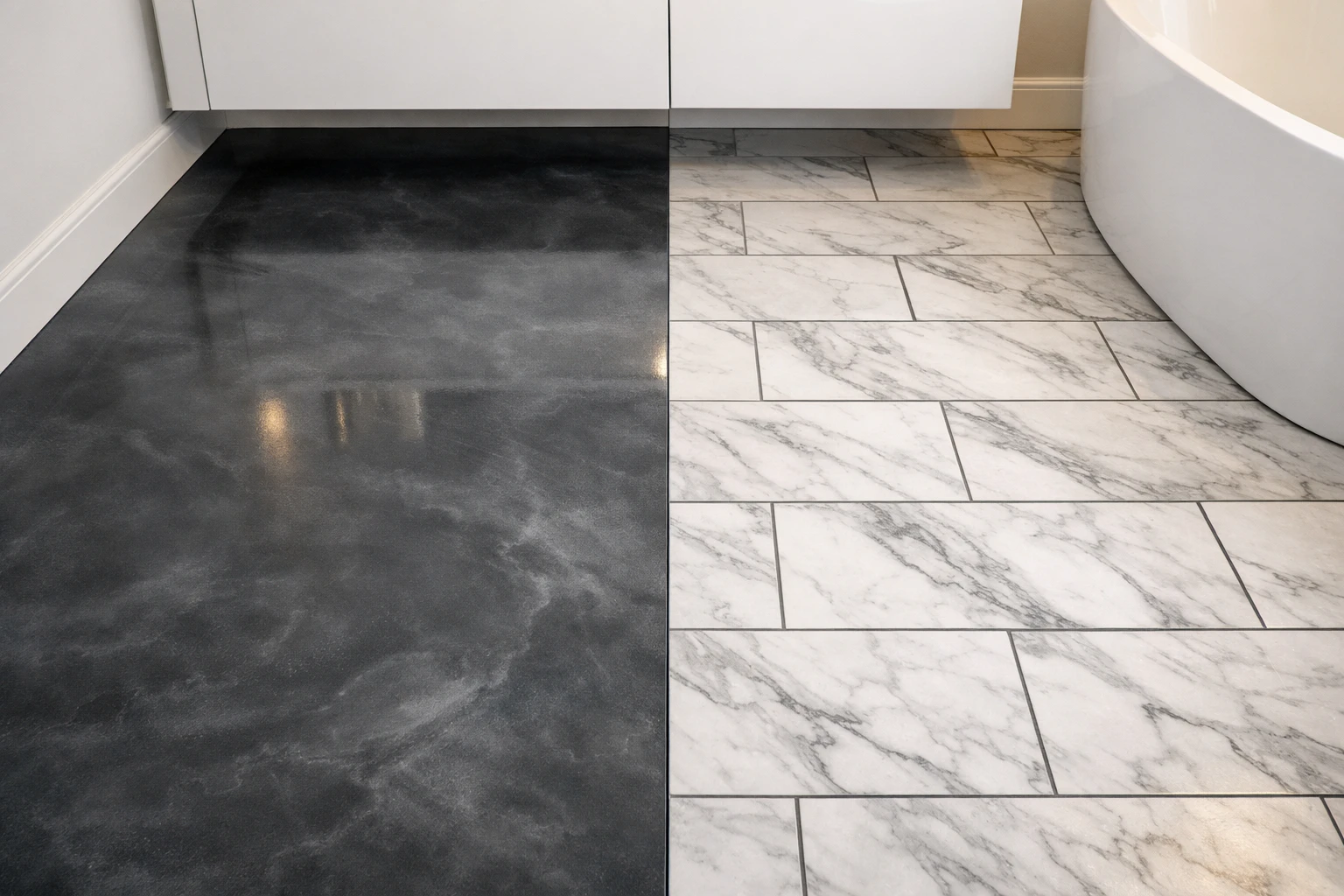 Bathroom Floor: Epoxy vs Tile
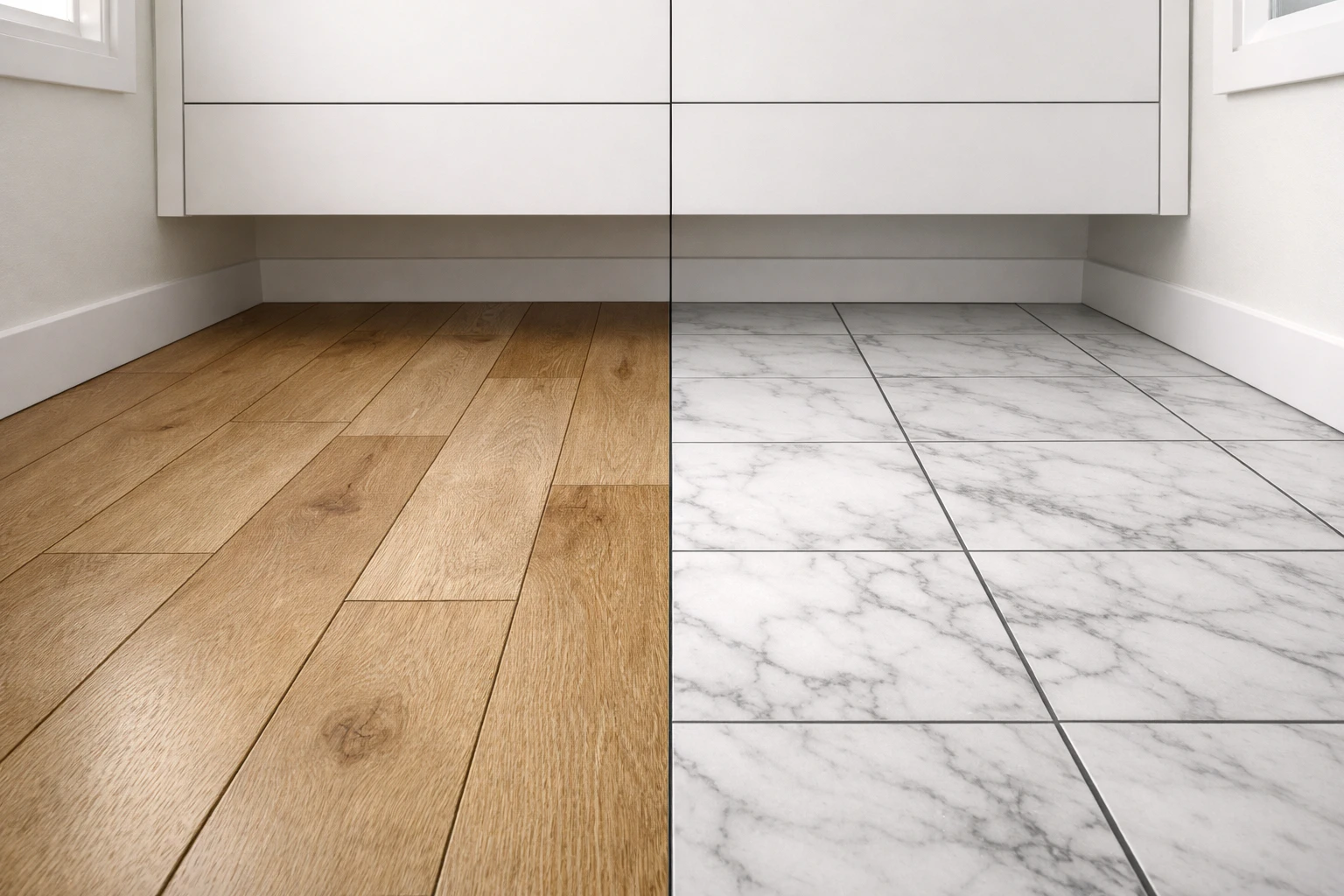 Bathroom Floor: LVP vs Ceramic Tile
 Hardwood vs Vinyl Plank: The Real Cost Breakdown