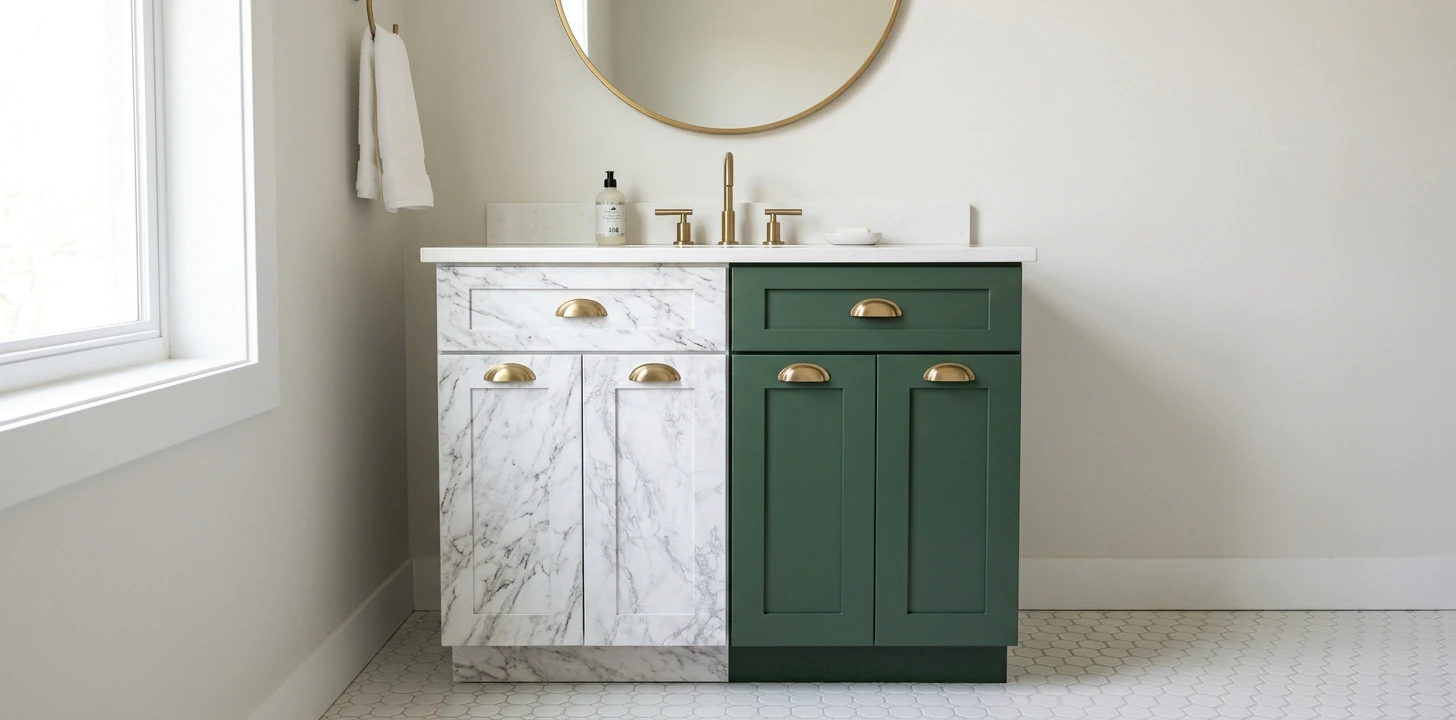
Updated July 2026. Prices reflect US market kit costs from Amazon and Home Depot. All comparisons based on a standard single-sink bathroom vanity with 6–10 sq ft of cabinet face (1–2 doors + 2 drawers).
The vanity refresh that splits renters and owners
"Should I wrap my bathroom vanity in contact paper or paint it?" is the same renter-vs-owner question that splits kitchen cabinet projects — but the math is different in a bathroom for three reasons: the surface is much smaller (6-10 sq ft vs 25-30 in a kitchen), humidity is harsher on adhesives than dry kitchen air, and the project is a fraction of the budget either way.
The short version: contact paper wraps a vanity for $5-15 and peels off in 30 minutes — the renter answer for any bathroom. Paint (with a humidity-rated topcoat) costs $40-100 and lasts 4-5 years through daily shower steam — the owner answer for a master bath. The decision is mostly about how long you'll own the bathroom and whether the vanity sees daily shower humidity.
Below: side-by-side table, when each one wins, the bathroom-specific humidity problem that decides it for many people, the $20 hardware upgrade that doubles perceived quality, and FAQs.
Side-by-side comparison
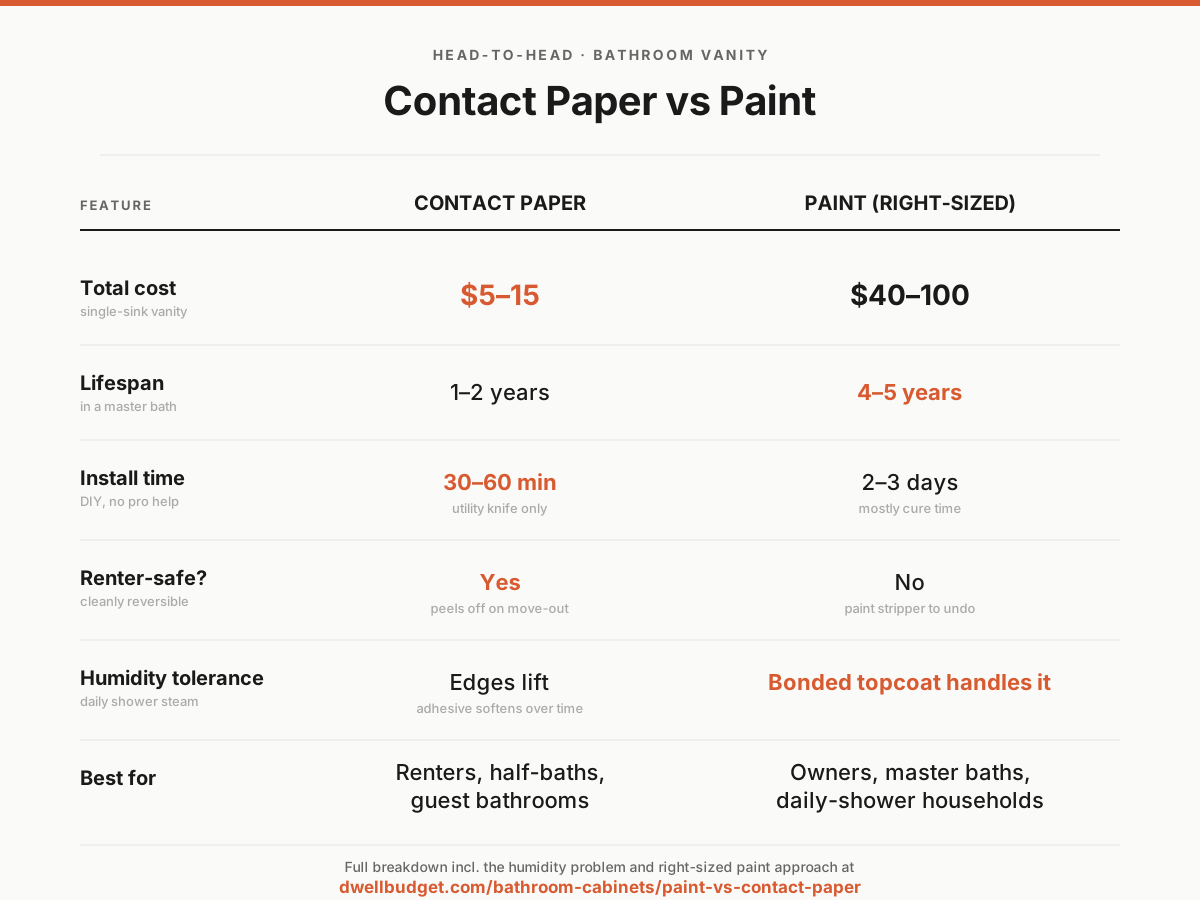
| Contact paper wrap | Paint (Rust-Oleum kit or quart) | |
|---|---|---|
| Cost | $5–15 | $40–100 |
| Cost per sq ft | $0.40–0.80 | $5–10 (quart) or $10 (full kit) |
| Lifespan (master bath) | 1–2 years | 4–5 years |
| Lifespan (half/guest bath) | 2–3 years | 5–6 years |
| Install time | 30–60 minutes | 2–3 days (mostly cure time) |
| Tools required | Utility knife, ruler, squeegee | Sandpaper, brushes, mini-roller |
| Removable cleanly? | Yes — peels off with hair dryer | No — paint stripper to undo |
| Humidity tolerance | Edges lift over time | Bonded topcoat handles steam |
| Best for | Renters, half/guest baths, quick refresh | Owners, master baths, stay 3+ years |
When to pick contact paper
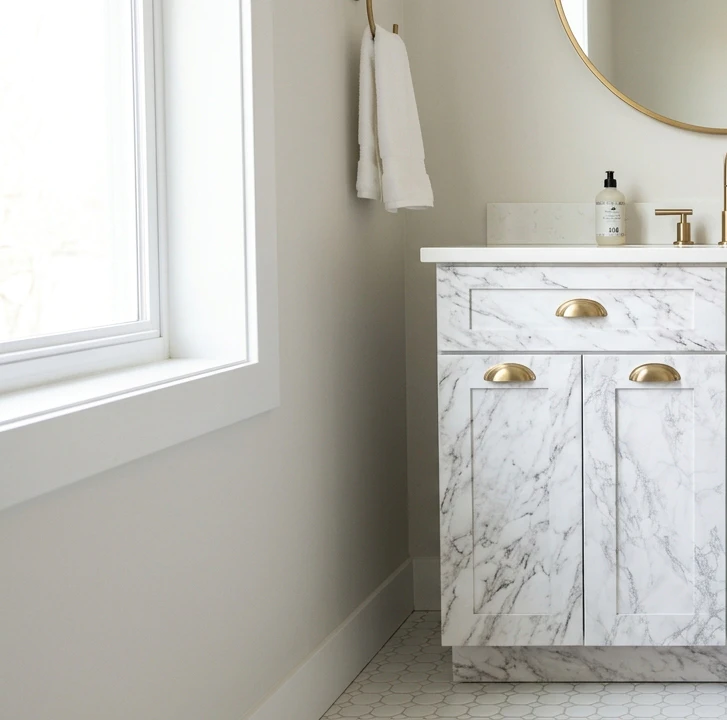
Pick contact paper if at least three of these are true:
- You rent — and you want the vanity back to original on move-out
- Total budget under $20
- You want it done in an hour with no tools beyond a utility knife
- The vanity is in a half-bath or guest bath (low daily humidity exposure)
- You're OK redoing it in 1–3 years
d-c-fix and Con-Tact at $0.40-0.80 per sq ft are the two reliable brands. For a typical single-sink vanity with 6-10 sq ft of cabinet face you're at $5-15 in material and roughly an hour of work. Marble-look, matte black and warm wood patterns are what fool people from 3 feet; bright colors and loud florals read as "vinyl wrap" up close.
The honest case for contact paper in a bathroom: it's the right answer for any rental vanity where you wouldn't paint anyway, AND for low-use bathrooms (half-bath, guest bath, powder room) where humidity isn't a daily punishment. It's also the right "intermediate" choice for owners who want a quick visual reset before deciding on a longer-term style.
What you give up: lifespan (1-2 years in a master bath where shower steam attacks the adhesive — see the humidity section below), splash tolerance at the sink edge (caulk the top seam or expect lifting near the faucet), and the premium underfoot feel of real paint — though on a small vanity even up close people rarely notice the wrap.
When to pick paint
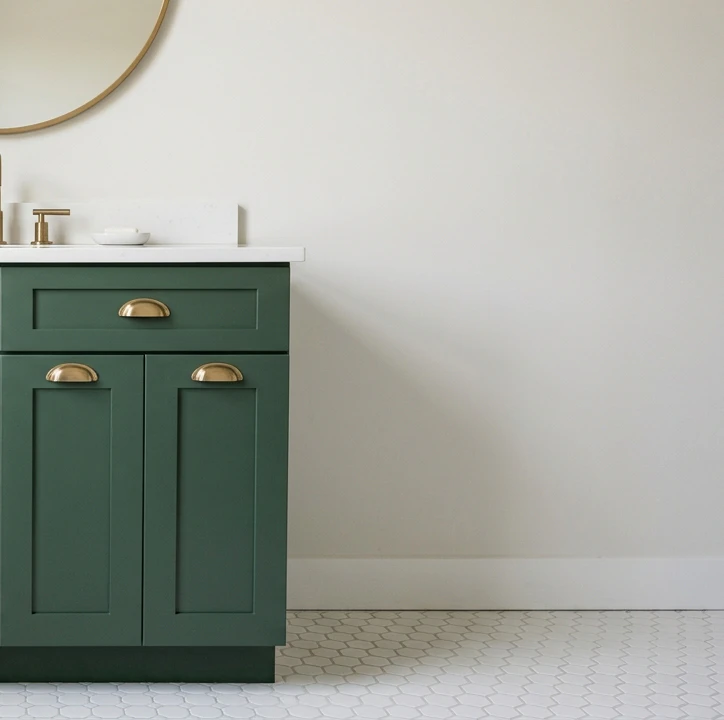
Pick paint if at least three of these are true:
- You own the home and plan to stay 3+ years
- The vanity is in a master bath with daily shower use
- You want a finish that survives 4-5 years of bathroom humidity
- You're willing to commit a full weekend plus drying time across 2-3 days
- You want the refresh to add modest resale value
For a small bathroom vanity, two paint paths work — and one of them is genuinely cheaper than people assume:
- Right-sized: quart of cabinet paint + bonding primer — about $40-50 total. A quart of Benjamin Moore Advance or Sherwin-Williams ProClassic ($28-32) plus a quart of bonding primer ($15) is plenty for a 6-10 sq ft vanity with two coats each. Built for cabinetry, handles humidity, no special kit needed.
- The full kit: Rust-Oleum Cabinet Transformations at $80-100. Overkill for a single vanity — the kit covers 100 sq ft and you'll use 10% of it. But if you're going to do a kitchen later, buy once and split across both projects.
Plan two days minimum: Day 1 — remove doors and drawers, clean with TSP or substitute, light sand, apply bonding primer, let cure. Day 2 — first paint coat, light sand, second paint coat. Day 3 (optional) — protective topcoat if going for the longest lifespan in a master bath. Reinstall doors after everything's fully cured (48 hours minimum).
What you give up: upfront time (2-3 days of cure windows even for a small vanity), reversibility (chemical paint stripper is the only way back), and flexibility on color — pick wrong and the redo is more work than the original.
The bathroom humidity problem (what makes both fail)
This is the single factor that makes a bathroom vanity project different from a kitchen project. Bathrooms hit 80%+ relative humidity during showers, every day — and that humid-to-dry cycling stresses adhesives and paint films in ways that grease and heat (the kitchen problems) don't.
What happens to each material:
- Contact paper: the pressure-sensitive adhesive on the back is rated for room-temperature dry surfaces. Daily exposure to high humidity softens the adhesive — not enough to fail immediately, but enough to fail at edges and seams over time. In a master bath, expect lifting at top edges (where steam condenses on the cool quartz countertop and drips back) within 12-18 months. In a half-bath, lifting is delayed to 2-3 years.
- Paint without a topcoat: latex paint stays slightly porous, and bathroom moisture works into the film. Within a year you'll see micro-cracking near hardware (where hands have been touching) and discoloration near the sink edge. The fix is non-negotiable: always apply a clear topcoat (polycrylic, polyurethane, or the topcoat from a cabinet-specific kit) over bathroom paint. With topcoat, lifespan jumps from 1-2 years to 4-5.
Universal fix for both: run the bathroom exhaust fan during AND for 15-20 minutes after every shower. This single habit drops the average humidity exposure of the vanity dramatically, and adds 2-3x lifespan to either finish regardless of the install quality. The fan is the most important "tool" in any bathroom refresh project.
Hardware: the $20 finishing touch
Whichever finish you pick, budget another $15-25 for new pulls or knobs. A bathroom vanity typically has 2-4 hardware pieces (1-2 door pulls + 2 drawer pulls), so the total spend is much lower than a kitchen. The combination that visually carries a $15 wrap job into "looks intentional" is:
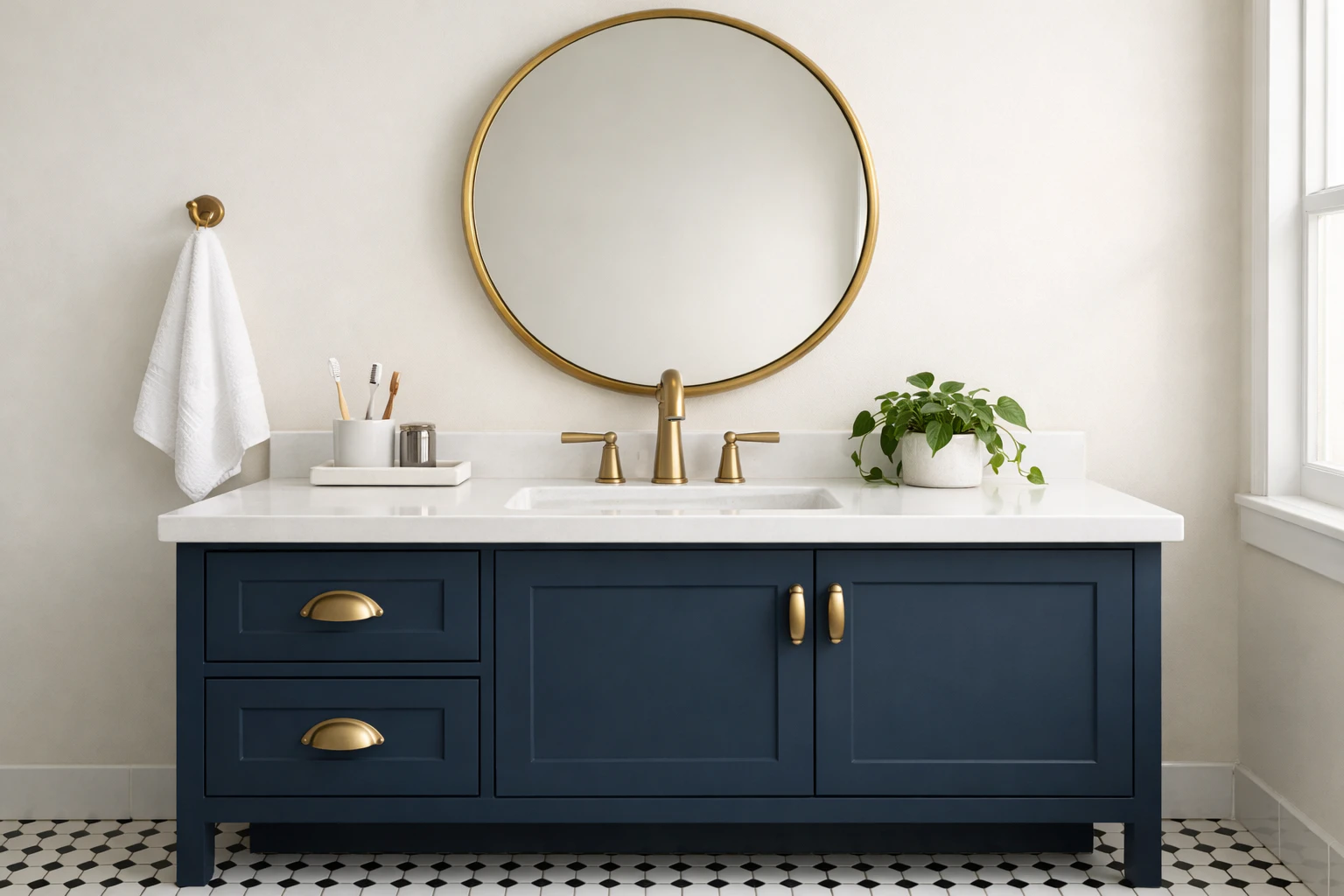
- Solid dark vanity color (navy, charcoal, sage, deep terracotta — whether painted or wrapped)
- Brushed brass OR matte black hardware (match the faucet finish — see FAQ below)
- Consistent style — all cup-pulls OR all bar-pulls, not mixed
Amazon's individual pulls from Amerock, Ravinte, and CRESTGATE deliver decent finish quality at $3-5 per piece. A 4-piece set runs $12-20 for a typical vanity. Skip the cheapest pieces under $2 each — the finish wears off in a humid bathroom within months.
The short verdict
Pick contact paper if you rent, your budget is under $20, the bathroom is a half-bath or guest bath with low humidity exposure, or you want a 30-minute project. Pick paint if you own, the vanity is in a master bath with daily shower use, or you want the finish to last 4-5 years and add modest resale value. The deciding factor is almost always humidity exposure — half-baths reward contact paper's flexibility; master baths punish it and reward paint's resistance.
For a small bathroom vanity specifically, don't buy the full Rust-Oleum kit unless you have a kitchen project lined up too — a quart of Benjamin Moore Advance plus a quart of bonding primer is right-sized for $40-50, and runs the bathroom humidity gauntlet just as well as the full kit.
Comparing more vanity options? The full bathroom vanity guide also covers chalk paint — useful if you want the no-prep promise but commit to topcoating it for humidity. Chalk paint without topcoat fails in bathrooms within months.
 11 Best Removable Tile Sticker Brands
 Full bathroom vanity guide
 Kitchen Cabinets: Paint vs Contact Paper
 Bathroom Walls
 Bathroom Floor