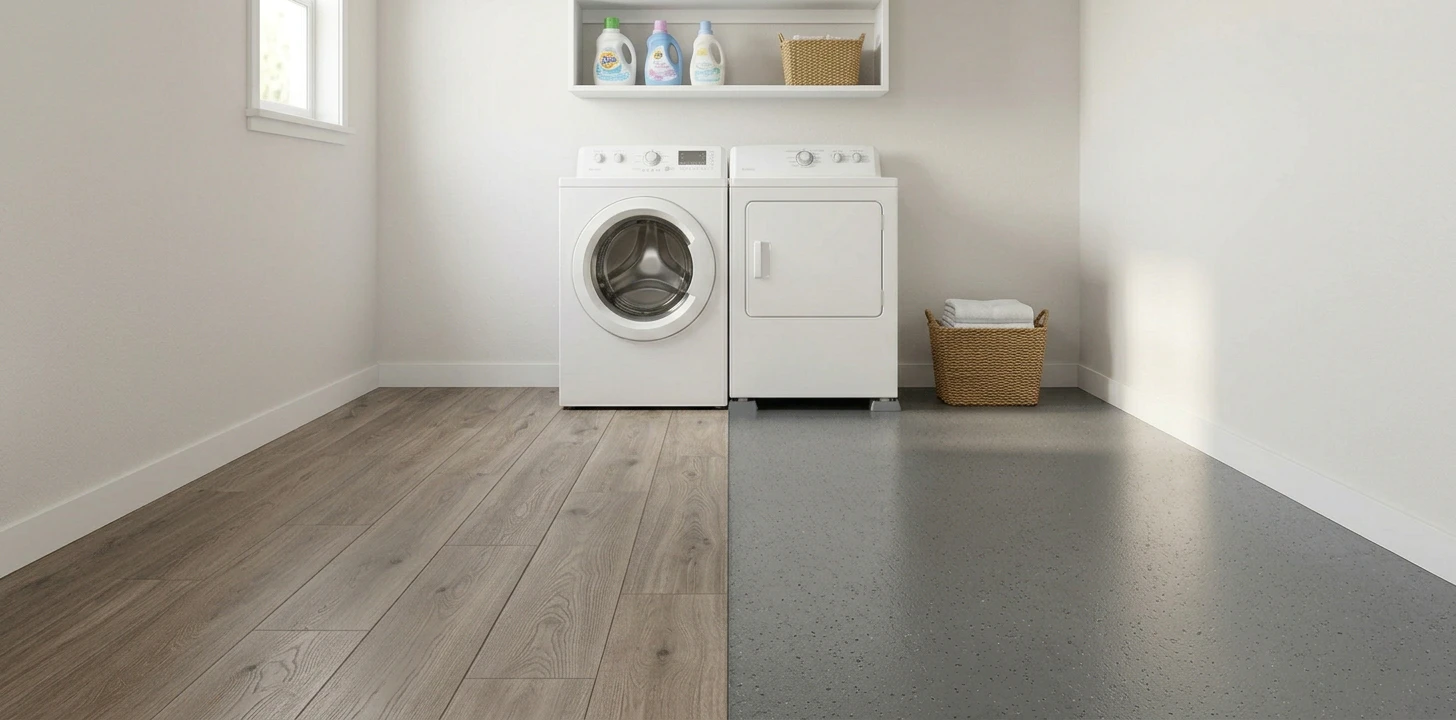
Updated July 2026. Prices reflect US market costs from Home Depot, Lowe's and Amazon. All comparisons based on a typical 50 sq ft laundry room (the size where the cost and install-difficulty differences actually matter).
The substrate decides first — start here
Most "LVP vs epoxy" comparisons skip the question that decides 40% of them before any other factor matters: what's under your laundry room floor right now?
Concrete slab (most basements, ground-floor laundries, slab-on-grade homes): both LVP and epoxy are valid. The decision moves on to leak resistance, vibration, cost, aesthetics.
Wood subfloor (most second-floor laundries, manufactured homes, additions over crawl spaces): epoxy is off the table. The film flexes with normal floor movement, hairline-cracks within 6-12 months, starts peeling. There's no workaround short of pouring a concrete topping. Your real choices become LVP, glued-down vinyl sheet, or porcelain tile (with cement backer board).
The 30-second test: walk across your laundry room floor with normal weight. If you can hear or feel floor flex, it's wood subfloor — epoxy is out. If it feels rock-solid with no give, it's concrete slab — both options are open.
The rest of this article assumes you're in the second category (concrete slab) and walks through the actual decision between LVP and epoxy on that substrate.
Side-by-side comparison
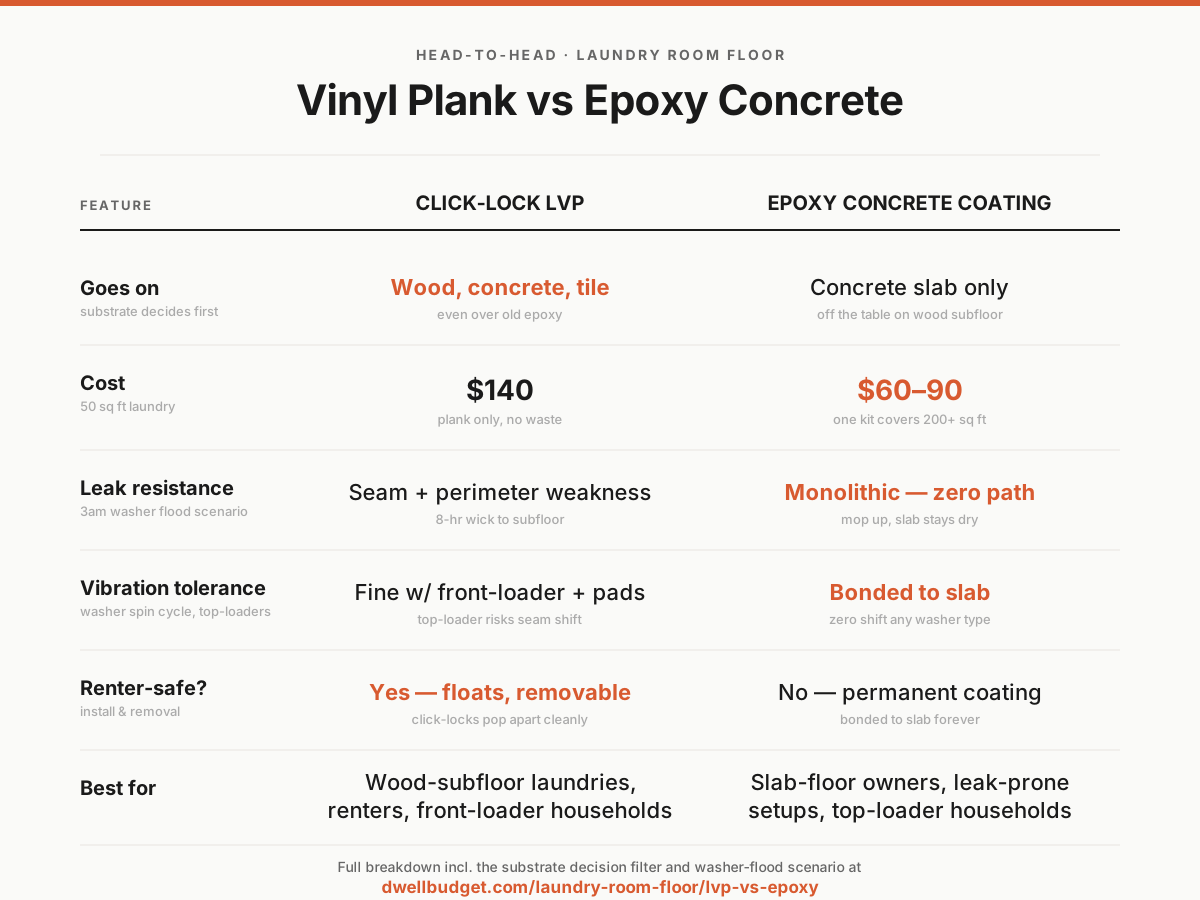
| Click-lock LVP | Epoxy concrete coating | |
|---|---|---|
| Substrate compatibility | Wood subfloor, concrete, tile, even old epoxy | Concrete slab only |
| Cost (50 sq ft laundry) | $140 (plank only) | $60–90 (one EpoxyShield kit) |
| Install time | One afternoon (3–4 hrs) | Two days incl. 24-hr cure between coats |
| Leak resistance | Waterproof body; seams + perimeter weak point | Monolithic — zero leak path through |
| Vibration tolerance | Fine with front-loader + anti-vib pads; risky with top-loader | Bonded to slab — zero shift risk |
| Chemical resistance | Handles diluted detergent; bleach can stain | Resistant to all common laundry chemicals |
| Bare-feet temperature | 3–5°F warmer than bare slab | Same as slab — 55–62°F in unheated spaces |
| Aesthetic | Wood-look, "feels like living space" | Industrial utility, "looks like a laundry" |
| Renter-safe? | Yes — floats, removes cleanly | No — permanent coating on slab |
| Best for | Renters, wood-subfloor laundries, warmer feel | Owners with slab, leak-prone setups, top-loader households |
When to pick vinyl plank
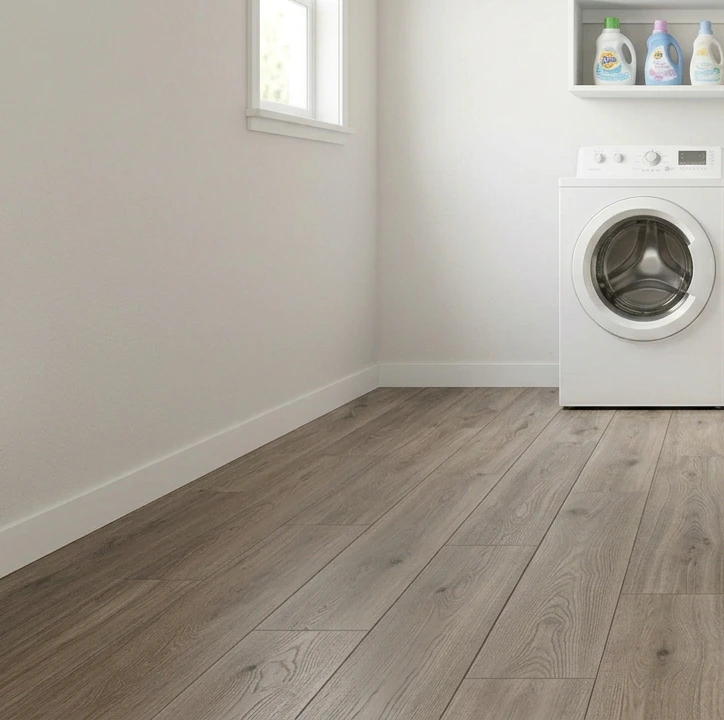
Pick click-lock LVP if at least three of these are true:
- Your laundry sits on wood subfloor (no real choice — epoxy can't go there)
- You rent or want a fully reversible install
- You have a front-loader (vibration risk is manageable with anti-vib pads)
- You want the floor to match adjacent living areas — kitchen, mudroom, hallway
- You want install done in one afternoon without a 24-hour cure wait
Click-lock LVP from LifeProof or Smartcore at $2.80/sq ft hits $140 for a 50 sq ft laundry plus 3-4 hours of install. The biggest advantages: works on any subfloor, renter-safe with reversible install, and aesthetic continuity with adjacent wood-look floors in kitchens, mudrooms, or hallways.
The under-discussed advantage in laundry rooms specifically is the warmth gap. Concrete slab in an unheated basement runs 55-62°F year-round; epoxy transmits that directly. LVP's plank body and click-lock air gap drop perceived foot temperature 3-5°F — not warm, but noticeably less cold first thing on a January morning.
What you give up: seam and perimeter leak weakness (run a clear silicone bead along the perimeter on install day), top-loader vibration risk (use anti-vibration pads at $20 minimum, glued-down vinyl sheet if your top-loader is heavy), and the "feels like a real floor" industrial look that epoxy delivers in utility spaces.
When to pick epoxy
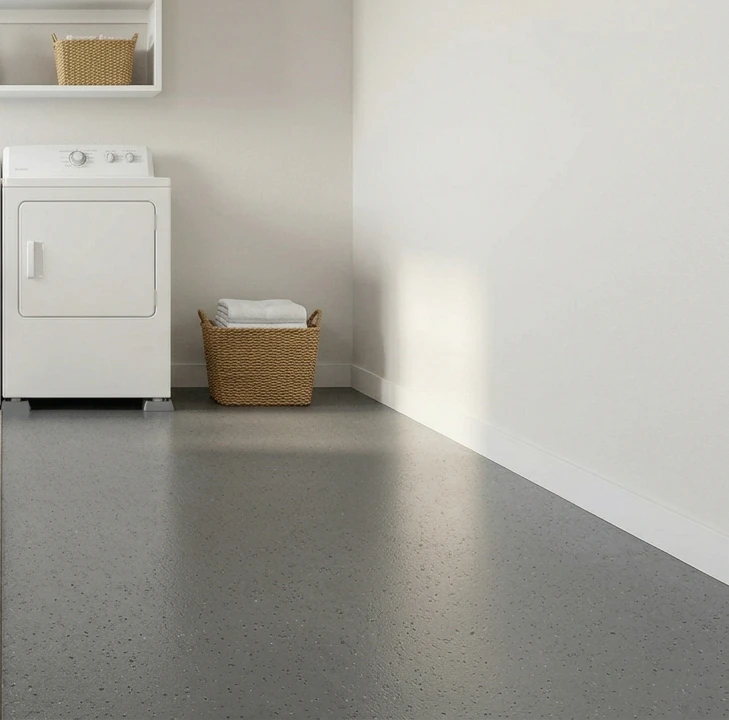
Pick epoxy concrete coating if at least three of these are true:
- Your laundry sits on a concrete slab (required — there's no workaround)
- You own the home and plan to stay 5+ years
- You have a top-loader or the washer has known vibration issues
- The laundry has a history of leaks or shares a slab with the water heater / utility area
- Budget is under $100 for the whole floor
Rust-Oleum EpoxyShield or Behr 1-Part Epoxy kits run $60-90 and cover 200-250 sq ft — way more than you need for a typical 50 sq ft laundry, with leftover for a small garage corner or workshop floor. The install is two days including 24-hour cure between coats, but the actual hands-on work is only 3-4 hours of that.
The biggest practical argument is monolithic leak resistance. Epoxy is one continuous bonded surface with no seams, no joints, no perimeter caulk. A washer overflow sits on top until you mop it up, with zero penetration path to the subfloor. For laundries with any history of leaks, water-heater proximity, or top-loader vibration concerns, that single property makes epoxy the safer-by-design choice.
What you give up: slab-only substrate requirement (off the table on wood subfloor), permanent install (no renter version), cold-feet factor (epoxy stays slab temperature year-round), and the "utility room industrial aesthetic" that some buyers see as a negative if they want the laundry to feel like part of the home.
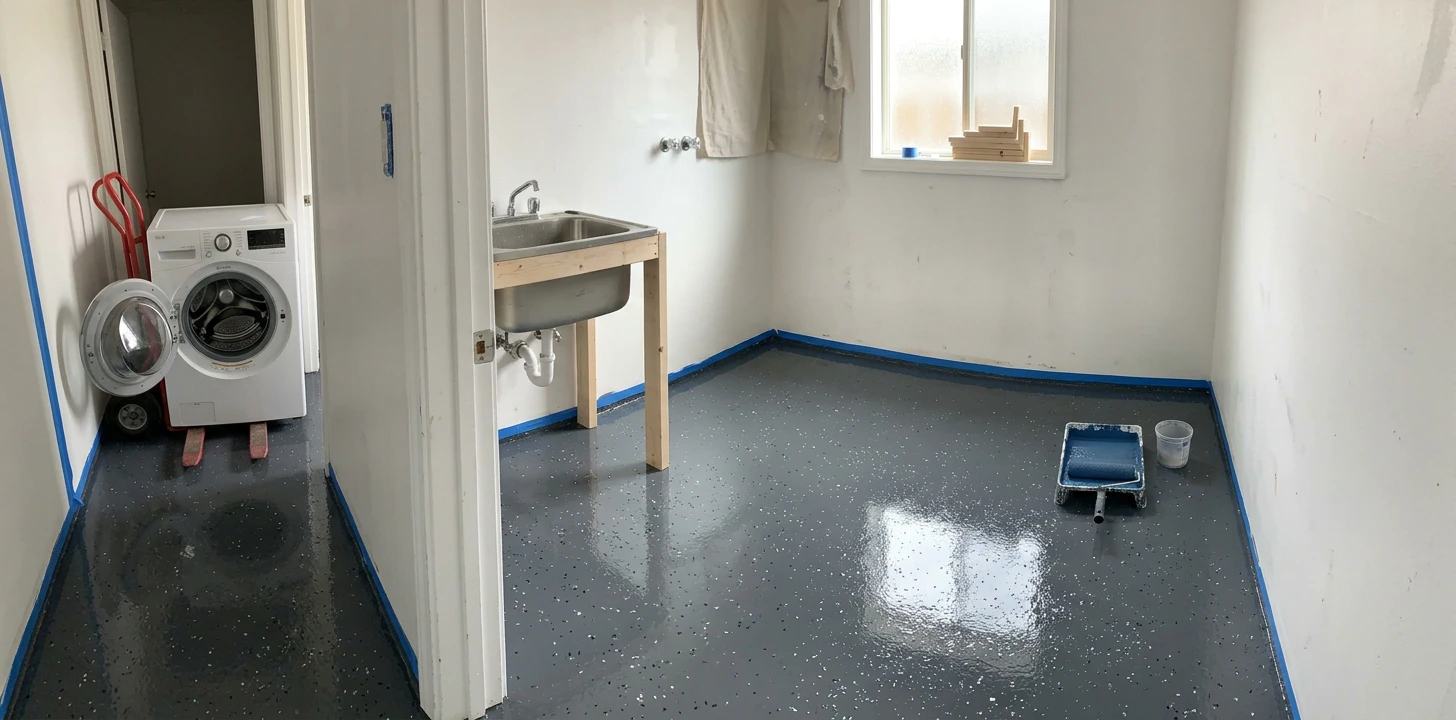
Epoxy floor in a laundry room: how the install actually goes
If the checklist above lands you on epoxy, here's the honest shape of the project in a small room — it's the garage workflow scaled down, with two laundry-specific twists.
- Empty the room completely — washer and dryer out (this is the step people underestimate; you'll need a hand truck and somewhere to park the machines for two days).
- Test the slab for moisture: tape a 2×2 ft plastic square to the concrete, sealed on all edges, and wait 24 hours. Condensation underneath = the slab is releasing vapor and any coating will blister; solve the moisture first.
- Degrease and etch. Laundry slabs collect detergent film — scrub with a degreaser first, then etch per the kit instructions so the surface feels like fine sandpaper.
- Coat in two thin passes with 24 hours between them, cutting in the edges with a brush and rolling the field. A 50 sq ft room is 30-40 minutes of actual rolling per coat.
- Broadcast anti-slip flakes or grit into the final coat — a laundry floor gets wet by definition, and smooth epoxy is slick. Non-negotiable, same rule as bathrooms.
- Respect the cure before the machines come back: 24-72 hours depending on the kit. Sliding a 200 lb washer onto under-cured epoxy gouges it permanently. Put anti-vibration pads under the feet as part of the move-back.
Total wall-clock time: two to three days, of which maybe 4-5 hours is hands-on work. The prep rules that make or break it are the same ones from our 7 garage epoxy mistakes guide — moisture, degrease, thin coats, full cure — just applied to a smaller, wetter room.
The 3am washer flood scenario
This is the scenario every laundry-room-floor decision should be tested against, and the under-discussed factor that gives epoxy its biggest advantage over LVP.
What actually happens during a washer overflow: the supply hose fails — rubber hoses harden and split with age, which is why the $25 braided-steel replacement is such a standard recommendation — water pumps out continuously, and it keeps coming until you notice or shut the line. If it happens at 3am with no one home for 8 hours, you're looking at 100-150 gallons across the laundry room floor.
How LVP handles it: the plank bodies are waterproof, so the wood-look surface won't warp or stain. But standing water has 8 hours to wick through the seams (1mm gaps between click-locked planks) and through the perimeter gap where LVP meets the wall. By the time you discover the flood, the subfloor underneath has been wet for hours. Plank seams may need sealing replacement; subfloor may need drying or partial replacement.
How epoxy handles it: water sits on top. Zero penetration. You mop it up like a spilled drink. The slab underneath stays dry. Insurance claim amount changes by an order of magnitude.
The non-negotiable insurance layer for either floor: $40 drain pan under the machine (catches small leaks), $25 leak detector with wifi alert (tells you within 30 seconds of water hitting the floor), and ideally a $150 automatic shutoff valve on the supply line. Total $200-215 of insurance, much cheaper than one flood regardless of floor type.
Washer vibration tolerance
The second laundry-specific factor that decides the question for some setups: how each floor handles continuous washer vibration over years.
Front-loaders spin at 1,200-1,400 RPM and transmit vibration mostly downward through the machine's feet directly into the slab. LVP with anti-vibration pads under the washer handles this fine for the floor's full 12-15 year lifespan. Epoxy bonded to the slab is unaffected — same as bare concrete.
Top-loaders are worse — they spin at lower RPM but transmit vibration laterally as well as downward. Over years, lateral vibration can shift floating LVP planks fractionally with each cycle, eventually opening seams under the unit. For top-loader households, the safer choices are glued-down vinyl sheet, epoxy, or porcelain tile — anything bonded to the substrate.
The fix for either floor: a $20 set of anti-vibration pads under the washer feet absorbs the worst of the spin-cycle shake and noticeably cuts what reaches the floor — you can feel the difference with a hand on the plank next to the machine. This is the highest-ROI laundry-floor accessory you can buy, and it's mandatory for any LVP install under any washer type.
The short verdict
Pick LVP if your laundry is on wood subfloor (no real choice), you rent, you have a front-loader, or you want the wood-look continuity with adjacent living areas. Pick epoxy if your laundry is on a concrete slab, you own long-term, you have a top-loader, or the room has any history of leaks or water-damage concerns. If you have a slab and the question is purely practical (not aesthetic), epoxy is the safer-by-design choice — monolithic leak resistance, chemical tolerance, and zero vibration shift add up to fewer 5-year problems than LVP on the same slab.
Comparing more laundry room floor options? The full laundry room floor guide also covers glued-down vinyl sheet (the under-$100 budget hero for top-loader households) and porcelain tile (the forever floor for owners with a flat slab and a contractor budget). The drain pan + leak detector + auto-shutoff insurance stack is the same regardless of which floor you pick.
 Epoxy Floor in a Laundry Room: Should You, and How
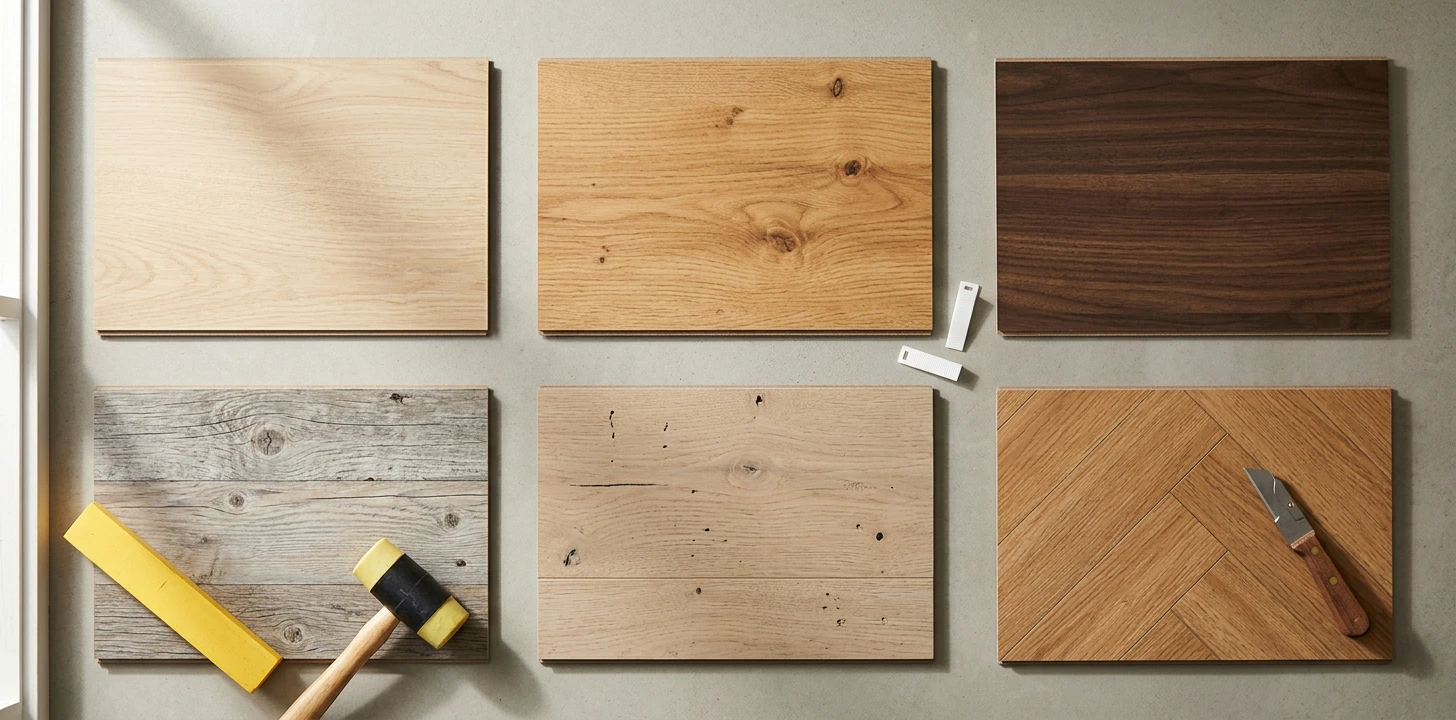 11 Best LVP Brands 2026
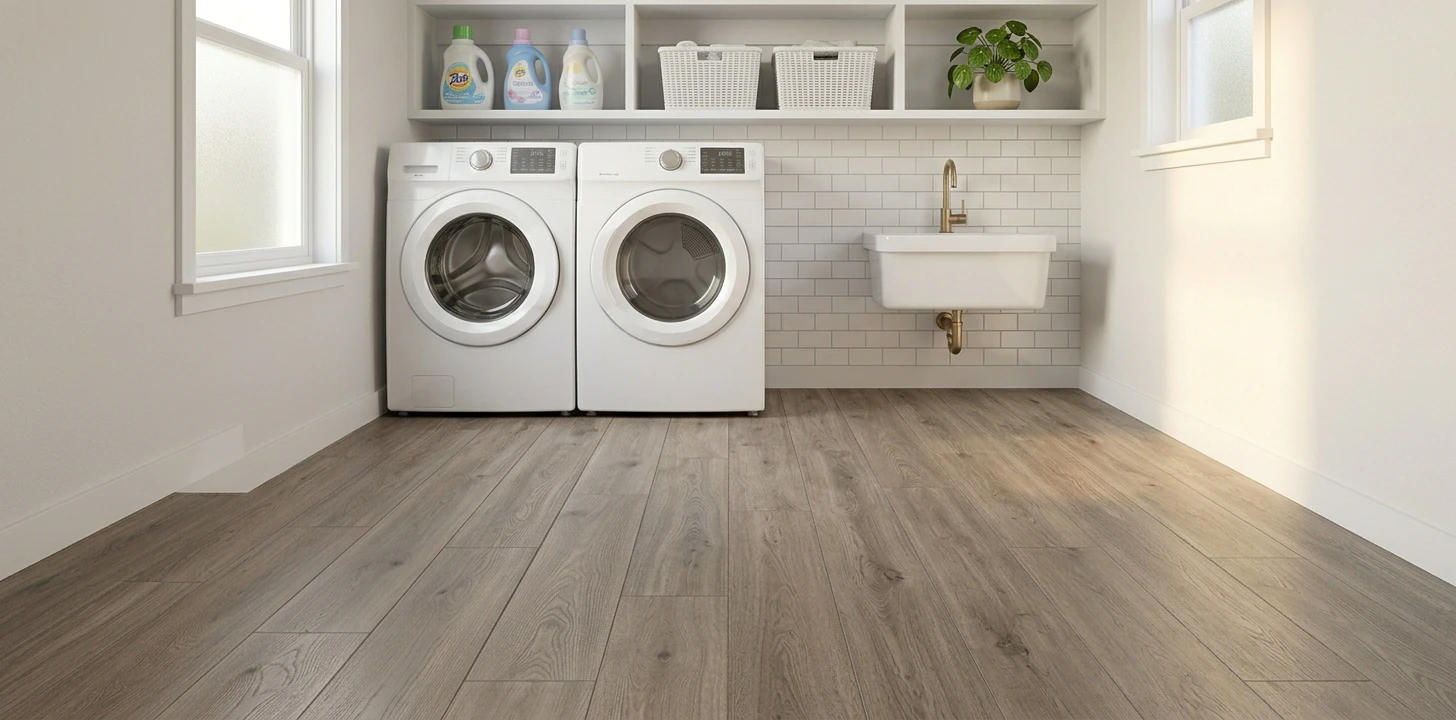 Full laundry room floor guide
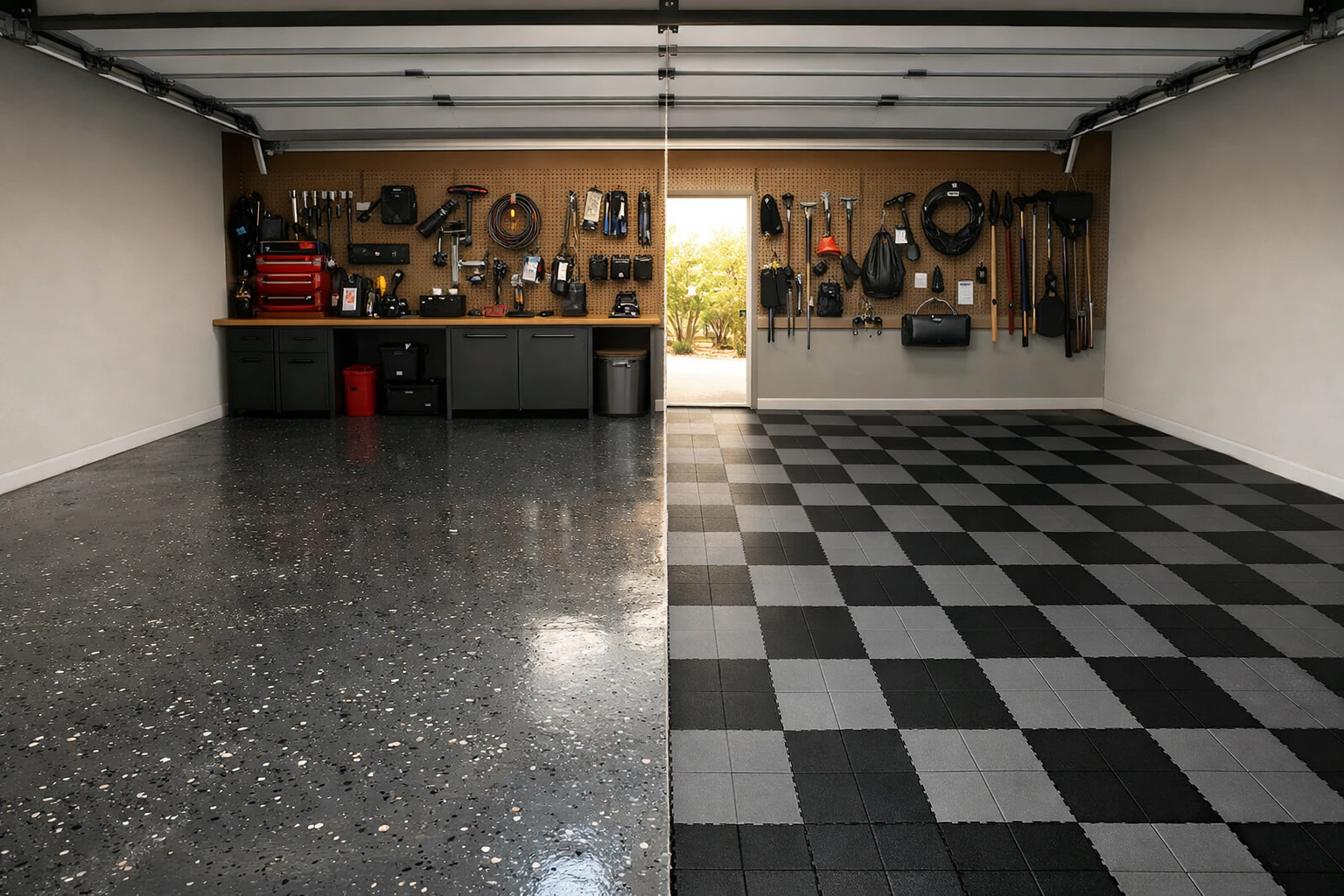 Garage Floor: Epoxy vs PVC
 Garage Floor: Paint vs Epoxy
 Kitchen Floor: LVP vs Hardwood