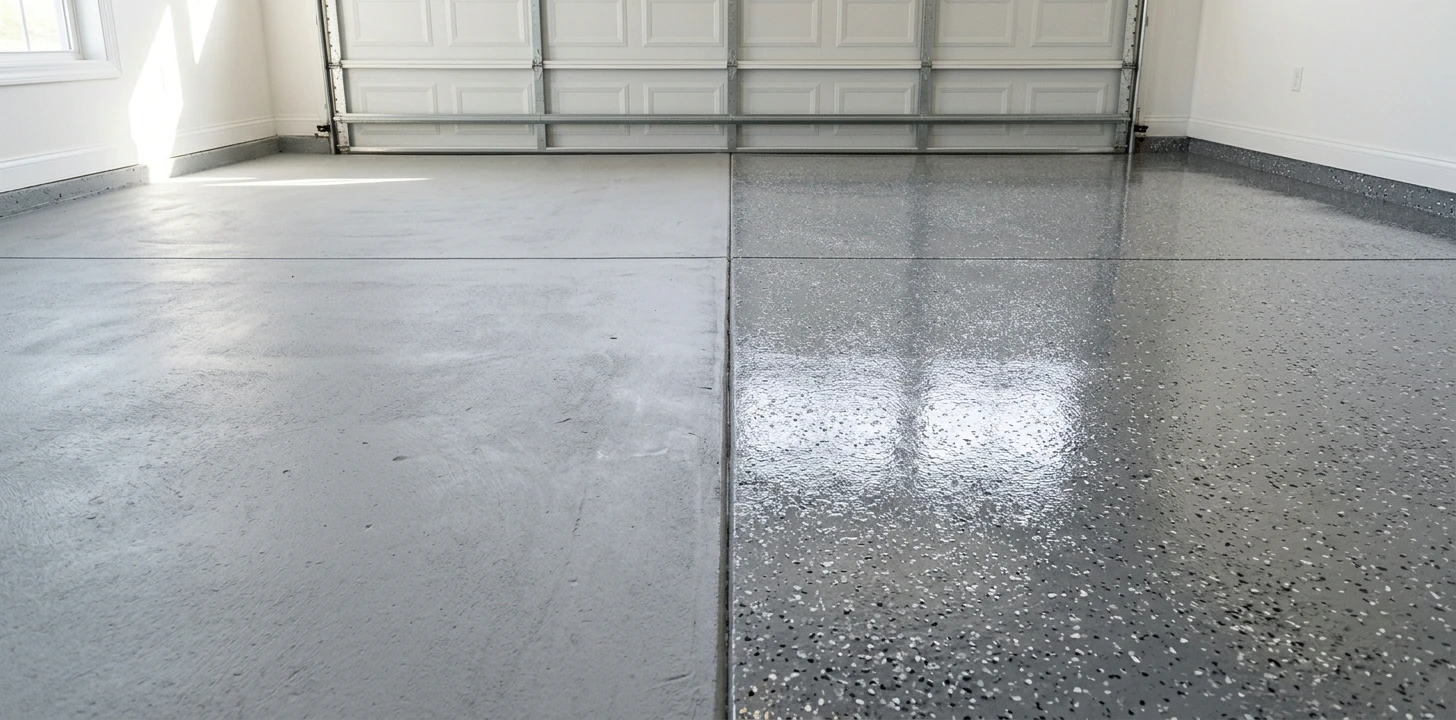
Updated July 2026. Prices reflect US market kit costs from Amazon, Home Depot and Lowe's. All comparisons based on a typical two-car garage (400 sq ft).
The garage floor dilemma everyone googles first
"Should I paint my garage floor or do epoxy?" is the question that stalls most garage projects, and for good reason — both are coatings, both go on a roller, both look fine on the shelf at Home Depot. The boxes cost almost the same. But what happens in year 2 is wildly different.
The short version: painted concrete is $0.50/sq ft, takes a single Saturday, and looks great for 3-5 years until your car tires start peeling chunks of it up. Epoxy is $1.50/sq ft, takes a long weekend with cure time, and holds for 5-10 years because the chemistry is fundamentally different — it doesn't soften under a hot tire the way paint does.
Below: side-by-side table, scenarios for picking each, the hot-tire pickup problem that decides it for daily-driver garages, the 24-hour moisture test that wrecks both finishes if you skip it, and 6 FAQs.
Side-by-side comparison
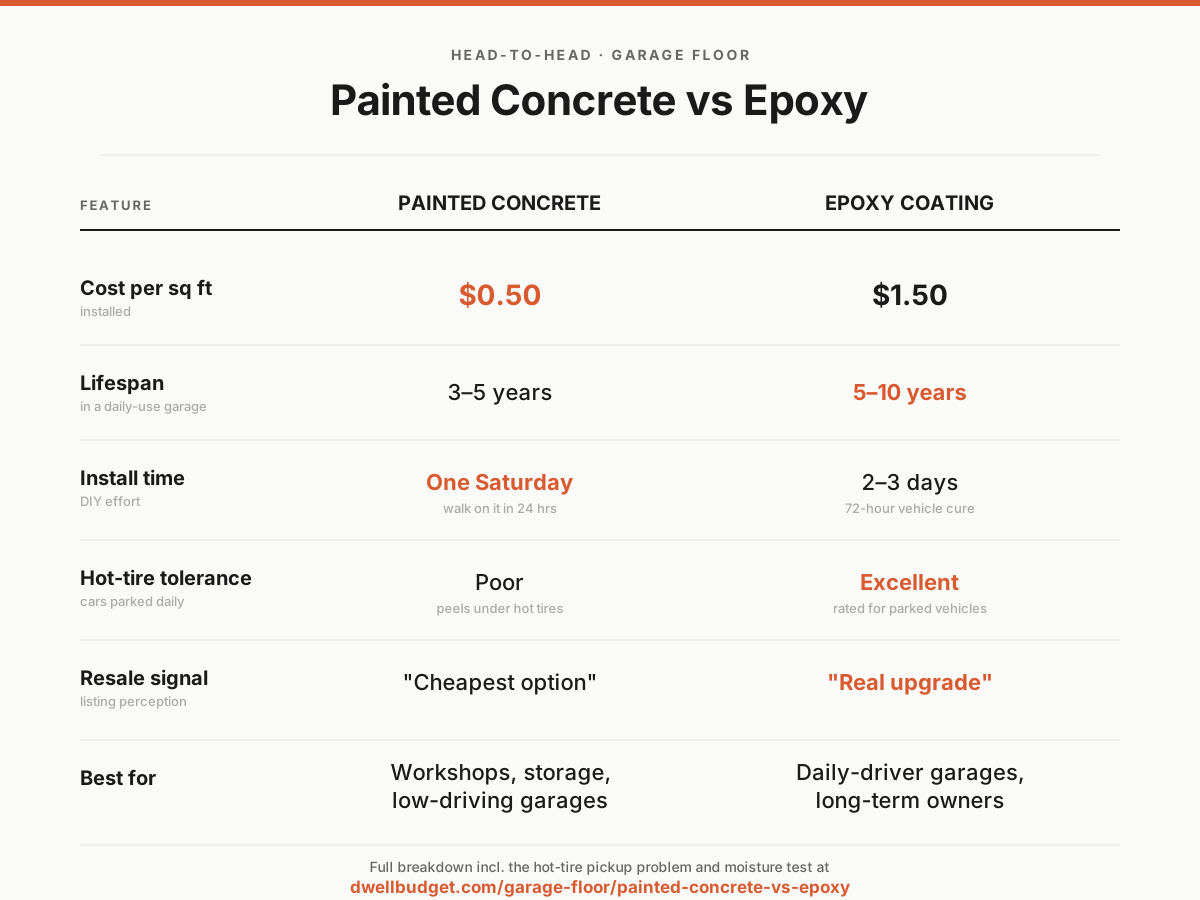
| Painted concrete | Epoxy coating | |
|---|---|---|
| Cost per sq ft | $0.50 (paint only) | $1.50 (kit with topcoat) |
| Two-car garage total (400 sq ft) | ~$200 | ~$600 |
| Lifespan | 3–5 years | 5–10 years (7 typical) |
| Install time | One Saturday, walkable in 24 hrs | 2–3 days, 72-hour vehicle cure |
| Hot-tire tolerance | Poor — peels under daily-driven tires | Excellent — rated for parked vehicles |
| Repaintable later? | Yes — just scuff sand and re-coat | Yes, with prep — but no one does |
| Hides slab imperfections | No — telegraphs cracks and pits | Better — kit fills minor surface texture |
| Cost per year (material only) | ~$0.14/sq ft | ~$0.20/sq ft |
| Best for | Workshops, storage, low-driving garages | Daily-driver garages, owners staying 5+ yrs |
When to pick painted concrete
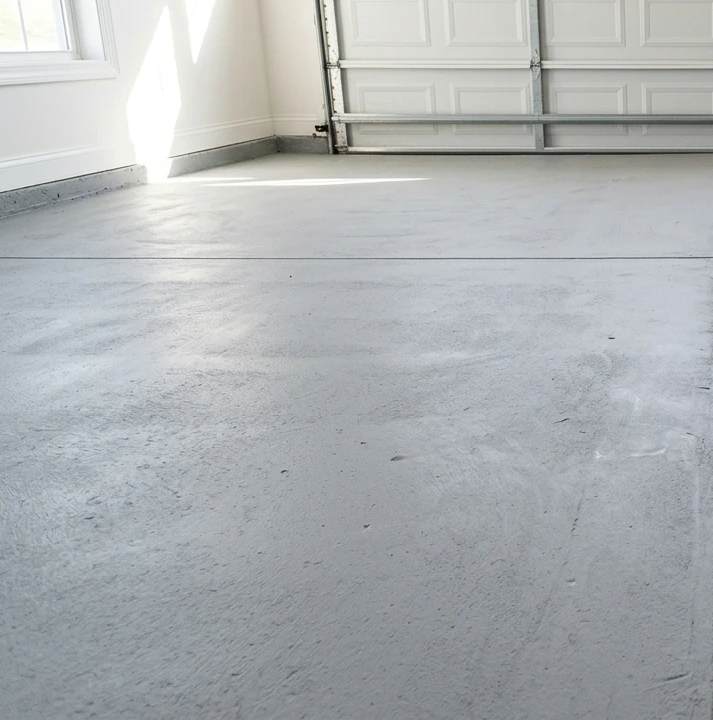
Pick painted concrete if at least three of these are true:
- Total budget under $250 for a two-car garage
- You park outside or only drive occasionally — no daily hot tires on the floor
- You want it done in one weekend with no special chemicals or cure-time planning
- The garage is mostly workshop or storage, not vehicle space
- You're OK repainting every 3-5 years (or you'll have moved by then)
Standard Drylok or Behr Concrete Floor Paint at $0.50/sq ft works out to $200 in material for a 400 sq ft garage and one Saturday of work. The install is genuinely beginner-friendly: clean, etch, roll on two coats, walk on it in 24 hours. No mixing, no pot life, no chemical fumes that need industrial ventilation.
The honest case for paint in 2026: it's the right choice for any garage where vehicles aren't the primary use. Workshop floors, storage garages, mother-in-law-suite garages converted to anything-but-cars, basement-level under-house garages used for tools — paint handles those just fine for 4-6 years.
What you give up: hot-tire tolerance (the deal-breaker for vehicle garages — see the dedicated section below), lifespan under cars (cuts in half compared to non-vehicle use), and resale signal (paint reads as "owner did the cheapest thing"; epoxy reads as "owner invested").
When to pick epoxy
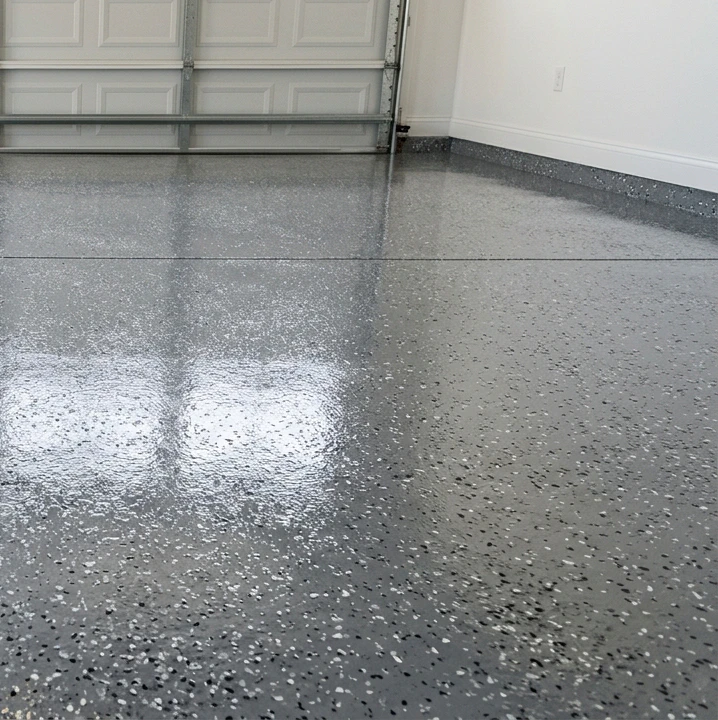
Pick epoxy if at least three of these are true:
- You drive your cars in and out of the garage daily
- You own the home and plan to stay 5+ years
- Budget allows $500-700 for a two-car garage
- You can shut the garage down for 72 hours of cure time (cars out, contents covered)
- You want a finish that resists oil drips, road salt, and dropped tools without chipping
The Rust-Oleum EpoxyShield kit at $1.50/sq ft installed (kit + chips + topcoat) lands at $600 for a typical 400 sq ft garage. The chemistry is fundamentally different from paint: two-part epoxy crosslinks into a hard, heat-resistant plastic shell on top of the concrete. That cross-linked structure is what survives hot tires, oil splashes, and dropped wrenches without failing.
Plan three days: Day 1 — clean, etch, apply bonding primer (3-4 hours hands-on). Day 2 — base coat + decorative chip throw + overnight cure (1-2 hours hands-on). Day 3 — protective topcoat + 48-72 hour vehicle cure window. Total hands-on work is 6-8 hours; the rest is cure time. Plan around the schedule, not just the work hours.
What you give up: 3x the upfront cost, 3-day garage shutdown for cure time, chemical handling (real fumes, real ventilation needed), and permanence — removing failed or unwanted epoxy is a grinding job that costs more than the original install.
The hot-tire pickup problem (the deal-breaker for paint)
This is the single technical reason painted floors fail early under vehicles. Understanding it makes the paint-vs-epoxy decision easier than any other factor.
What happens: When you drive your car for 30+ minutes — highway commute, errand run, anything beyond 5 minutes — the tires reach surface temperatures of 130-170°F. That's hot enough to soften the resin in standard latex or acrylic floor paint. When you park, the hot tire sits on the softened paint film and slowly cools, with the rubber pressing into the paint surface. By the time you drive away the next morning, the tire literally peels chunks of paint up off the floor.
After a year of daily use, you'll see bare patches under every wheel position. By year 2-3 those patches grow until the whole tire path is bare concrete. The rest of the floor still looks fine, but the area that actually gets used is destroyed.
Epoxy doesn't soften at tire temperatures — the cross-linked structure stays rigid through normal automotive heat. That's the entire reason it costs 3x more, and it's the entire reason it lasts 3x longer under cars. If you park vehicles in your garage daily, this single factor decides the question.
Workaround for paint: "Hot-tire-resistant" paints (Behr Premium Concrete Stain & Sealer, Rust-Oleum Concrete Saver) at $0.75-1/sq ft do better than basic paint — extended polymer technology raises the softening point. Expect 4-6 years of life instead of 3, but you're still not at epoxy's tier.
The moisture test that wrecks both finishes if you skip it
Both paint and epoxy fail catastrophically over a slab that's wicking moisture from below. The fix is a 24-hour test that costs nothing and adds a day to your project plan.
How to test: Tape a 2×2 ft sheet of clear plastic to a clean section of bare concrete on all four edges with painter's tape. Leave undisturbed for 24 hours. Peel back a corner — check the underside of the plastic AND the concrete under it.
- Dry on both: You're good. Proceed with whichever finish you picked.
- Condensation on the underside of the plastic OR damp concrete under it: The slab is wicking moisture. Apply a moisture-blocking primer (Rust-Oleum Concrete Bonding Primer) before paint or epoxy, or both will lift within months regardless of how perfect the rest of your prep is.
This step takes 24 hours and $0. Skip it and either finish can fail at the 4-6 month mark — at which point you're starting over from bare concrete. Worth the day.
The short verdict
Pick painted concrete if your garage is mostly workshop or storage, you park outside, your budget is genuinely capped at $250, or you want a Saturday project with no chemicals or cure time. Pick epoxy if cars live in your garage, you own and stay long-term, you can plan around a 3-day shutdown, and you want a finish that ignores hot tires for 5-10 years. The pivot point is almost always vehicle use — paint is fine for everything except daily-driven cars, and epoxy is overkill for everything except daily-driven cars.
Comparing epoxy to something else? The Epoxy vs PVC tiles head-to-head covers the comparison when "permanent coating" loses to "snap-together rival" — the right read if you might move within 5 years or your slab is too rough for any liquid coating.
 11 Best Garage Floor Coatings 2026
 7 Garage Epoxy Mistakes That Make It Peel
 Full garage floor guide
 Garage Floor: Epoxy vs PVC Tiles
 Bathroom Floor: LVP vs Ceramic Tile
 Outdoor Deck: Pressure-Treated vs Composite