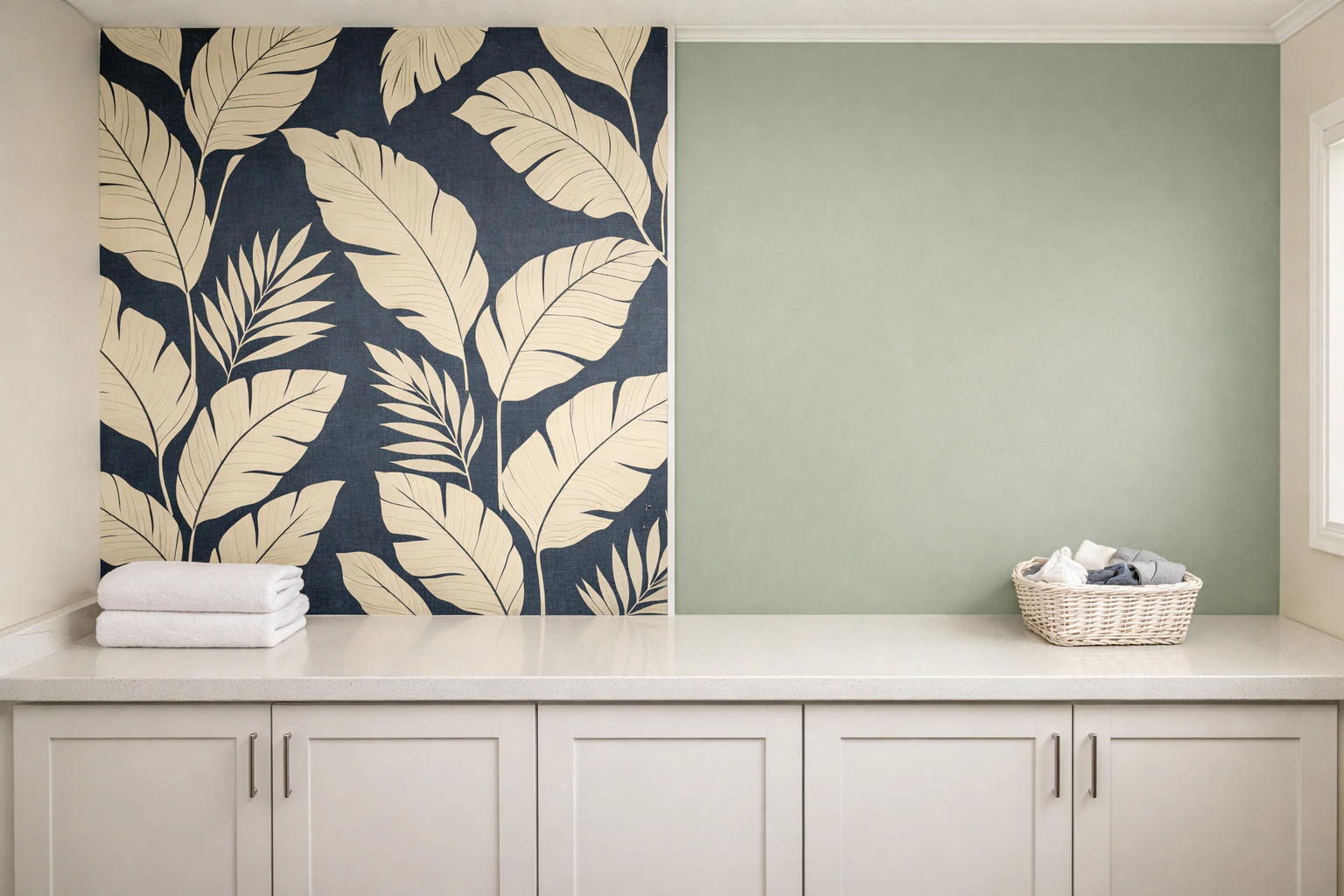
Updated July 2026. Prices reflect US market costs from Amazon, Tempaper, NuWallpaper, Zinsser and Behr. All comparisons based on a typical 40 sq ft of accessible wall surface in a compact laundry room (the wall area not blocked by washer, dryer, cabinets or counter).
The most-ignored decorating room in the house
Laundry rooms are the room everyone has and almost nobody decorates. Bare drywall, builder-grade beige paint, mildew creeping up the corners by year four — that's the default in most American homes. But laundry walls have specific demands no other room shares: steam from the dryer vent, detergent and bleach splatter, lint that floats and lands, humidity that peaks at 70%+ during wash cycles. The right wall material has to handle all of that AND look like someone made a choice.
The short version: peel-and-stick wallpaper at $80 turns the most-ignored room in your house into a Pinterest moment — bold pattern in a small room reads as intentional design, the cost is low because the room is small, and the install is 90 minutes. Mold-resistant paint at $30 wipes detergent splash clean, survives the dryer-vent humidity that destroys regular paint, and lasts 5-7 years — but the room reads as "a laundry room" rather than "a designed laundry room." The decision is mostly about how much chemical splash the walls actually take and whether the design statement matters to you.
Below: side-by-side table, when each one wins, the steam-and-dryer-vent humidity problem that decides it for poorly-vented laundries, the detergent and bleach splash factor unique to this room, the zone-based hybrid recipe that gets both benefits, and FAQs.
Side-by-side comparison
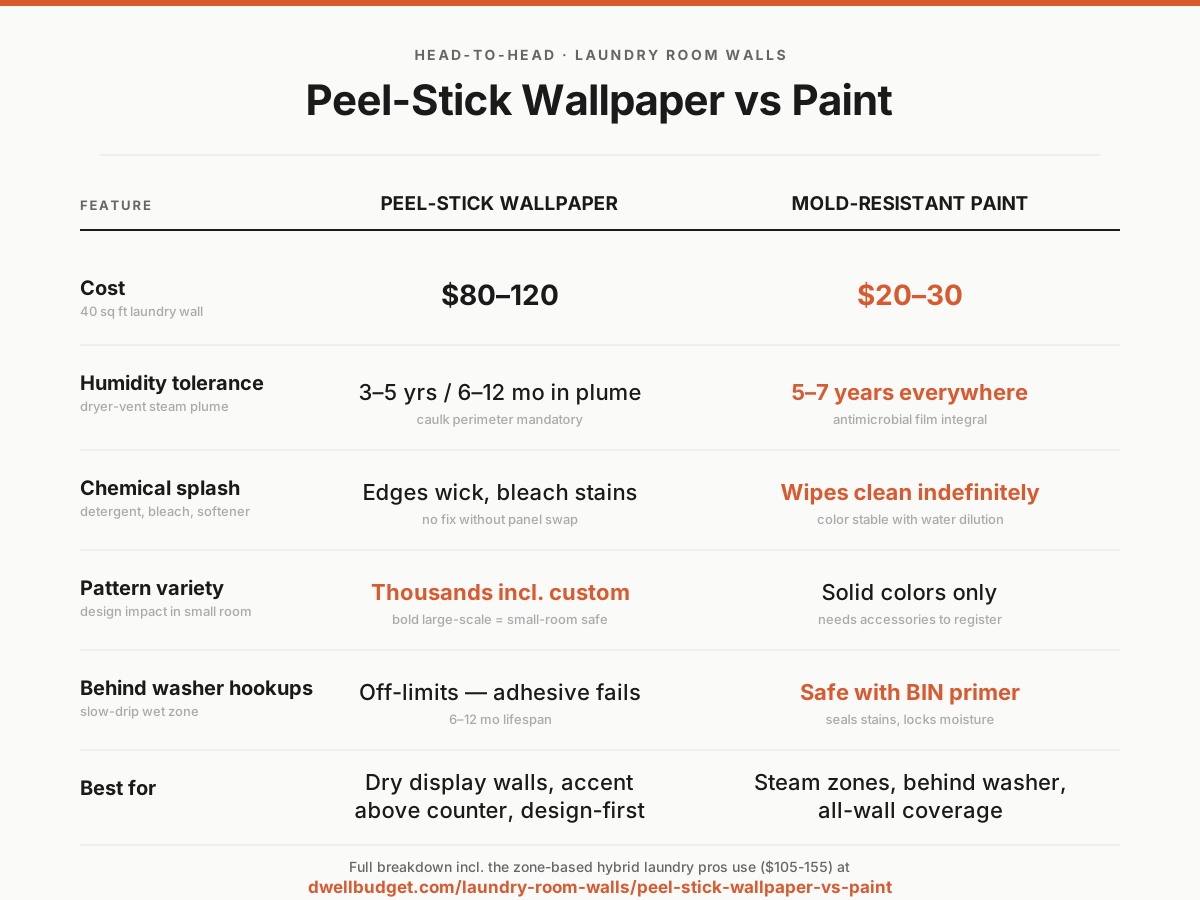
| Peel-and-stick wallpaper | Mold-resistant eggshell paint | |
|---|---|---|
| Cost (40 sq ft laundry wall) | $80–120 (1 roll covers a small laundry) | $20–30 (quart + roller + tape) |
| Install time | 90 min | 2–3 hrs incl. prep + 4 hr cure |
| Humidity tolerance | 3–5 yrs outside steam zone; 6–12 mo in plume | 5–7 yrs everywhere with mold-resistant grade |
| Detergent splash | Edges wick liquid — dark spots | Wipes clean indefinitely |
| Bleach splash | Permanent lightened spots on pattern | Color stable with quick water wipe |
| Lint accumulation | Slightly textured — holds more lint | Smooth — sheds lint with light dusting |
| Pattern variety | Thousands incl. custom Spoonflower | Solid colors only |
| Behind washer hookups | Off-limits — slow drip kills adhesive | Safe with Zinsser BIN primer beneath |
| Renter-safe? | Yes — clean removal from cured paint | Yes — paint over on move-out |
| Best for | Dry display walls, accent above counter | Steam zones, behind washer, all-wall coverage |
When to pick peel-and-stick wallpaper
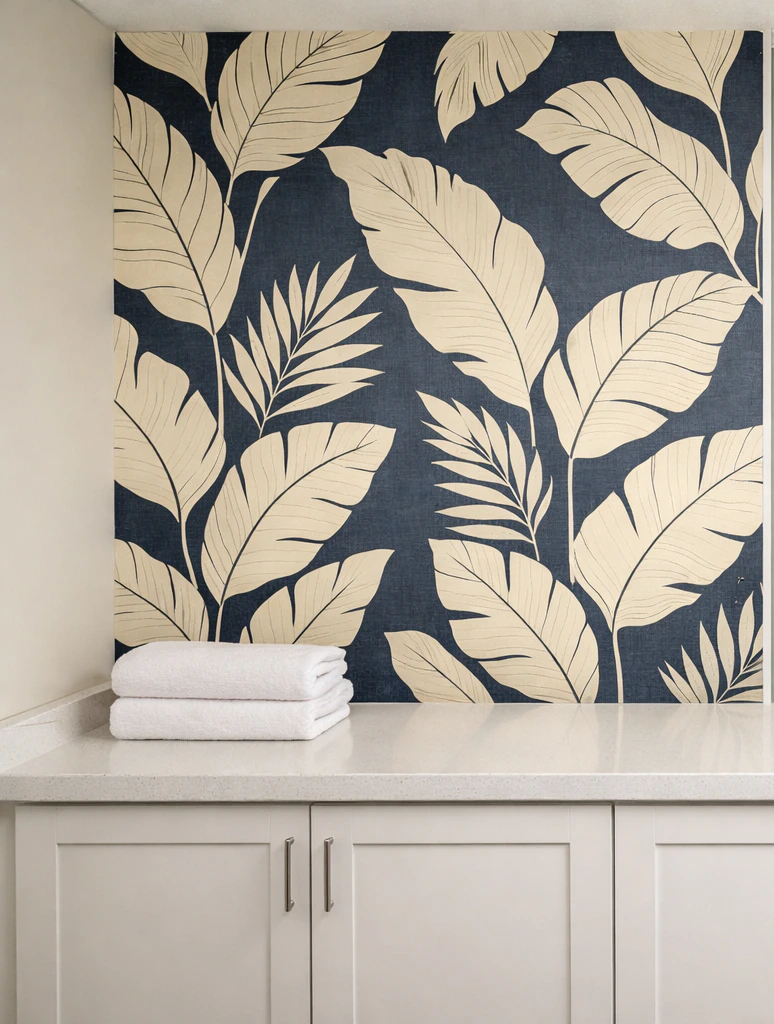
Pick peel-and-stick wallpaper if at least three of these are true:
- The wall you want to wallpaper is opposite the washer/dryer (out of the direct steam plume)
- You rent or want a reversible accent without committing to a permanent finish
- Your design voice leans pattern-rich and the rest of the house already has bold accents
- You want the laundry to feel like a designed room, not a utility closet
- You're committing to one accent wall only (not wallpapering all four walls)
Removable wallpaper from Tempaper, NuWallpaper, or custom-printed Spoonflower at $80-120 covers a typical 40 sq ft laundry accent wall plus 90 minutes of install. Because laundry rooms are small, a single wallpaper roll usually covers the whole accent zone with material left over — the cost-per-impact ratio is the highest in any room of the house.
The under-discussed advantage is pattern-scale economics in small rooms. In a 30-40 sq ft laundry, bold large-scale patterns (motif repeats over 6 inches) read as intentional design statement; small fussy patterns make a tight space feel chaotic. Large botanicals, oversized geometric shapes, big graphic florals all work because the eye can take in 1-2 complete motif repeats per wall — proportional and calming. The room reads "designed" instead of "wallpapered."
What you give up: complete unsuitability for the wall behind washer hookups (slow drips from hose connections kill adhesive within months), edge-lift risk in dryer-vent steam plume (silicone-caulk perimeter mandatory for any wall within 3 ft of the vent), permanent damage from bleach splash (lightened spots on the pattern that can't be cleaned out), and 1-3 year pattern fatigue on bold prints if the room is on the main floor where you see it daily.
When to pick mold-resistant paint
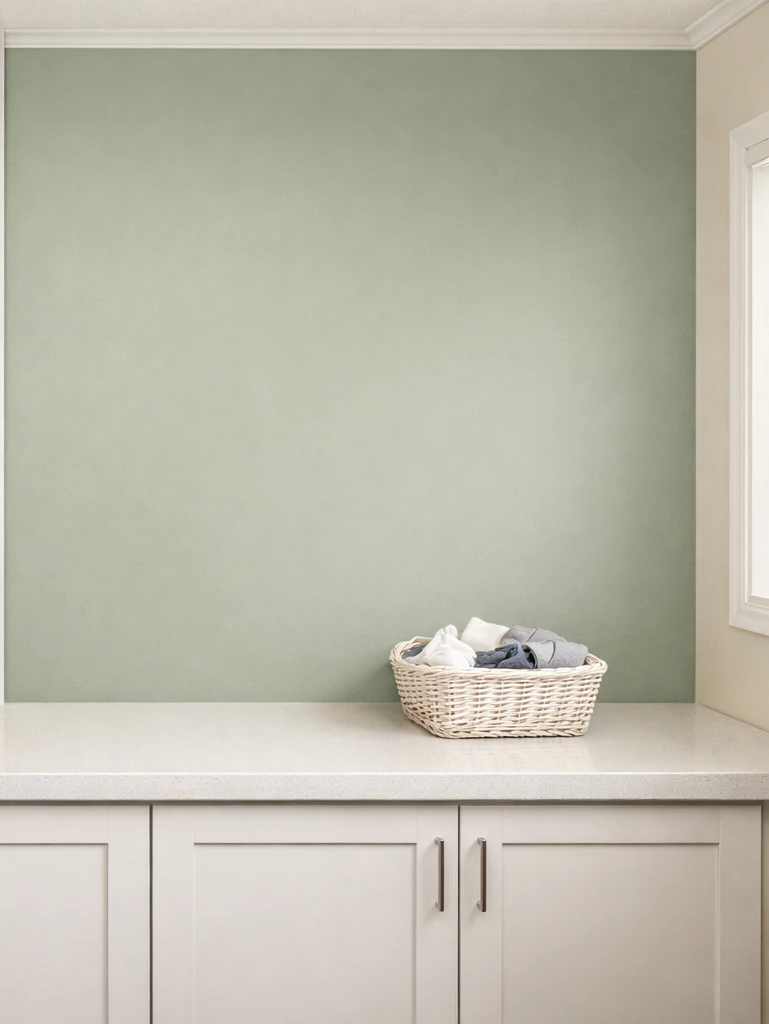
Pick mold-resistant paint if at least three of these are true:
- Your laundry has a dryer vent that runs through the room (or vents internally) — humidity is constant
- You do high-volume laundry — frequent detergent, bleach, fabric-softener splash on walls
- You want the wall behind washer hookups covered with the same material as the rest
- You own the home and plan to stay 5+ years (mold-resistant paint lasts 5-7 years vs wallpaper's 3-5)
- Your design voice leans minimal, clean, or year-round consistent
Mold-resistant paint from Zinsser PermaWhite or KILZ Restoration at $30-40 per gallon (covers a small laundry plus the cabinet trim with paint left over) plus a roller, tray, and painter's tape lands at $20-30 total per wall. The antimicrobial agents are integrated into the paint film, not a topcoat — they survive scrubbing and laundry-chemical splash without releasing.
The two big advantages over wallpaper in laundries specifically: chemical splash resistance (eggshell wipes clean of detergent, fabric softener, bleach splash; wallpaper edges wick liquid and stain permanently) and steam-zone safety (paint works on every wall including behind the washer hookups when paired with a Zinsser BIN shellac primer underneath; wallpaper is off-limits on at least one wall per laundry).
The reliable Zoom-friendly... wait, wrong room. The reliable laundry-friendly mid-tone picks that work in low-light or windowless laundries: Sherwin-Williams Sea Salt (soft sage), Benjamin Moore Pale Smoke (warm grey), Behr Silver City (light grey with warmth). Skip pure white (looks clinical), pure black (absorbs the limited light), and saturated brights (compete with detergent bottle colors on the counter).
What you give up: 3-5 second design-recognition delay (paint reads as "they painted it" rather than wallpaper's instant "they decorated it"), requires accessory styling (white wicker basket, ceramic vase, framed botanical print) to register as intentional, 4-hour cure time between coats, and the pattern-rich aesthetic wallpaper delivers natively.
The steam and dryer-vent humidity problem
This is the laundry-specific factor that decides the wallpaper-vs-paint question for households with poorly-vented dryers, internal vent runs, or condensation-prone laundries.
The humidity profile. Laundry rooms typically run 40-50% relative humidity at rest, spike to 60-75% during washer cycles, and peak at 75-85% during dryer cycles if the vent isn't running perfectly to the outside. Older homes with internal dryer vent runs, blocked outside vents, or vents that exit into attics often hit 90%+ RH for 30-60 minutes per dryer load — that's bathroom-shower-room humidity, sustained.
Paint behavior in this profile. Mold-resistant paint with eggshell or semi-gloss finish handles 75% peak RH indefinitely. The antimicrobial agents in Zinsser PermaWhite and KILZ Restoration are formulated for exactly this humidity range and prevent mildew bloom on the paint film even with daily cycling. Regular interior paint develops mildew spots in corners and along the ceiling line within 2-3 years; mold-resistant grades triple that to 5-7 years.
Wallpaper behavior in this profile. Modern non-woven matte peel-stick handles ambient laundry humidity (60-70% RH range) on walls outside the direct dryer-vent steam plume for 3-5 years with no issues. Within the direct steam plume (the wall the vent points at, or any wall sharing a corner with an internal vent run), edges lift in 6-12 months regardless of brand. The mandatory mitigation: clear silicone caulk along all wallpaper edges on install day — top, bottom, sides. The caulk seals the adhesive line against humidity penetration and roughly triples wallpaper lifespan in steam-adjacent positions.
The decision rule: if your dryer vents through any interior wall or has known vent issues, paint is the safer-by-design choice for the entire room. If your dryer vents cleanly to the outside through a short exterior wall run, wallpaper works fine on walls outside the immediate steam plume with the perimeter-caulk install discipline.
Detergent, bleach and fabric softener splash
The second laundry-specific factor that no other wall comparison has to address: chemical splash from the products you're using in the room.
The splash zone. Detergent and fabric softener splatter happens during pouring, measuring, and top-loader use; bleach splash happens during direct-pour into the dispenser; spot-treatment sprays land on walls near the folding counter. The splash zone is roughly the wall area within arm's reach of the washer top, the detergent shelf, and the folding counter — usually the bottom half of one or two walls.
Paint splash behavior. Eggshell or semi-gloss mold-resistant paint handles detergent and fabric softener splash with a damp-cloth wipe within hours of the splash — no residue, no staining, no color shift. Bleach splash on painted walls needs immediate water dilution (within 30 seconds) to prevent the paint film from breaking down at the contact point; with that quick wipe, color stays stable for the paint's full lifespan.
Wallpaper splash behavior. The plastic-coated pattern surface wipes clean from detergent splash on first contact, but the seams between panels and the wallpaper-to-wall edges wick liquid into the substrate, creating dark stain rings around the splash point that don't fully dry out and become visible mildew over weeks. Bleach splash on wallpaper almost always lightens the pattern permanently within the contact zone — there's no fix short of replacing the panel.
The implication: for the wall directly behind or beside the washer where splash is daily-routine, paint is the more forgiving long-term choice. For walls 3+ ft from the washer (the wall you face when loading, the wall above the folding counter), wallpaper is safe from splash and the splash-resistance argument doesn't apply.
The zone-based hybrid laundry pros use
The under-discussed third option that combines wallpaper's design impact with paint's chemical resilience by treating different walls of the laundry differently based on their function and proximity to splash/steam.
The recipe:
- The wall behind washer hookups + the steam-plume wall — mold-resistant eggshell paint with Zinsser BIN primer beneath. Handles slow-drip moisture, dryer-vent humidity, and the bleach/detergent direct-splash zone. Pick a quiet mid-tone (sage, warm grey, pale blue) that complements the wallpaper accent.
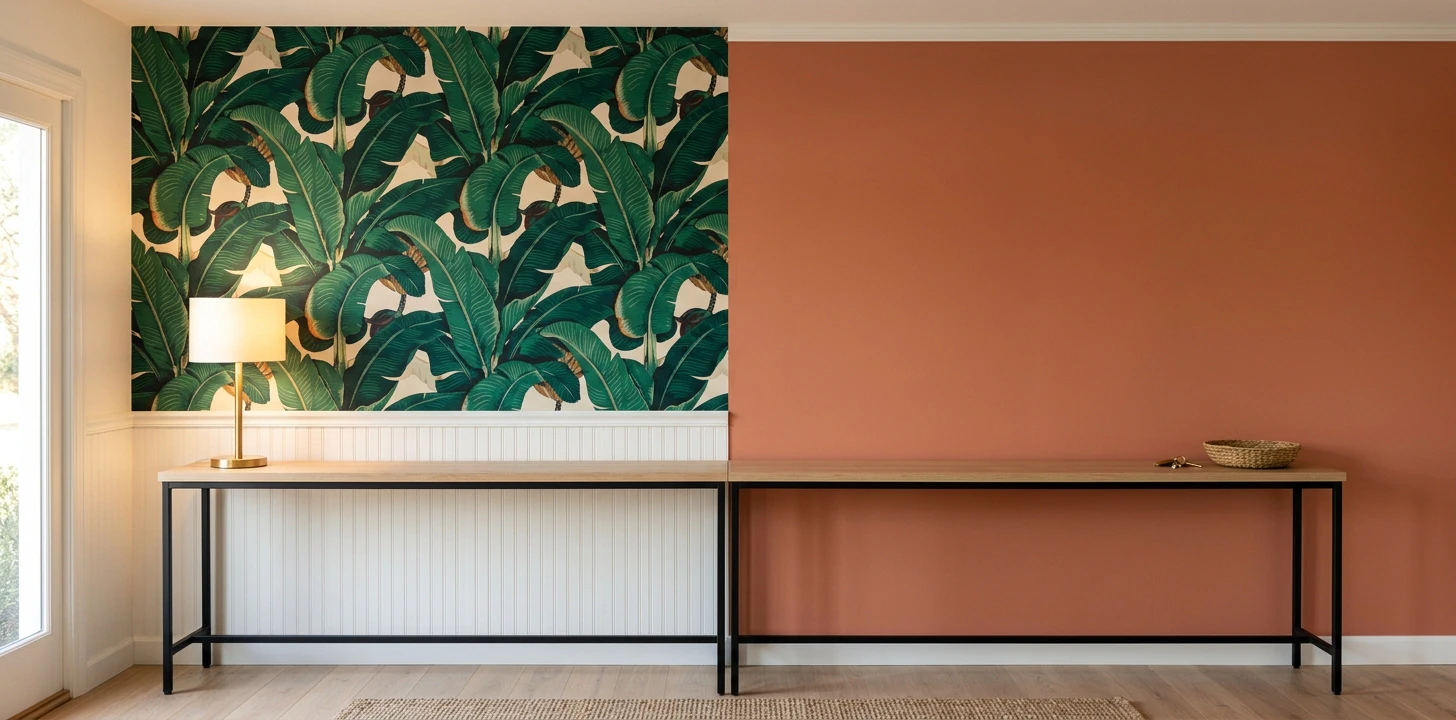
- The wall opposite the washer (the wall you face when loading) — bold peel-and-stick wallpaper as the accent. This is the wall most visible from the laundry doorway, and it's outside both the splash and steam zones. Maximum design impact, minimum risk.
- Side walls and behind cabinetry — same mold-resistant paint as the steam wall, so the wallpapered accent reads as one intentional choice rather than competing patterns.
The math: $25-35 paint for the painted walls + $80-120 wallpaper for the accent wall = $105-155 total for a complete laundry refresh. Compare to $300-400 for full PVC beadboard wainscoting + $30 paint above, or $40-50 for plain paint everywhere. The hybrid sits in the middle on cost but delivers the design impact of the more-expensive wainscot approach without permanent install.
The aesthetic logic: when you walk into the laundry to load a wash, your eye lands on the wall facing you — that's where the wallpaper does the work. The painted walls in your peripheral vision (the wall the washer's against, the side walls) read as quiet background. The whole room registers as "designed laundry" because the focal wall is wallpapered, even though 75% of the wall surface is just paint.
The short verdict
Pick peel-and-stick wallpaper for the wall opposite the washer (the wall you face when loading), if you rent or want a reversible accent, your dryer vents cleanly to the outside, and your design voice leans pattern-rich. Bold large-scale patterns work best in compact laundries. Pick mold-resistant paint for the wall behind washer hookups, any wall in the dryer-vent steam plume, splash-zone walls within arm's reach of the washer, and any all-wall coverage approach. Zinsser PermaWhite or KILZ Restoration in eggshell or semi-gloss is the reliable spec. For most laundry rooms with budget under $200, do the zone-based hybrid — paint the steam and splash walls, wallpaper the focal wall opposite the washer — for $105-155 total and the designed-laundry-room result that single-material approaches can't deliver.
Comparing more laundry room wall options? The full laundry room walls guide also covers PVC beadboard wainscoting (the durable upgrade for laundries with damaged drywall behind the washer), peel-and-stick subway tile (the renter compromise for backsplash-style coverage), and metal pegboard storage (the function-multiplier that turns the laundry from appliance closet into utility space).
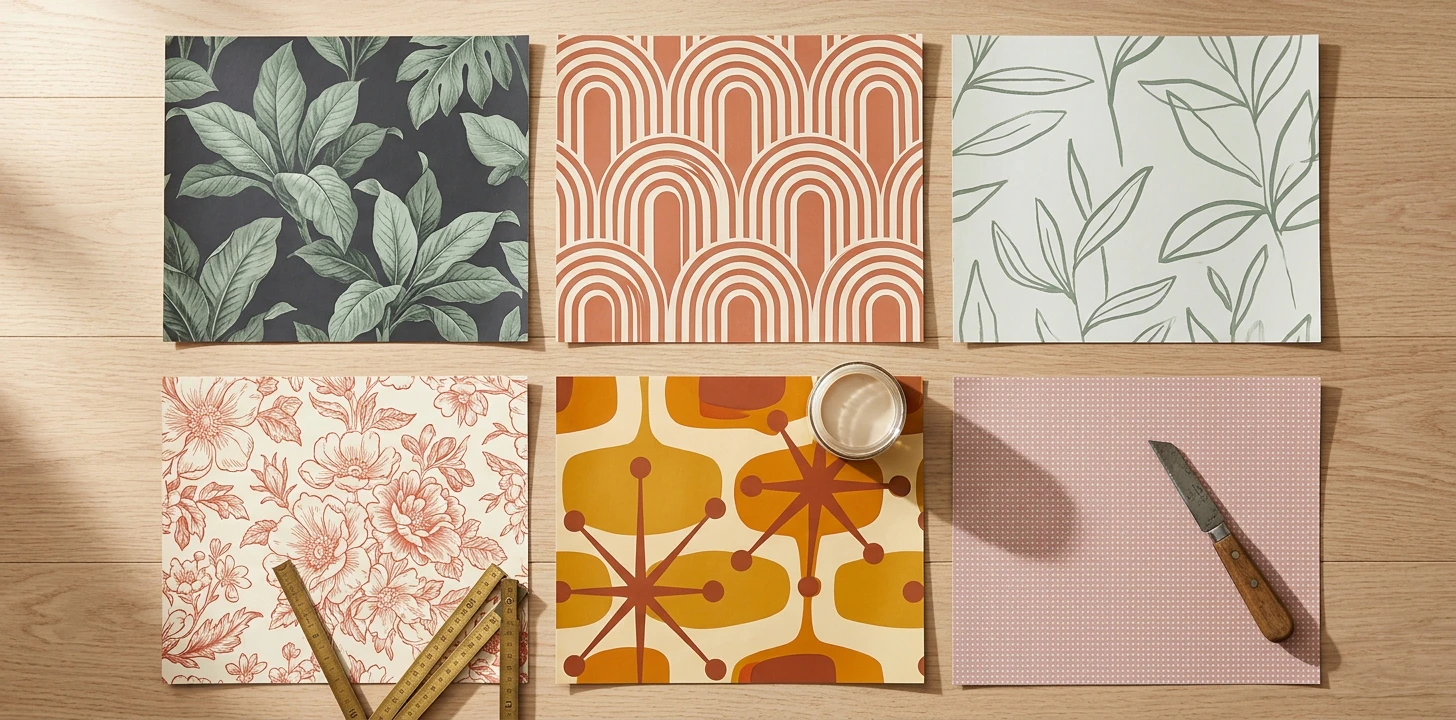 11 Best Peel-Stick Wallpaper Brands
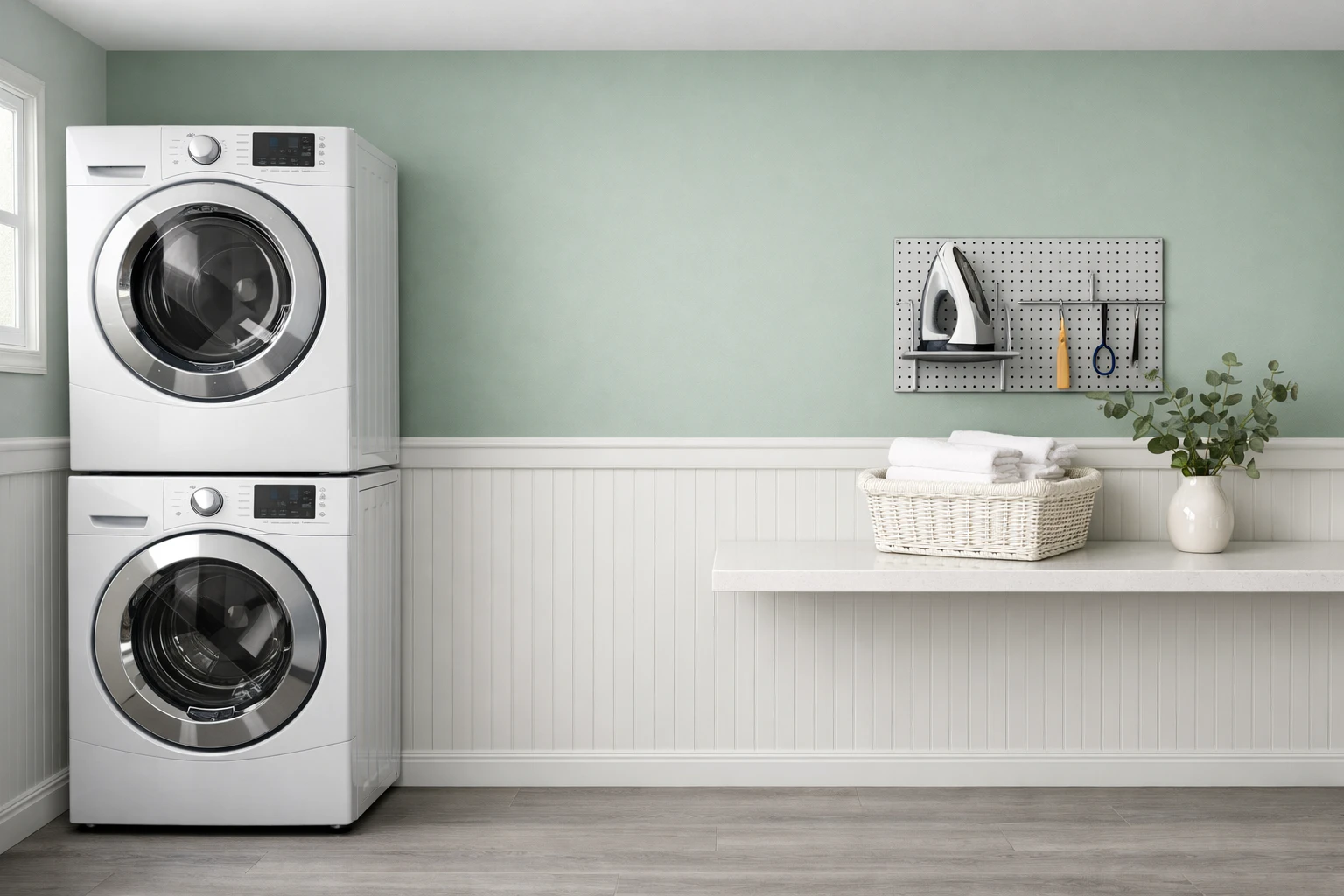 Full laundry room walls guide
 Laundry Room Floor: LVP vs Epoxy
 Bathroom Walls: Wallpaper vs Tile Stickers
 Entryway Walls: Wallpaper vs Paint