Updated July 2026. Prices reflect US market installed costs from Home Depot, Lowe's, Trex direct, TimberTech, and Wolf Serenity. All comparisons based on a typical 250 sq ft residential deck (the size where the material cost difference and 25-50 year warranty math actually compounds).
Two premium synthetic decking options, very different feel underfoot
Composite and PVC are the two real choices for premium synthetic decking — both come in wood-look colors, both install with hidden fasteners, both carry 25-50 year warranties, both cost 2-3× pressure-treated lumber. From across the yard they look almost identical. But underfoot in July heat, against a spilled glass of red wine, after 15 years of salt-air coastal exposure — the two materials perform differently in ways that decide the choice for most homeowners.
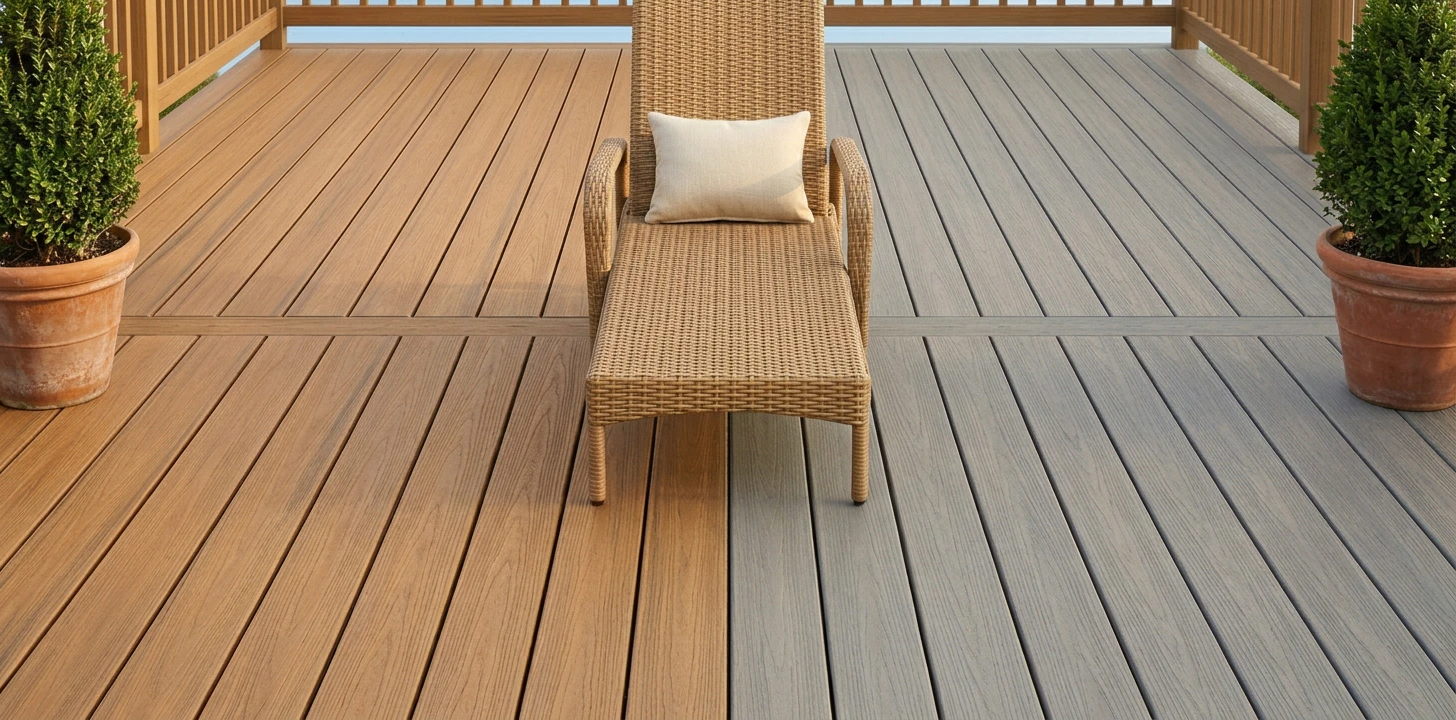
The short version: composite at $7-12 per sq ft installed gets you the more realistic wood-fiber surface at lower cost — the right answer for shaded decks, inland climates, and budgets that prioritize square-footage maximization. PVC at $10-15 per sq ft installed stays 20-30°F cooler underfoot, is nearly stain-proof, handles coastal salt-air, and carries 50-year warranties — the right answer for sun-baked decks, coastal locations, outdoor dining hubs, and long-term ownership where the upfront premium pays back over a 20+ year horizon.
Below: side-by-side table, when each one wins, the bare-feet heat physics that decides for sun-exposed decks, stain resistance and outdoor dining, the coastal salt-air decision filter, the composite-field-plus-PVC-railings hybrid pattern designers use on premium projects, and FAQs.
Side-by-side comparison
| Composite decking | PVC (capped polymer) decking | |
|---|---|---|
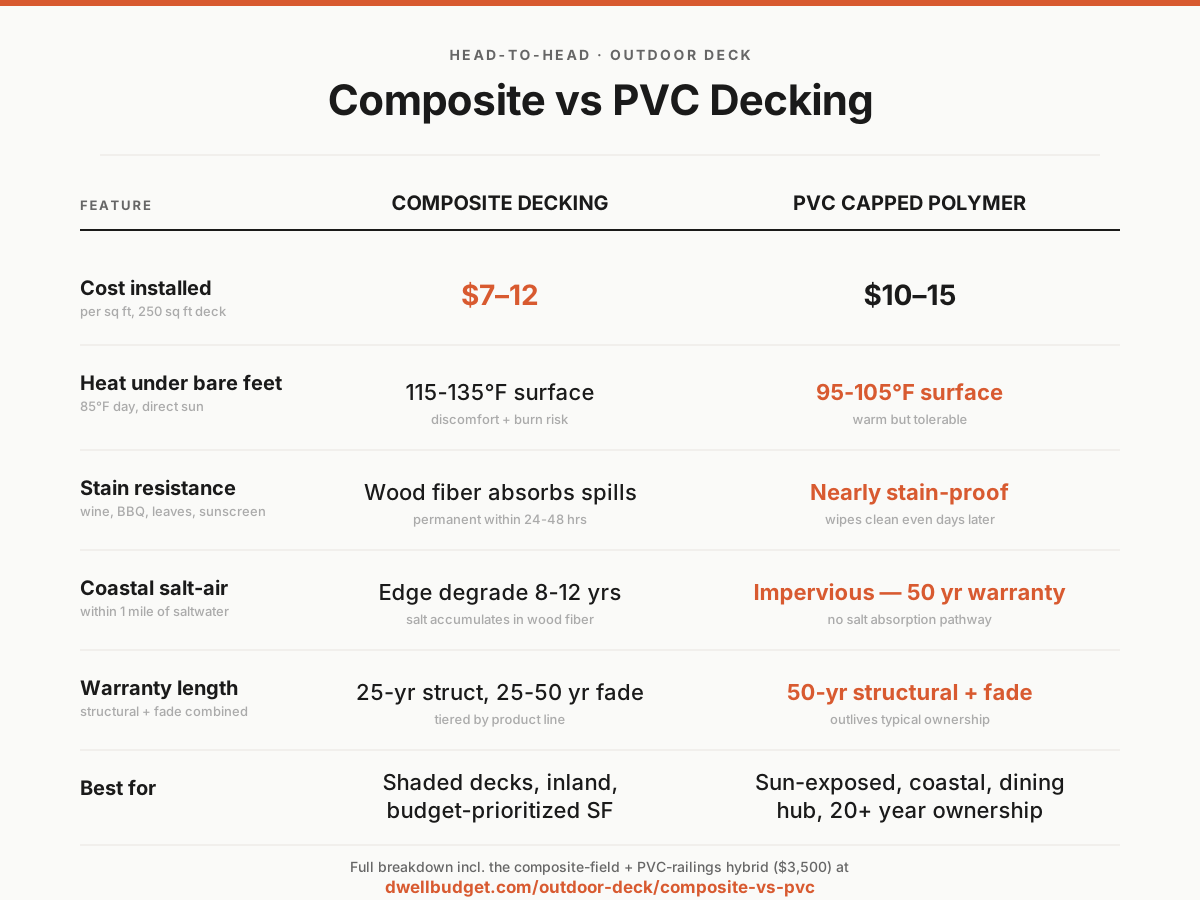
| Cost installed (per sq ft) | $7–12 | $10–15 |
| 250 sq ft deck total | $1,750–3,000 | $2,500–3,750 |
| Heat retention (85°F day, direct sun) | 115–135°F surface (uncomfortable / burn risk) | 95–105°F surface (warm but tolerable) |
| Stain resistance | Wood fiber absorbs liquid spills | Nearly stain-proof — wipes clean |
| Coastal salt-air performance | Edge degradation in 8-12 yrs near coast | Impervious — no salt absorption |
| Lifespan / warranty | 25-yr structural, 25-50 yr fade | 50-yr structural + fade combined |
| Color fade over 15 yrs | 10-15% fade in direct sun | 5% or less fade |
| Aesthetic at close range | More realistic wood-look (slight edge) | Slightly more synthetic look |
| Weight per board | ~10 lb (heavier handling) | ~7 lb (easier handling) |
| Best for | Shaded decks, inland, budget-prioritized SF | Sun-exposed, coastal, dining hub, 20+ yr ownership |
When to pick composite
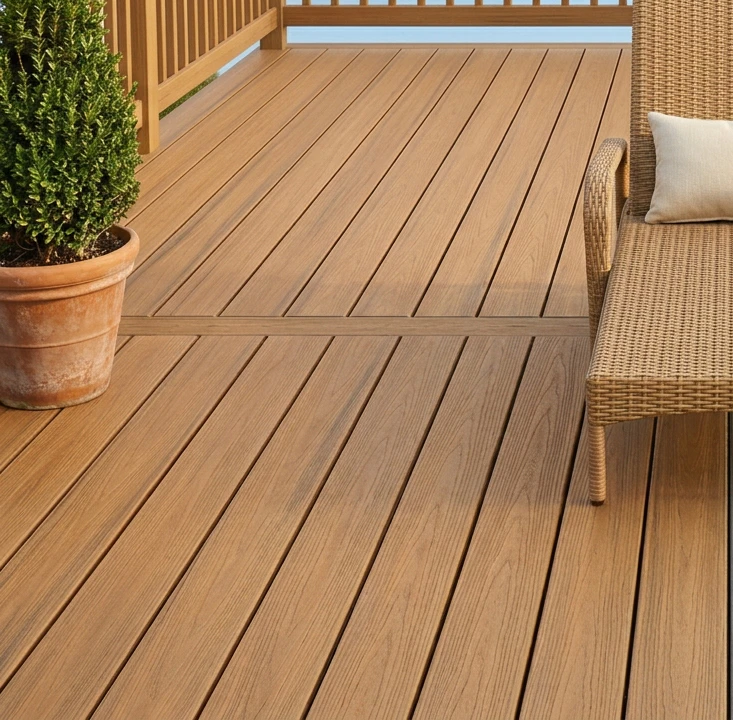
Pick composite if at least three of these are true:
- Your deck is in a shaded or partially-shaded location (under a pergola, tree canopy, or building shadow)
- You're 2+ miles inland from saltwater coast — no salt-air concerns
- Your budget prioritizes maximum square footage at lowest material cost
- You wear shoes outdoors and bare-foot heat is not a daily concern
- You value the more realistic wood-fiber surface authenticity at close range
Composite decking from Trex Transcend, TimberTech Edge, or Fiberon Sanctuary at $7-12 per sq ft installed hits $1,750-3,000 for a typical 250 sq ft deck. Install is moderate-difficulty DIY for those with framing experience: composite uses hidden fasteners that clip between boards, attaching to the joist below — cleaner than face-screwing but requires precise joist spacing.
The under-discussed advantage is close-range aesthetic authenticity. Composite has actual wood fiber in the surface mix (30-50% wood content), which gives the surface a slight natural grain variation that PVC's printed wood-look can't quite match at 2-foot inspection range. For homeowners who entertain with friends sitting on or kneeling near the deck (kids playing, planting in deck pots, intimate dinners), the surface authenticity reads more "real wood" than PVC alternatives.
What you give up: 30-50°F hotter surface in direct summer sun (bare-foot use becomes uncomfortable to dangerous), stain absorption from food/wine/leaves (composite's wood content absorbs spills that PVC wipes clean), weaker coastal salt-air resistance (composite degrades in 8-12 years near saltwater vs 20-25 years inland), and the 25-year vs 50-year warranty gap for owners staying 20+ years in the home.
When to pick PVC
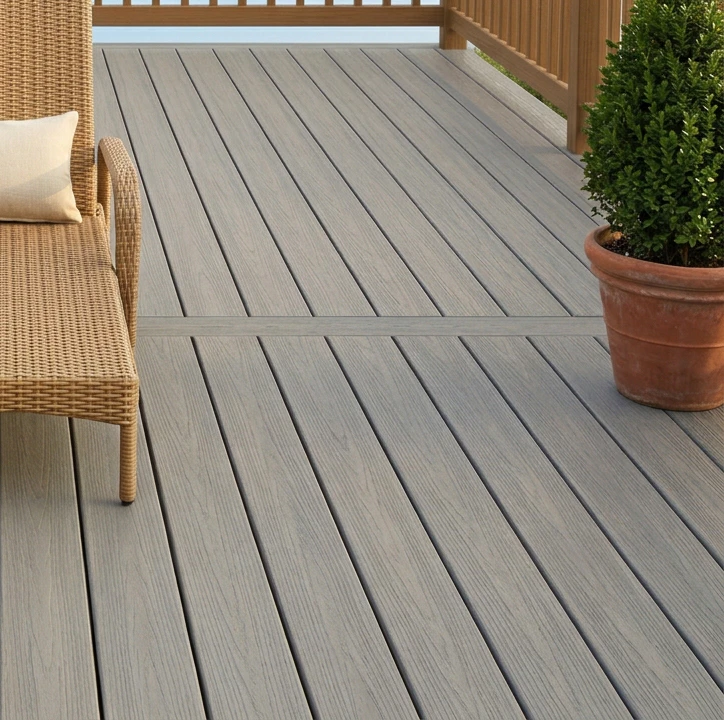
Pick PVC if at least three of these are true:
- Your deck is in direct afternoon sun and bare-foot use matters (kids, pool deck, dining barefoot)
- You live within 1 mile of saltwater coast — salt-air degradation makes PVC the only durable choice
- Your deck is the outdoor dining or entertaining hub — frequent food/drink spills
- You own the home long-term (20+ years where the 50-year warranty plays out)
- Budget can absorb the 30-50% premium ($2,500-3,750 vs $1,750-3,000 for 250 sq ft)
PVC capped polymer decking from TimberTech AZEK, Wolf Serenity, or Deckorators Voyage at $10-15 per sq ft installed hits $2,500-3,750 for a typical 250 sq ft deck. Install is similar to composite (hidden fasteners + joist spacing), slightly easier due to lighter board weight (~7 lb PVC vs ~10 lb composite per board).
The biggest practical argument is heat under bare feet. Composite holds heat 30-50°F above ambient in direct sun (an 85°F day = 115-135°F deck surface — burn risk on 30+ second contact). PVC holds heat only 10-20°F above ambient (same day = 95-105°F — uncomfortable but tolerable). For families with kids who run across the deck barefoot or pool decks where wet bare feet hit hot surfaces, PVC is the meaningfully safer-by-design choice. The physics: composite's wood fiber absorbs solar infrared; PVC's pure polymer with reflective surface treatment minimizes IR absorption.
The second under-discussed argument is coastal salt-air resilience. PVC has no wood content and no salt absorption pathway — Florida, Carolinas, Gulf Coast, Pacific Northwest coastal installations show PVC hitting full 50-year warranty period with zero salt degradation. Composite in the same locations shows edge degradation, color shift, and structural softening in 8-12 years. For coastal homes, PVC isn't a premium upgrade — it's the only material that hits expected lifespan.
What you give up: 30-50% higher upfront cost ($750-1,500 budget gap for 250 sq ft deck), slightly more synthetic aesthetic at close range (gap is ~15-20% in 2026 PVC products vs 40-50% in 2015-era products — modern PVC is much improved), and marginally less wood-look authenticity that purists who inspect every board at 2 ft will notice.
The bare-feet heat physics
This is the deck-specific factor that decides the question for many families and the one composite manufacturers rarely volunteer in their sales material.
The physics: all dark surfaces absorb solar infrared (IR) radiation and re-radiate it as heat. Surface temperature depends on three factors: absorption rate (how much IR the material soaks up), thermal mass (how long it retains the heat once absorbed), and surface reflectivity (whether the surface bounces IR or absorbs it). Composite has 30-50% wood fiber content; wood absorbs IR readily and retains it (high thermal mass + high absorption). PVC is pure polymer with a surface treatment that reflects more IR than composite absorbs.
The typical numbers (manufacturer heat-test data and trade-press measurements consistently show this pattern at ~85°F ambient in direct sun):
- Pressure-treated lumber: 105-115°F surface (5-15°F above ambient — wood breathes/transpires)
- Composite decking: 115-135°F surface (30-50°F above ambient — worst-case material)
- PVC capped polymer: 95-105°F surface (10-20°F above ambient — best of the synthetics)
- Aluminum decking: 130-150°F surface (worst of all common materials — avoid for bare-foot use)
The skin-contact threshold: bare skin tolerates ~120°F for 1-2 seconds before discomfort registers and ~140°F for 30+ seconds before burn risk becomes real. Composite at 115-135°F sits right at the discomfort threshold; PVC at 95-105°F stays well below.
The decision rule by deck location:
- Direct sun all afternoon (west-facing, south-facing in northern hemisphere): PVC essentially mandatory for bare-foot use. Composite causes daily discomfort and is unsafe for kids/toddlers.
- Morning sun only (east-facing): composite is fine — surface cools by mid-afternoon when peak use happens.
- Shaded by pergola, trees, or building: composite is fine — surface stays close to ambient.
- Pool deck adjacent: PVC mandatory (wet bare feet hitting hot composite is a burn risk).
Stain resistance and outdoor dining
The factor that decides for homes that actually USE the deck for entertaining — and the one composite owners regret most after their second summer.
Composite stain failure modes: red wine, BBQ sauce, ketchup, mustard, salad dressing, vinegar-based marinades, oil from grills, sunscreen (the bigger one — sunscreen oil + UV chemistry creates permanent yellow stains within 4-6 hours of contact), and the worst category — leaf tannins. Fallen oak, maple, and walnut leaves left on composite for 2-3 weeks in autumn leave brown spots that don't come out with any cleaner.
PVC stain behavior: the same spills wipe off with damp cloth + dish soap, even if left on the surface for days. No wood fiber to absorb liquids; the polymer-cap surface is essentially impervious. The only thing that stains PVC is colored caulk or marker — accidental industrial chemistry. For normal residential dining and entertaining, PVC is functionally stain-proof.
The cleaning math: composite deck after 3 years of entertaining = noticeable concentrated stain spots near grill, dining table, lounge chairs (where drinks sit). PVC deck after same 3 years = same surface as install day, looks brand new. The aesthetic difference becomes obvious in listing photos at resale and during weekly hosting.
Coastal salt-air decision
The location-specific factor that converts the composite-vs-PVC comparison from an aesthetic decision into a structural-longevity requirement.
The salt-air degradation mechanism: coastal air carries salt mist that lands on outdoor surfaces. On composite decking, the salt migrates into the plastic-encapsulated wood fiber through micro-fractures and surface wear. Over years, salt accumulates in the wood layer, accelerating decomposition. Plastic encapsulation slows but doesn't prevent this — the wood content is the failure pathway.
Real-world coastal performance:
- Composite within 0-0.5 mi of saltwater: 6-10 year lifespan before visible edge degradation and structural soft spots
- Composite 0.5-1 mi inland: 8-12 year lifespan
- Composite 1-2 mi inland: 15-20 year lifespan (close to inland warranty range)
- PVC at any coastal distance: full 50-year warranty period — no salt-degradation pathway exists
The cost-per-year math for coastal homes: composite at $7-12/sq ft × 250 sq ft = $1,750-3,000 ÷ 8 years = $220-375/year. PVC at $10-15/sq ft × 250 sq ft = $2,500-3,750 ÷ 50 years = $50-75/year. PVC is 4-7× cheaper per year of ownership in coastal locations. The 30-50% upfront premium isn't a premium at all — it's a discount over 20+ year coastal ownership.
The decision rule: if you can smell saltwater from your deck, PVC isn't a choice — it's the requirement that hits expected deck lifespan. Composite within 1 mile of coast is functionally a 10-year disposable material.
The composite-field + PVC-railings hybrid
The combined approach professional deck designers actually use on premium residential projects — and the one that gets PVC's stain resistance and cool-touch where it matters most while keeping the composite material cost advantage across the bulk of square footage.
The recipe:
- Composite for the main deck field (the floor surface, 80-100% of deck square footage). Lower cost per sq ft, more realistic wood-look at viewing distance, perfectly fine for the surface that's mostly walked on in shoes.
- PVC for railings, stair treads, and food-prep zones (the high-touch, high-grip, high-spill surfaces). Railings touched daily by hands — PVC's cool-touch and stain resistance matter most here. Stair treads hit by wet bare feet from pool/sprinkler — PVC's heat-safe surface decisive. Food-prep zone (grill platform, table area) — PVC's stain-proof for the drink-spill compound.
- Match colors across both materials — TimberTech specifically sells composite and PVC in same color families (Pacific Rosewood, Coastline, Storm Grey) for this hybrid pattern. Wolf Serenity does the same with their Whisper line.
The math (250 sq ft deck with 60 linear ft of railing and 12 stair treads):
- Composite deck field: 250 sq ft × $8/sq ft = $2,000
- PVC railing: 60 linear ft × $15/linear ft = $900
- PVC stair treads: 12 × $50 each = $600
- Hybrid total: $3,500
- Compare: all-composite $2,500-3,000 (but stained railings within 2-3 years requiring upgrades anyway)
- Compare: all-PVC $3,750-4,500 (overkill on the deck field where heat/stain matter less)
The hybrid lands at the cost-per-year sweet spot AND delivers premium feel where touch matters daily. This is the pattern used by professional deck builders for premium clients but rarely communicated to DIY audiences because it requires ordering two material sets and managing color-matching.
The short verdict
Pick composite if your deck is shaded or partial-sun, you're 2+ miles inland from saltwater, your budget prioritizes maximum square footage, you wear shoes outdoors, or you value the more realistic close-range wood-look. Pick PVC if your deck gets direct afternoon sun and bare-foot use matters (kids, pool deck, dining barefoot), you live within 1 mile of saltwater coast, the deck is your entertaining hub (frequent food/drink spills), or you're staying 20+ years and want the 50-year warranty payoff. For premium deck projects with budget, do the hybrid — composite for the deck field + PVC for railings, stair treads, and food-prep zones — for $3,500 on a 250 sq ft deck that gets both materials' best properties where they matter most.
Comparing more outdoor deck options? The full outdoor deck guide also covers pressure-treated lumber (the budget option for inland decks), interlocking deck tiles (the renter shortcut for balconies and patios), and outdoor rugs (the no-install seasonal refresh). For the wood-vs-composite tier-down decision specifically, see the Pressure-Treated vs Composite comparison covering the budget-vs-premium synthetic choice.
 11 Best Deck Stain Brands 2026
 Full outdoor deck guide
 Outdoor Deck: Pressure-Treated vs Composite
 Outdoor Deck: Outdoor Rugs vs Deck Tiles
 Outdoor Walls: Cedar vs Composite