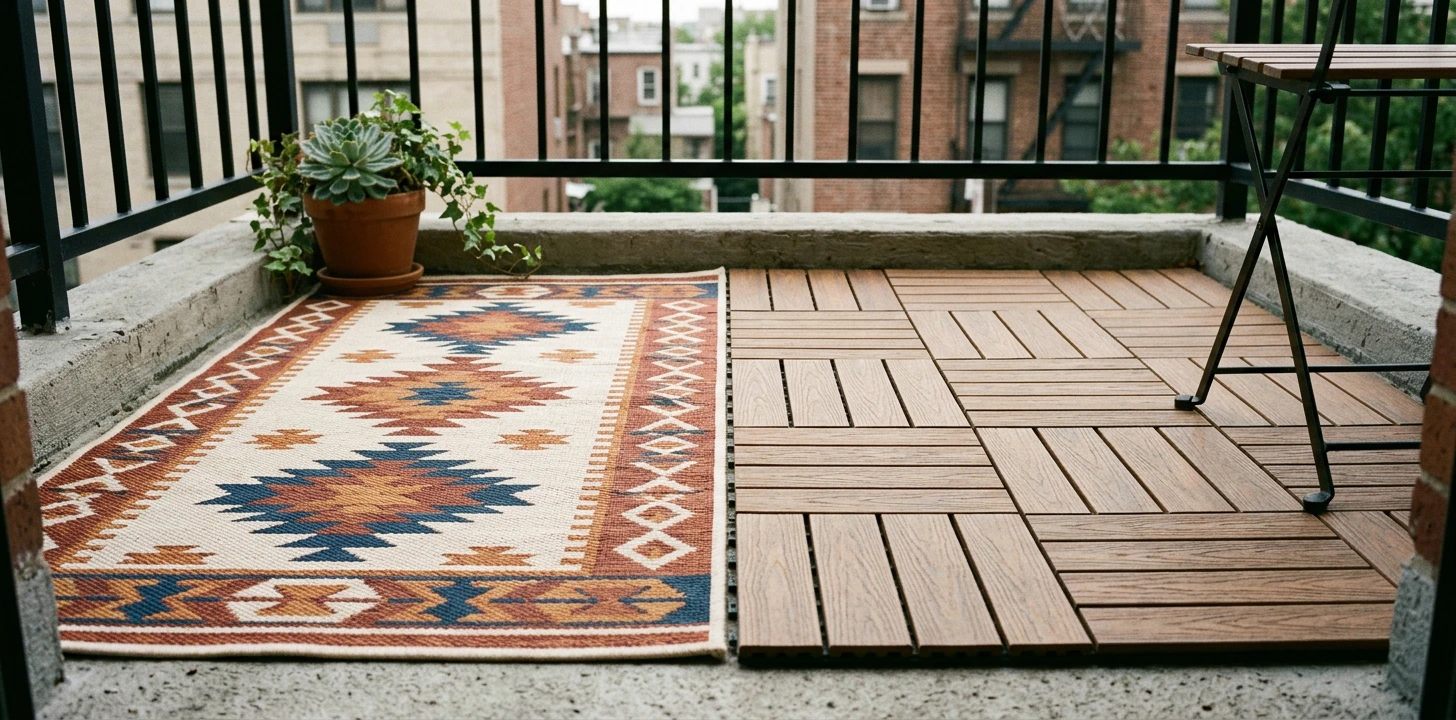
Updated July 2026. Prices reflect US market costs from Amazon, Home Depot and Wayfair. All comparisons based on a typical 50 sq ft urban apartment balcony — the realistic small-space situation most renters face.
The renter balcony refresh you can do today
Most apartment balconies are 30-60 sq ft of bare concrete that lets you down a little every time you step out. The good news — for renters who can't drill, paint, or permanently install anything, there are exactly two real options: outdoor rugs and interlocking deck tiles. Both go down without tools, both come up cleanly on move-out, both transform the visual feel of a balcony in under two hours.
The short version: outdoor rugs are $45 and roll out in 30 seconds — the absolute easiest balcony upgrade, and the right call for any small-space renter on a budget. Interlocking deck tiles are $150 and snap together in 2 hours — the lasting choice that solves rain drainage and survives 5-8 years instead of 2-3.
Below: side-by-side table, when each one wins, the rain-and-drainage problem that decides it for most balconies, the kids-and-pets question (rug softness vs hot tiles in summer sun), and FAQs.
Side-by-side comparison
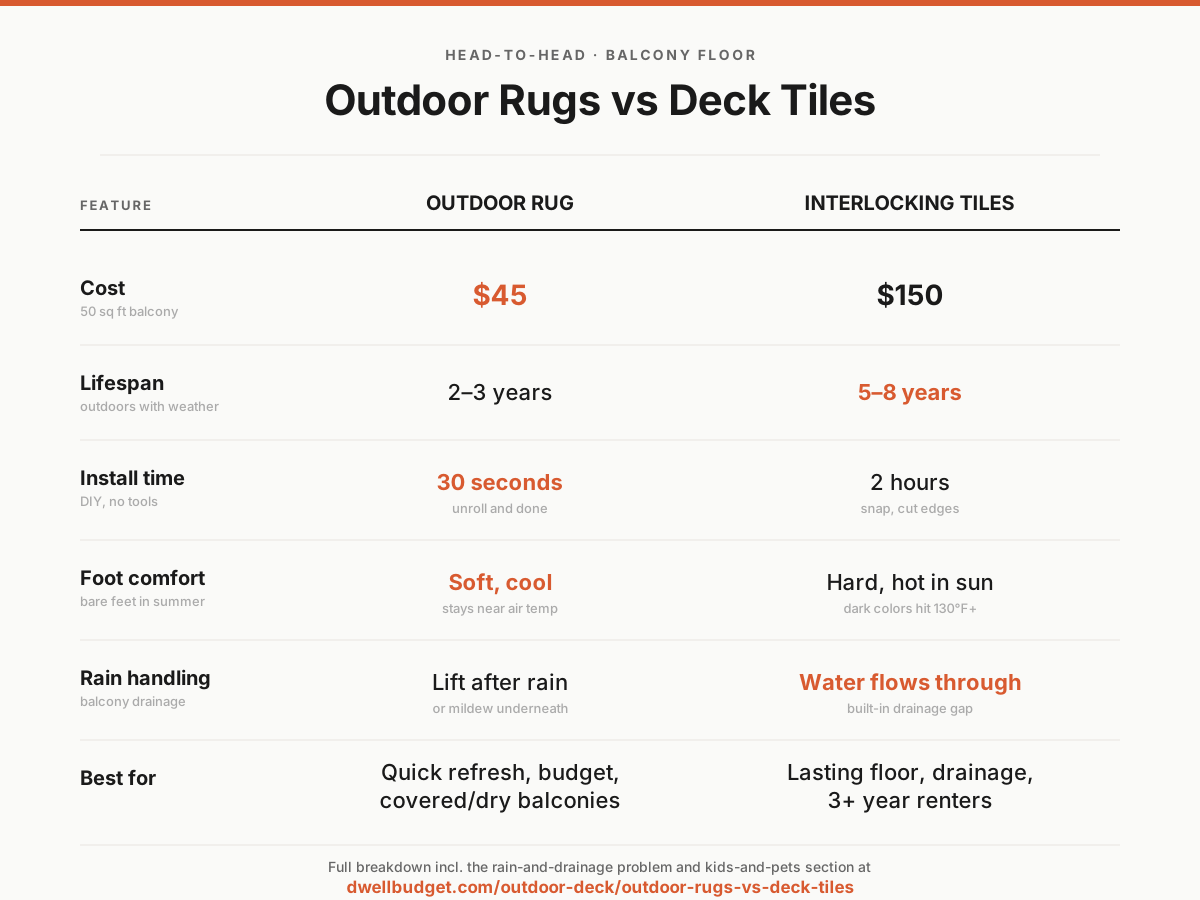
| Outdoor rug | Interlocking deck tiles | |
|---|---|---|
| Cost per sq ft | $1.20 (5×7 ft typical) | $3 (snap-together pieces) |
| 50 sq ft balcony total | ~$45 | ~$150 |
| Lifespan outdoors | 2–3 years (UV + weather) | 5–8 years |
| Install time | 30 seconds (unroll) | 2 hours (snap together, cut edges) |
| Foot comfort | Soft, stays cool in sun | Hard, dark colors get hot |
| Rain handling | Lift after rain or mildew underneath | Drainage channels — water flows through |
| Renter-safe? | Yes — fully reversible | Yes — pops apart, moves with you |
| Off-season storage | Rolls to a 6-inch cylinder | Stack of 50+ pieces — needs real storage |
| Best for | Quick refresh, low effort, budget | Lasting balcony floor, drainage, longer stays |
When to pick outdoor rugs
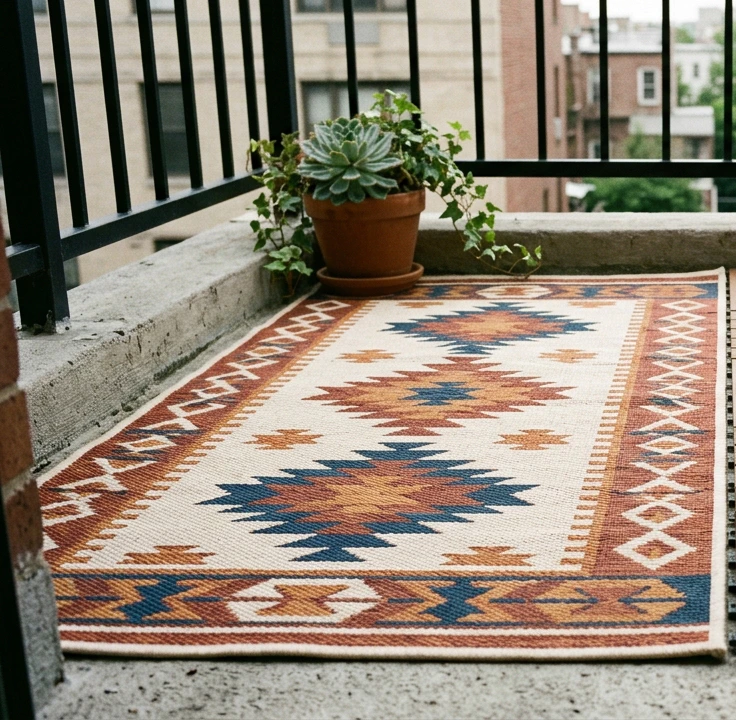
Pick an outdoor rug if at least three of these are true:
- Budget under $60 for the whole balcony
- You want it done in 30 seconds with literally no tools
- You'll be in the apartment under 2 years
- You'd prefer something soft underfoot for bare feet and lounging
- Storage space is tiny — you need it to roll up small for winter
A UV-resistant polypropylene outdoor rug from Gertmenian, Ruggable, or Safavieh at $1.20/sq ft works out to $45 for a typical 5×7 ft rug — perfect coverage for a small balcony. The install is literally pulling it out of the package and laying it down. Mediterranean blue, warm boho, and neutral cream patterns all photograph well on a balcony.
The honest case for outdoor rugs: they're the right answer for any rental balcony where you want to feel something other than concrete underfoot. The pattern defines the space visually without committing you to anything. Move-out is one rug roll away.
What you give up: lifespan (2-3 years before UV fading and edge fraying), rain handling (you must lift the rug after rain or mildew grows on the concrete underneath — see the dedicated section below), and drainage (rugs block balcony drainage holes, which can cause pooling water and mildew issues in heavy-rain climates).
When to pick interlocking deck tiles
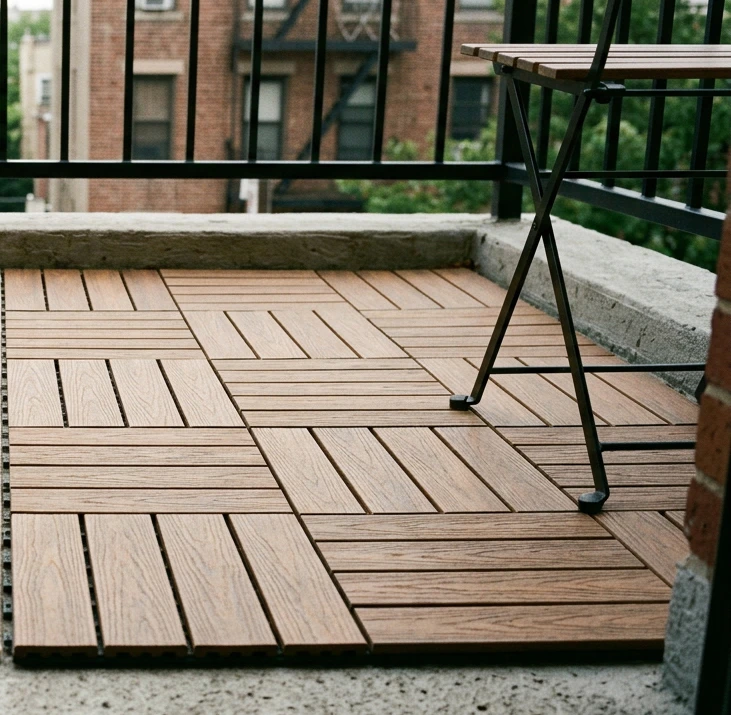
Pick interlocking deck tiles if at least three of these are true:
- You'll be in the apartment 3+ years and want a lasting refresh
- Your balcony has drainage issues — standing water after rain
- You don't want to lift floor covering after every storm
- Budget allows $150-200 for the whole balcony
- You have storage space (basement, garage, closet shelf) for off-season storage
Snap-together acacia wood or composite deck tiles from acacia wood tile sets at $3/sq ft land around $150 for a 50 sq ft balcony. Each tile is roughly 12×12 inches with plastic support feet underneath that create a 3/8-inch air gap — that gap is what handles rain drainage. The install is genuinely 2 hours: dry-fit the layout, snap tiles together row by row, cut edge pieces with a hand saw or jigsaw, done.
The honest case for tiles: they're the right answer for any balcony with real weather exposure (rain, snow), drainage holes that need to stay clear, or longer renter stays where the $100 premium over a rug amortizes across 5-8 years instead of 2-3. They also fix the aesthetic problem of plain concrete more completely than a rug — covering the entire floor edge-to-edge instead of leaving exposed concrete around the rug perimeter.
What you give up: upfront cost (3x more than a rug), 2 hours of install instead of 30 seconds, hot underfoot in direct sun (dark tiles especially — see the kids/pets section below), and storage complexity for the off-season — 50+ tiles need real space to stack against a wall somewhere.
The rain & drainage problem (the deciding factor for many balconies)
This is the single technical factor that flips the rug-vs-tiles decision for many balconies. Understanding it makes the choice clearer than any other consideration.
Most apartment balconies are designed to drain: the concrete floor is pitched slightly (1-2% slope) toward a small drainage hole near the railing or in a corner. When it rains, water hits the floor, flows downhill to the drain, and exits. Without that drainage, balconies would flood in any meaningful rain.
What outdoor rugs do to drainage: a flat polypropylene rug laid over the entire balcony floor blocks the water path. Rain hits the rug, soaks through (polypropylene is permeable enough to let water through slowly), and pools UNDER the rug. The drainage hole still works, but only for water at the rug edges — the rest sits stagnant under the rug for days. Result: mildew under the rug, mildew stains on the concrete, and a damp smell whenever you lift it.
What deck tiles do to drainage: tiles sit on plastic support feet that create a 3/8-inch air gap underneath. Rain hits the tile, drains through the small gaps between tiles to the floor below, then flows under the tiles to the drainage hole — exactly as the balcony was designed to do. The drainage works perfectly, the concrete under the tiles dries between rains, no mildew develops.
The decision rule: if your balcony has visible drainage holes or gets meaningful rain, tiles solve a real problem that rugs create. If you're in a dry climate (Arizona, Nevada, Southern California summers) or your balcony is fully covered/recessed and doesn't get direct rain, rugs work fine. Most US balconies in non-desert climates fall in the "tiles handle rain better" category.
Kids, pets and bare feet
The other major factor for many balcony decisions is who actually uses it barefoot.
Outdoor rugs win for:
- Small kids — softer on falls, no hard edges, easier to lounge on
- Hot afternoon sun — rugs stay close to ambient air temperature
- Cat paws indoor-outdoor — rug texture is more familiar/comfortable than hard plastic
Deck tiles win for:
- Wet conditions — better grip than wet polypropylene rugs (which get surprisingly slick when soaked)
- Active dogs — paws don't snag on tiles the way they can on rug fibers
- Heavy furniture — bistro tables, planters, grills don't crush or stain tiles like they can on rugs
The hot-tile question specifically: dark composite tiles in direct afternoon sun can hit 130°F+ — uncomfortable for bare feet and potentially painful for pet paws. Light-grey or natural-acacia tiles stay 15-20°F cooler than dark grey or black. If your balcony gets full afternoon sun and bare feet matter, pick light-colored tiles OR pair tiles with a smaller rug in the seating zone for layered comfort.
The short verdict
Pick outdoor rugs if budget matters, you're staying under 2 years, you want it done instantly with zero tools, or your balcony is fully covered and doesn't see rain. Pick interlocking deck tiles if your balcony has drainage holes that need to stay clear, you'll be in the apartment 3+ years, or you've already had mildew-under-rug problems and want them gone permanently. The pivot factor is almost always rain exposure — rugs in dry/covered balconies, tiles in rainy/open ones.
The third option for budgets that allow it: do both. Tiles wall-to-wall for the floor + a smaller boho rug in the seating area for softness. Best of both worlds at around $200 total, and the rug stays drier sitting on top of the drained tile surface than it ever would on bare concrete.
Building a real deck instead of refreshing a balcony? The Pressure-Treated vs Composite head-to-head covers full-deck-build options — useful when you have actual yard space and a permanent install is on the table.
 11 Best Deck Stain Brands 2026
 Full outdoor deck guide
 Outdoor Deck: PT vs Composite
 Bedroom Walls: Wallpaper vs Paint
 Bathroom Floor: LVP vs Ceramic Tile