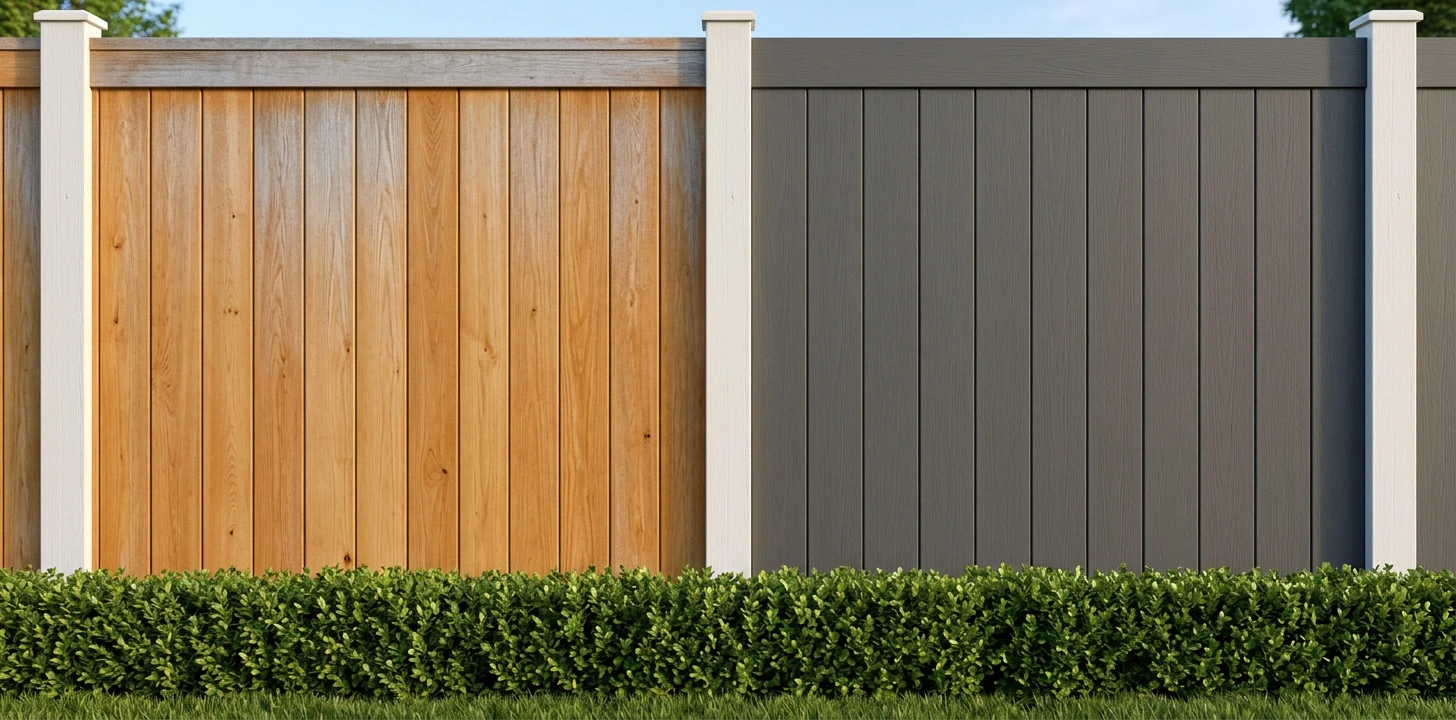
Updated July 2026. Prices reflect US market installed costs for 6-foot privacy fence panels and outdoor accent walls. All comparisons based on 100 linear feet (typical small-to-medium backyard perimeter). For full-house siding the same logic applies but costs scale up 2-3×.
The 30-year decision that flips upside-down on maintenance
Cedar and composite are the two real options for outdoor wall surfaces — fences, privacy walls, accent screens, outdoor room dividers. The upfront price difference is decisive ($15-25 cedar vs $30-50 composite per linear foot), but the 30-year ownership math flips the answer for most homeowners once you factor maintenance.
The short version: cedar at $15-25/linear ft is the budget-friendly natural-warmth choice if you accept staining every 3-5 years and live in the right climate. Composite at $30-50/linear ft costs more upfront but holds factory color for 25-50 years with zero maintenance, performs better in humid climates, and meets stricter fire codes. The decision is mostly about climate, your relationship with weekend maintenance, and how long you'll own the property.
Below: side-by-side table, when each one wins, the 30-year maintenance math that flips the cost answer, climate compatibility factors most homeowners don't think about until year 3, the hybrid cedar-focal-wall-plus-composite-perimeter pattern designers actually use, and FAQs.
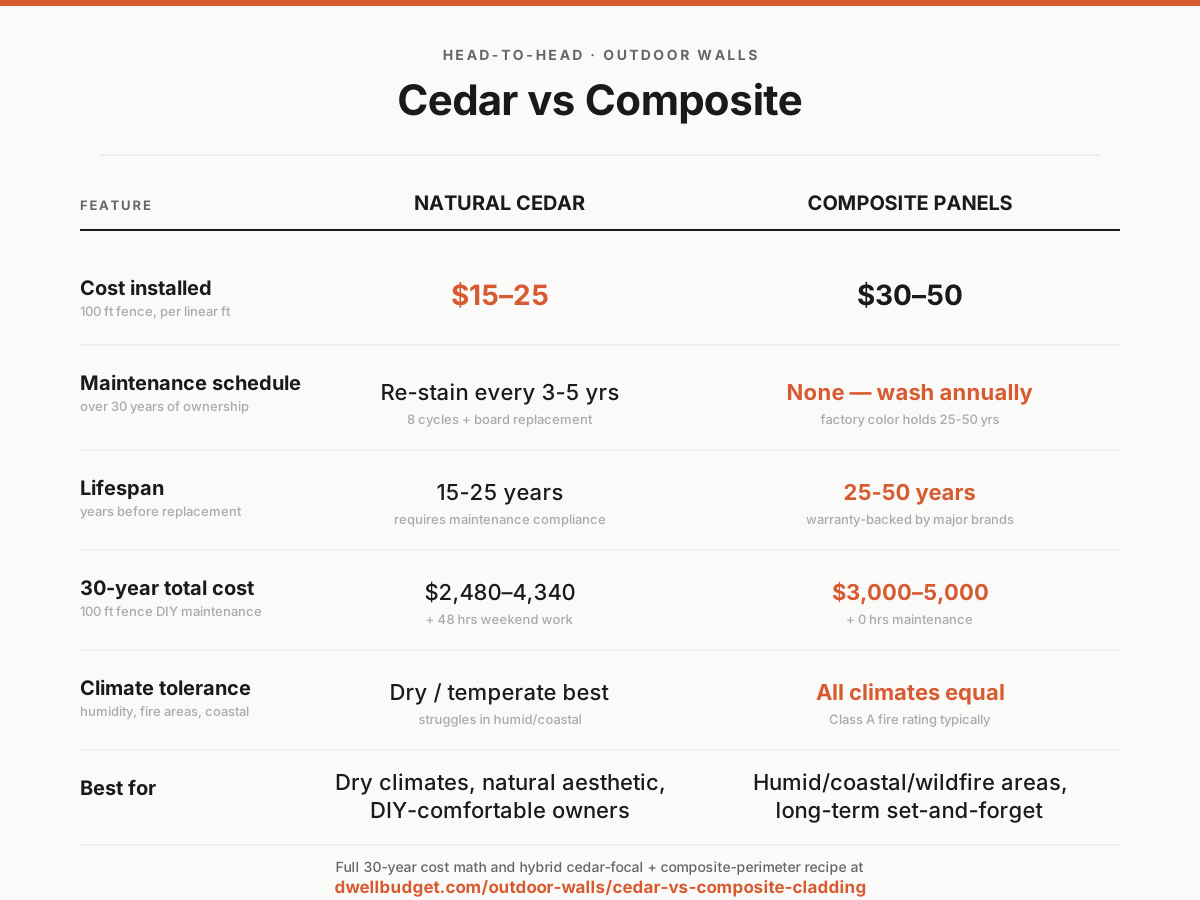
Side-by-side comparison
| Cedar panels | Composite panels | |
|---|---|---|
| Cost installed (per linear ft) | $15–25 | $30–50 |
| 100 ft fence total | $1,500–2,500 | $3,000–5,000 |
| Maintenance schedule | Re-stain every 3-5 yrs | None — wash off annually |
| Lifespan | 15–25 yrs (with maintenance) | 25–50 yrs (warranty-backed) |
| 30-year total ownership (DIY) | $3,400–5,300 incl. maintenance | $3,000–5,000 — done |
| Climate tolerance | Best in dry/temperate | Excellent in all climates |
| Color stability | Fades to silver-gray in 12-18 mo | Holds factory color 25-50 yrs |
| Fire rating | Class B or C (treated higher) | Typically Class A |
| Insect / pest resistance | Natural cedar oils — moderate | Impervious — synthetic material |
| End-of-life | Composts naturally — true renewable | Landfill (95% recycled input though) |
| Best for | Dry climates, DIY-comfortable owners, natural aesthetic | Humid climates, wildfire areas, set-and-forget owners |
When to pick cedar
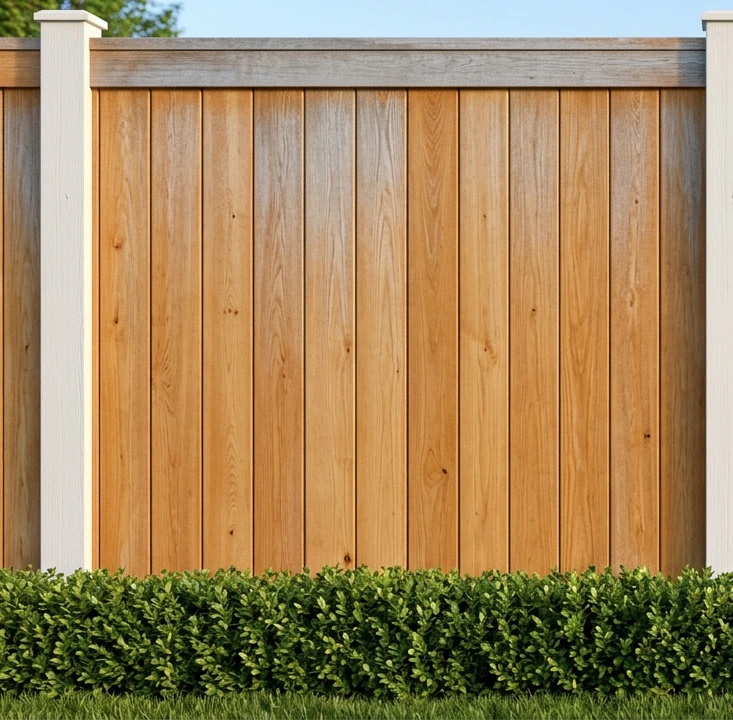
Pick cedar if at least three of these are true:
- You live in a dry or temperate climate (Pacific Northwest, Mountain West, Midwest, Northeast)
- Your aesthetic preference is natural wood warmth, weathered patina, organic feel
- You're comfortable with a Saturday of staining work every 3-5 years
- Your budget is under $2,500 for a typical 100 ft fence
- Sustainability and end-of-life biodegradability matter to you
Cedar fence panels from local lumber yards or Amazon cedar panels at $15-25 per installed linear foot hit $1,500-2,500 for a 100 ft fence. The install is moderate-difficulty DIY: set posts in concrete, attach 2×4 rails to posts, screw cedar boards (or pre-built panels) to the rails. Plan two weekends — one for posts/concrete cure, one for panels.
The under-discussed advantage in dry climates specifically is the natural silver-gray weathering. Unstained cedar in Pacific Northwest, Colorado, Vermont, or Northern California yards develops a uniform silver patina within 12-18 months as UV breaks down surface lignin. This is the look of premium country and modern-cottage homes — and it costs nothing to achieve. In humid climates the same process gets blotchy from mildew, so this advantage doesn't transfer.
What you give up: maintenance Saturday every 3-5 years for staining ($60-80 in materials DIY, or $400-800 contracted), 10-20% board replacement over 30 years from rot/splitting ($300-800), lower fire rating (Class B/C — restricted in some wildfire-prone CA counties), and weaker performance in humid climates where cedar rots faster despite oil-based natural resistance.
When to pick composite
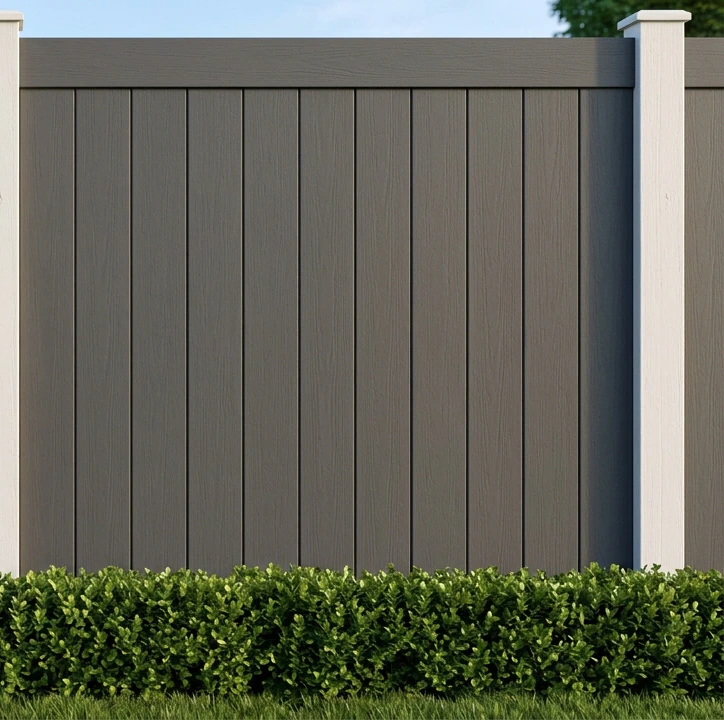
Pick composite if at least three of these are true:
- You live in a humid, coastal, or wildfire-prone climate (Florida, Gulf Coast, California, Arizona)
- You own the home long-term (10+ years) and want the 30-year cost-per-year math to play out
- Set-and-forget appeals to you more than weekend DIY maintenance
- Your budget can absorb the higher upfront cost ($3,000-5,000 for 100 ft fence)
- Local building codes require Class A fire rating (defensible space zones in CA, OR, etc.)
Composite fence panels from Trex Fencing, TimberTech, or Bufftech at $30-50 per installed linear foot hit $3,000-5,000 for a 100 ft fence. Install is moderate-difficulty DIY similar to cedar, but the panel system uses interlocking pickets rather than nailed boards, which simplifies the picket-attachment step. Plan one full weekend (posts + cure) and one Saturday (panels).
The biggest practical argument is 30-year amortization. Cedar's upfront $1,500-2,500 + $1,600-2,400 in DIY maintenance over 30 years = $3,100-4,900 total. Composite's $3,000-5,000 upfront + $0 = $3,000-5,000 total. Almost identical 30-year cost — but composite saves you 8 maintenance weekends. If you value your weekend time at anything above $0, composite wins on lifetime cost.
The under-discussed advantage in fire-aware areas is Class A fire rating. Several California counties (Marin, Santa Cruz, parts of LA County) now require Class A exterior materials within defensible space zones around homes. Cedar is being phased out of permitted fencing in these areas; composite remains compliant. For homeowners in wildfire-vulnerable regions, this isn't an aesthetic choice but a code-compliance requirement.
What you give up: 2-2.5× higher upfront cost ($1,500-2,500 budget gap), plastic-y aesthetic if you spec the wrong product (cheap generic imports look obviously synthetic — stick to Trex/TimberTech/Bufftech), not biodegradable at end-of-life (lands in landfill vs cedar composting), and the natural grain warmth that makes cedar a sensory-favorite for many homeowners.
The 30-year maintenance math
This is the cost factor that decides the question for most long-term homeowners — and the one cedar lumber yards never put on the price sticker.
Cedar 30-year cost ownership (DIY maintenance, 100 ft fence):
- Upfront installed: $1,500-2,500
- Re-stain every 3-5 years (8 cycles over 30 yrs): $60-80 in stain + brushes + tape per cycle, $480-640 total materials
- Board replacement (10-20% of boards lost to rot/splitting over 30 yrs): $300-800
- Power-washing prep before each stain cycle: rental or pressure-washer ownership $200-400 amortized
- Your time: 8 weekends × ~6 hours each = 48 hours over 30 years
- 30-year DIY total: $2,480-4,340 in materials + 48 hours of work
Cedar 30-year cost ownership (contracted maintenance, 100 ft fence):
- Upfront installed: $1,500-2,500
- Re-stain contracted (8 cycles): $400-800 each, $3,200-6,400 total
- Board replacement contracted: $400-1,200 over 30 yrs
- 30-year contracted total: $5,100-10,100
Composite 30-year cost ownership (100 ft fence):
- Upfront installed: $3,000-5,000
- Maintenance: $0 — annual hose-wash if you want, optional
- 30-year total: $3,000-5,000
The honest comparison: composite is cheaper than DIY cedar over 30 years for the high end of budgets (composite $5,000 vs DIY cedar $4,340 — basically a wash) and significantly cheaper than contracted cedar across all budgets. The decision pivots on whether you value 48 hours of weekend maintenance work at $0 or at any positive number.
The under-15-year math is different: for homeowners staying 5-10 years, cedar's lower upfront cost wins because the maintenance haven't compounded yet. Cedar's the move for short-term ownership; composite for long-term.
Climate compatibility
The factor that decides whether cedar is even an option in many parts of the country — and one most product reviews skip because they're written from one geographic perspective.
Cedar thrives in: Pacific Northwest, Mountain West (Colorado, Utah, Montana), Northern California (away from coast), Northeast (Vermont, New Hampshire, Maine), Midwest (Wisconsin, Minnesota). Low humidity + cold winters + moderate UV = cedar develops uniform silver-gray patina, resists rot, holds shape. Lifespan 20-30 years with light maintenance.
Cedar struggles in: Gulf Coast (Texas, Louisiana, Mississippi, Alabama), Florida, Atlantic Southeast (Carolinas, Georgia), Pacific Coast California (San Diego to San Francisco coastal). High humidity + warm temperatures + salt air = cedar develops blotchy mildew weathering rather than uniform gray, rots faster (especially at ground contact), needs staining every 2 years instead of 3-5. Lifespan 10-15 years with heavy maintenance.
Composite performs equally well in all climates. The synthetic material doesn't rot, doesn't mildew, doesn't host insects, doesn't fade in saltwater air. Coastal Florida composite fences look the same after 20 years as Vermont composite fences. This climate-agnostic property is composite's biggest under-discussed advantage for homeowners outside cedar-friendly regions.
The decision rule by climate: if you're in cedar's sweet-spot region and prefer the natural aesthetic, cedar is the right answer. If you're in a humid/coastal climate, composite is essentially the only durable choice — fighting cedar's maintenance schedule in humid air is a losing battle most homeowners give up on by year 5.
The hybrid approach pros use
The combined approach that landscape designers use on higher-end residential projects — and the one that gets the natural-cedar aesthetic where it matters most while keeping maintenance burden minimum across the rest of the yard.
The recipe:
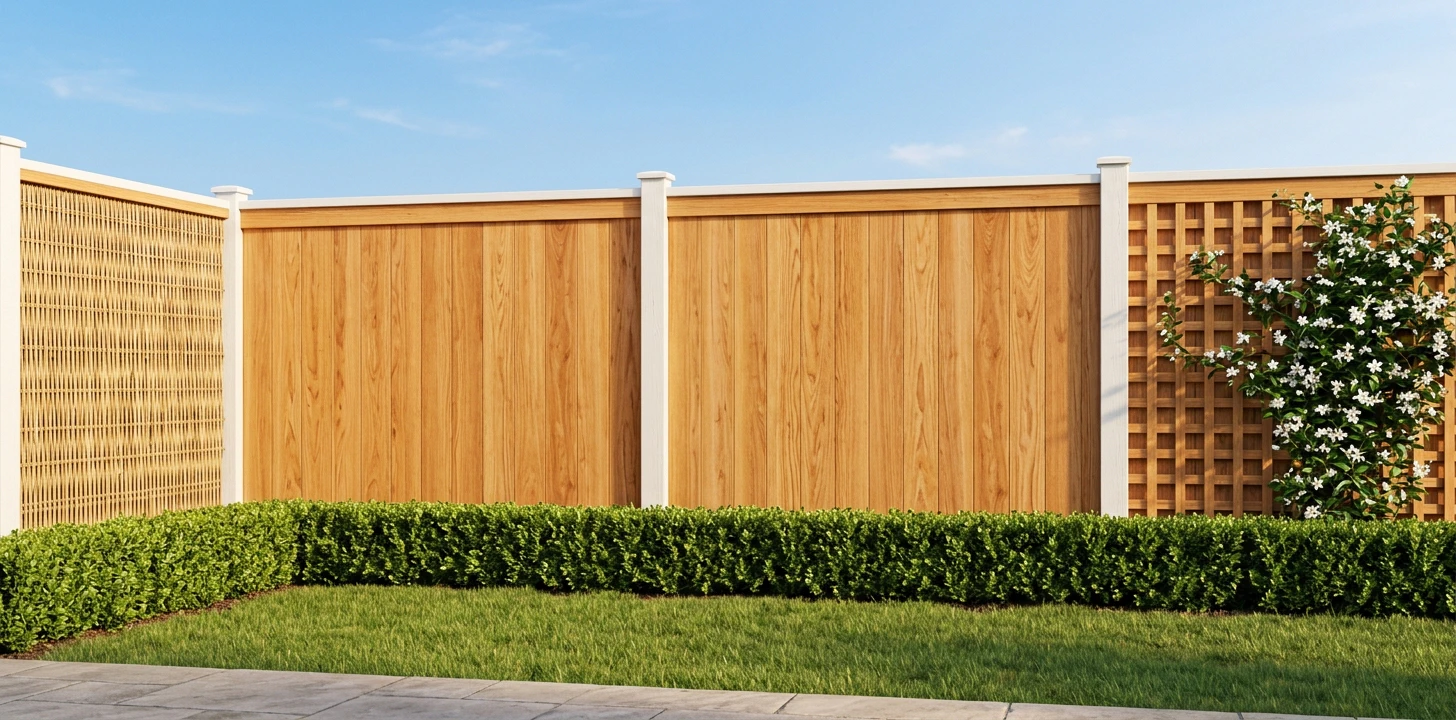
- Cedar on the focal-point walls — the side facing your patio, deck, pool, or outdoor dining area where you actually look at and touch the fence daily. Typically 30-50 linear feet of high-visibility frontage.
- Composite on the back, side, and alley-facing walls — the perimeter you rarely look at but still need privacy from. Usually 60-100 linear feet of low-priority frontage.
- Matching post color across both materials (typically white-painted wood or black powder-coated metal) to visually tie the systems together rather than looking like mismatched fixes.
The math (130 ft total yard perimeter): 30 ft cedar focal wall at $25/ft = $750 + 100 ft composite perimeter at $35/ft = $3,500 = $4,250 total. Compare to $6,500 all-composite or $3,250 all-cedar with maintenance over 30 years = $4,850-5,650 amortized. The hybrid lands at the cost-per-year sweet spot.
The aesthetic logic: from your patio you see warm natural cedar grain right where the eye lives the longest; from the kitchen window or driveway you see clean composite that doesn't need attention. Visitors compliment "the fence" assuming the whole thing is cedar, but you're only maintaining 30 feet of it. This is the strategy used by professional landscape designers but rarely communicated to DIY audiences because it requires two material orders and two install passes.
The short verdict
Pick cedar if you're in a dry/temperate climate, prefer the natural-wood aesthetic, are comfortable with a Saturday of maintenance every 3-5 years, your budget is under $2,500 for a 100-ft fence, or you're staying under 10 years. The natural silver-gray weathering in cedar-friendly climates is a real aesthetic advantage at lower cost than composite. Pick composite if you live in a humid or wildfire-prone climate, you own long-term (10+ years where the 30-year math plays out), set-and-forget appeals more than DIY weekends, or local fire codes require Class A. For higher-end residential projects with mixed visibility, do the hybrid — cedar on the focal-point walls + composite on the perimeter — for the natural aesthetic where it matters and zero maintenance everywhere else.
Comparing more outdoor wall options? The full outdoor walls guide also covers fence stain (the maintenance product for cedar), bamboo privacy screens (the renter shortcut), cedar lattice (the vine-ready architecture), and faux brick panels (the curb-appeal cheat for ugly utility walls).
 7 Deck Staining Mistakes That Make It Peel
 Full outdoor walls guide
 Outdoor Deck: Pressure-Treated vs Composite
 Outdoor Deck: Outdoor Rugs vs Deck Tiles
 Garage Walls: Paint vs Pegboard