Updated July 2026. Prices reflect US market costs from Amazon, Levolor, Bali, and Custom Blinds Direct. All comparisons based on a typical 36×48 inch residential window.
Two different mechanisms, two different problems solved
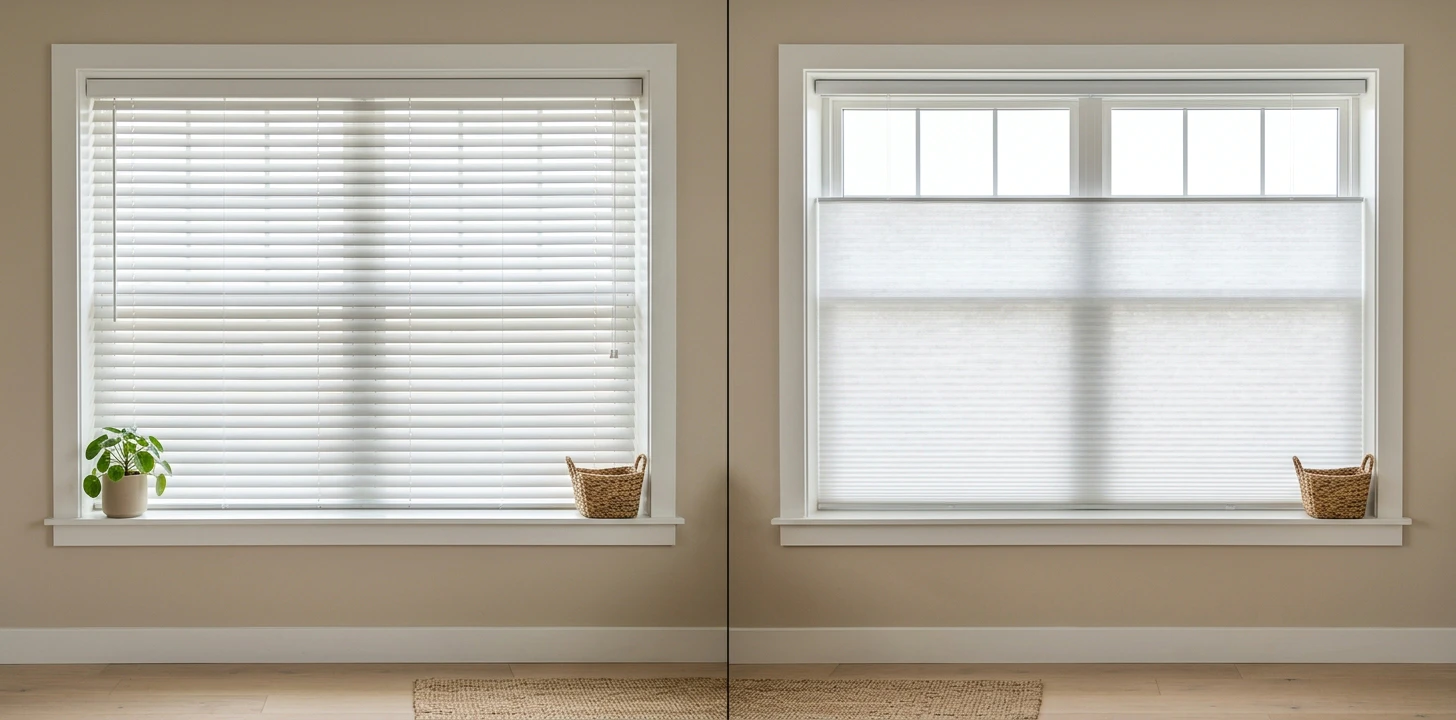
Blinds and shades look superficially similar — both mount inside or outside a window frame, both raise and lower, both add privacy. But mechanically they're completely different products solving different problems. Blinds tilt: horizontal slats rotate to redirect light direction (down toward floor, up toward ceiling, fully open horizontally) without changing the blind's height. Shades lift: a single piece of fabric raises and lowers, controlling only how much of the window is covered.
The short version: blinds at $15-50 per window give you light-direction control plus privacy at any partial-open angle — useful for offices, kitchens, and any window where you want light in but eyes out. Cellular and roller shades at $30-150 per window give you measurable insulation (R-2 to R-5 for cellular) and cleaner aesthetics — useful for primary living spaces, energy-conscious homes, and rooms where dust accumulation matters (allergy households).
Below: side-by-side table, when each one wins, the light-direction-vs-height mechanism that decides it for most rooms, the cellular shade R-value math that pays back AC bills in 2-3 seasons, the blinds-plus-cellular-shade hybrid for specific positions, and FAQs.
Side-by-side comparison
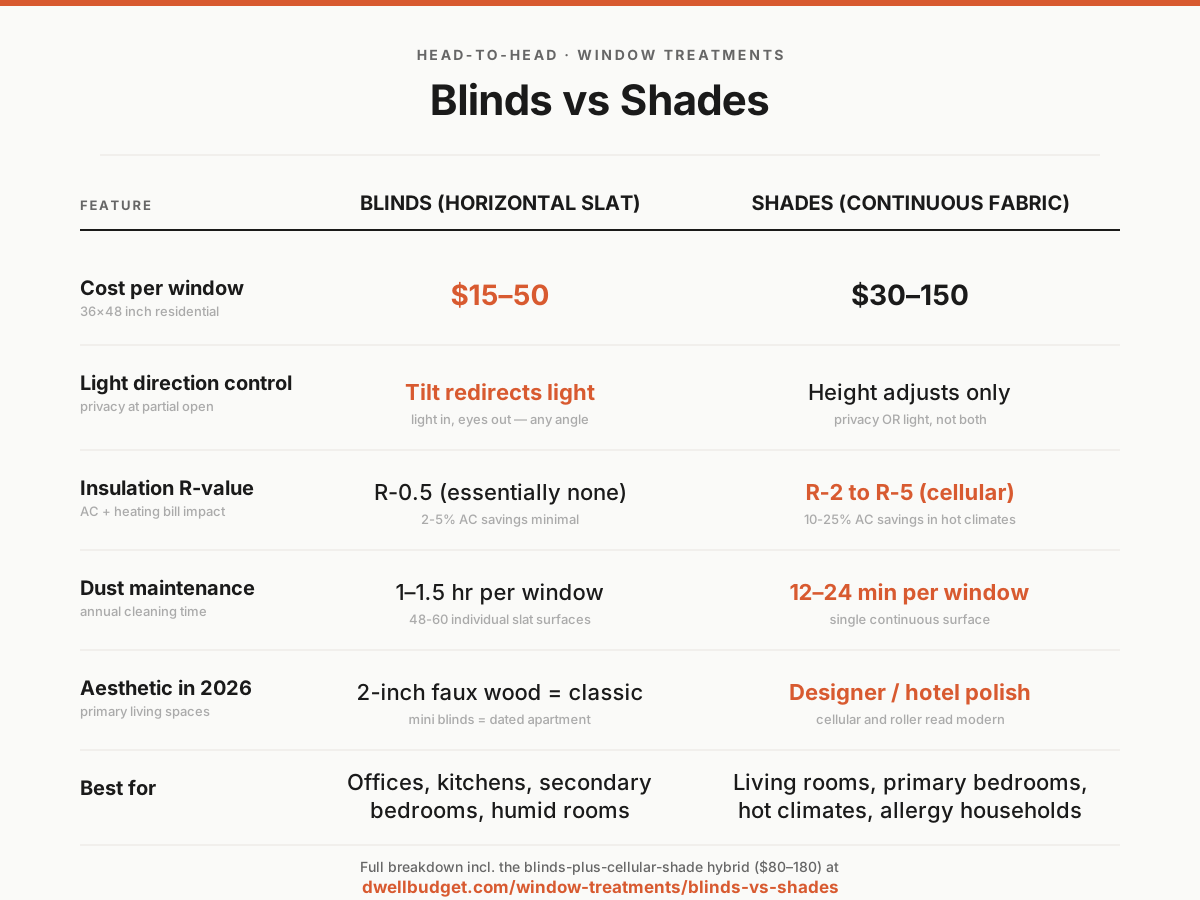
| Blinds (horizontal slat) | Shades (continuous fabric) | |
|---|---|---|
| Cost per window | $15–50 | $30–150 |
| Mechanism | Slats tilt + entire unit lifts | Single fabric raises and lowers |
| Light direction control | Yes — redirect at any angle | No — only height adjusts |
| Privacy at partial open | Excellent — tilt for light + privacy | Binary — privacy or light, not both |
| Insulation R-value | R-0.5 (essentially none) | R-2 to R-5 (cellular shades) |
| AC bill savings | 2–5% (minimal) | 10–20% (cellular shades in hot climates) |
| Dust accumulation | Heavy — 48-60 surfaces per blind | Light — single continuous surface |
| Cleaning time per year | 1–1.5 hours per window | 12–24 minutes per window |
| Aesthetic in 2026 | Faux wood + 2-inch reads classic; mini reads dated | Cellular and roller read polished + modern |
| Wet-room safe? | Faux wood / aluminum yes; real wood no | Roller vinyl yes; cellular fabric grows mildew |
| Best for | Offices, kitchens, secondary bedrooms, light-control needs | Living rooms, primary bedrooms, energy-conscious, allergy households |
When to pick blinds
Pick blinds if at least three of these are true:
- You want light direction control (redirect daylight up to ceiling, down to floor, or fully open) — not just height adjustment
- Privacy at partial open matters daily — home office calls, kitchen prep with neighbors close, bathroom morning routine
- The window is in a humid room (bathroom shower-adjacent, kitchen above stove) where fabric shades grow mildew
- Your budget is $15-50 per window — blinds at the entry price point beat shades at the same budget
- You're OK with the 1-1.5 hour annual cleaning time per window (or you don't have dust allergies)
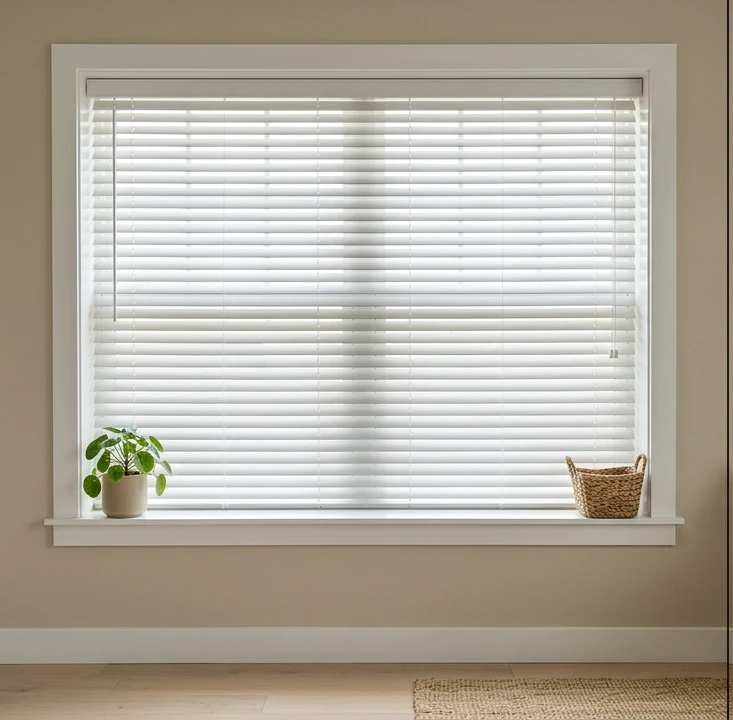
2-inch faux-wood blinds from Levolor or Bali at $30-60 per window are the standard 2026 recommendation — they look like real wood from 6 feet away but are PVC composite (impervious to humidity, no warping in wet rooms). Install is moderate-difficulty DIY: measure window opening, order to spec, mount inside-frame brackets with included screws, snap blind into brackets. 20-30 minutes per window for first-timers.
The under-discussed advantage in offices and kitchens specifically is privacy at partial open. Tilt the slats slightly downward — daylight enters from the top, redirected toward the room interior, while the slats block direct line-of-sight from outside in. Neighbors see closed blinds; you see well-lit room. Shades can't do this; they're either open (full view both ways) or closed (no light, no view).
What you give up: 1-1.5 hour annual cleaning time per window (48-60 individual slat surfaces accumulate dust), zero insulation R-value (R-0.5 vs cellular shades at R-4-5), aesthetic risk if you spec wrong (1-inch mini blinds read as dated 1990s rental; stick to 2-inch faux wood for current look), and cord/safety concerns (cordless versions only for kids/pets households — see FAQ).
When to pick shades
Pick shades if at least three of these are true:
- The window is in a primary living space (living room, master bedroom, dining) where polished aesthetic matters
- You live in a hot climate (Texas, Arizona, Florida, Southern California) and want measurable AC bill reduction
- Someone in the household has dust allergies — cellular shades stay clean where blinds compound dust
- You want minimal annual cleaning time (12-24 min per window vs 1-1.5 hours for blinds)
- Modern minimalist aesthetic is your design preference
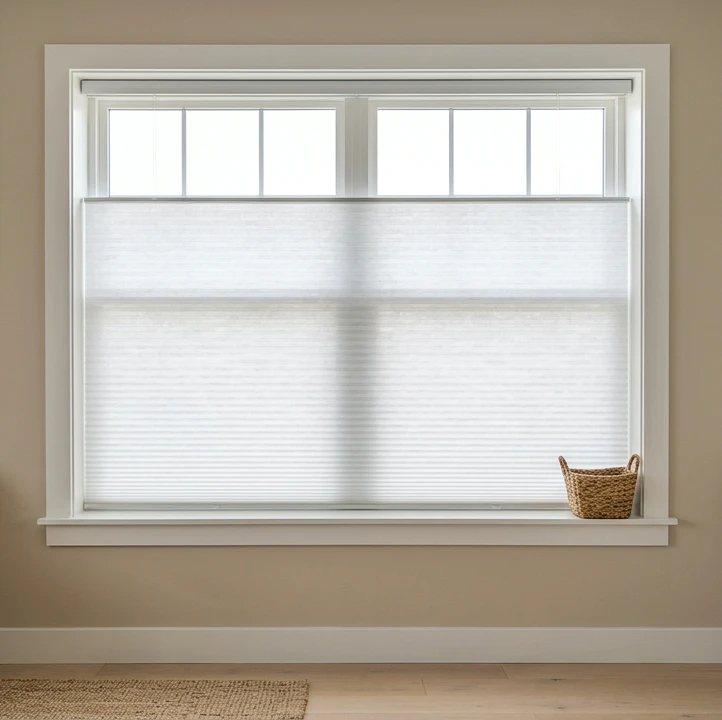
Cellular (honeycomb) shades from Bali or Levolor cellular at $50-120 per window deliver R-4 to R-5 insulation via the honeycomb structure that traps an air layer between two fabric layers. US Department of Energy testing puts the AC savings at 8-15% in moderate climates and up to 25% in hot southern climates with west-facing windows.
The under-discussed practical advantage is dust maintenance time. A typical home with 8-12 windows: blinds need 1-1.5 hr × 12 windows = 12-18 hours per year of dust cleaning. Cellular shades need 12-24 min × 12 = 2.4-4.8 hours per year. The 8-13 hour difference annually compounds across decades of homeownership — and the cleaning is the kind of housework people skip and then regret when dust visibly accumulates and triggers allergies.
The biggest aesthetic argument: cellular and roller shades read as "designer" or "hotel" in 2026 design language, while traditional blinds (especially 1-inch aluminum mini) read as "apartment-grade" or "office building." For primary living spaces where aesthetic registers in every Instagram and listing photo, shades are the polished default.
What you give up: 50-200% higher cost per window ($50-150 vs $15-50 blinds), no light direction control (binary up or down, no tilt), fabric mildew risk in humid rooms (skip cellular in bathrooms/kitchens — use vinyl roller instead), and partial-open binary (you choose privacy OR light, not both at the same time — see hybrid section below for the workaround).
The light-direction-vs-height decision
This is the mechanism distinction that decides the question for most rooms, and the one most window-treatment shoppers don't think about until they're living with the wrong choice.
Blinds adjust DIRECTION. Slats tilt independently of blind height. Three states matter daily: full open (slats horizontal, view straight through, light streaming in directly), tilted down (slats angled with leading edge below — daylight enters from above and bounces upward to ceiling, privacy maintained at eye level), tilted up (slats angled with leading edge above — daylight enters from below and bounces downward to floor, privacy maintained at eye level). The middle two are uniquely blinds' superpower — light in without visibility out.
Shades adjust HEIGHT. Single piece of fabric. Two states matter: fully raised (window fully exposed, light streaming in directly), partially or fully lowered (window covered, light filtered through fabric but no direction control). No tilt, no direction redirect — only "how much" of the window is showing.
The decision rule by room function:
- Home offices, kitchens, bathrooms — blinds win because light-while-private is the daily need (Zoom calls, cooking prep, morning routine without neighbors looking in)
- Bedrooms with sleep cycle — shades win because you want either blackout-darkness (sleep) or fully-open (morning) — partial-tilt-with-light isn't the use case
- Living rooms — depends on window placement. Street-facing = blinds (tilt for daytime privacy); backyard-facing in private lot = shades (no privacy concern)
- Dining rooms, formal spaces — shades win because they read more polished and use is intermittent (dinner with curtains/blinds visible, not daily-use room)
Cellular shade R-value and AC savings
The energy-efficiency factor that turns cellular shades from "premium upgrade" into "pays for itself" in hot climates — and the under-discussed reason most southern-state homeowners switch from blinds to cellular shades within 2-3 years of moving in.
The physics: cellular (honeycomb) shades have two fabric layers separated by an air-filled cellular structure. Trapped air is a poor heat conductor — the honeycomb creates a dead-air space that resists heat transfer in both directions. Single-cell shades = R-2 to R-3; double-cell shades = R-4 to R-5 (the cost-effective sweet spot); triple-cell available but $$$ and diminishing returns.
Compare to blinds: aluminum mini-blinds = R-0.4; 2-inch faux wood blinds = R-0.5. Essentially no insulation. The slats let heat through almost unimpeded.
The AC bill math (testing data from US Department of Energy): for a typical 8-12 window home in Texas/Arizona/Florida with $250-350 monthly AC bill during peak summer, switching from blinds to double-cell cellular shades on west-facing and south-facing windows cuts cooling load by 15-25%. That's $40-90/month savings during peak cooling months × 4-6 months = $160-540/year saved. The cellular shade premium ($40-80 per window × 4-6 west/south windows) = $160-480 payback in 2-3 cooling seasons.
The "winter heating" bonus: cellular shades work the same way for heat retention in winter. In cold climates (Vermont, Montana, Minnesota, Wisconsin), the heating bill savings are 8-12% with the same product — smaller delta because heating systems are typically more efficient than AC, but still measurable.
The decision rule: if you're in a hot climate with high AC bills, cellular shades on west-facing windows specifically deliver the highest ROI window treatment upgrade available. If you're in a moderate climate with modest energy bills, the cellular premium is more about aesthetic preference than energy ROI.
The blinds-plus-cellular-shade hybrid
The combined approach that delivers both mechanisms' benefits on specific windows — and the one most window-treatment retailers don't recommend because it requires selling two products instead of one.
The recipe:
- Cellular shade mounted inside the window frame (closest to the glass) — provides insulation R-value, blackout-when-needed, polished aesthetic baseline
- Blinds mounted outside the frame on a separate header (or 2-inch faux wood blinds inside-mount on top of cellular) — provides light direction control when daytime privacy + light is the daily need
- Both operate independently — pull cellular down for insulation during peak sun, tilt blinds for video-call lighting, raise both for full open
The math: $50-120 cellular shade + $30-60 faux wood blinds = $80-180 per window. Compare to single-product at $50-150 for cellular alone or $30-60 for blinds alone. The hybrid premium ($30-80 per window) buys both mechanisms' benefits on the windows where it matters.
Where this makes sense:
- Home office windows that need Zoom-call lighting control (blinds tilt) plus afternoon insulation (cellular shade)
- Bedroom windows that need daytime privacy with light (blinds) plus night blackout (cellular shade lowered fully)
- Living room front-facing windows in hot climates that need street privacy (blinds tilt) plus AC bill savings (cellular shade)
Where it's overkill: small bathroom and kitchen windows (window film + single blinds is cheaper and sufficient), low-use guest bedrooms (any single product), garage and utility windows (basic blinds suffice).
The short verdict
Pick blinds if you want light direction control with privacy at partial open (home office, kitchen, bathroom), your budget is $15-50 per window, the room is humid (skip real wood — spec faux wood), or you're OK with 1-1.5 hour annual per-window cleaning. Pick shades if the window is in a primary living space (living room, master bedroom), you're in a hot climate with high AC bills (cellular shades deliver 10-25% cooling savings), allergies make blind dust a problem, or modern minimalist aesthetic is your design language. For specific high-use windows, the blinds-plus-cellular-shade hybrid at $80-180 per window delivers both mechanisms' benefits — light direction control plus measurable insulation plus polished aesthetic.
Comparing more window treatment options? The full window treatments guide also covers curtains (the blackout-and-sound option for primary bedrooms), tension rod approaches (the no-drill renter shortcut), and the layered curtain-plus-shade pattern that delivers maximum versatility. See the related Curtains vs Roman Shades comparison for the parallel head-to-head on the curtain-versus-roman-fold decision.
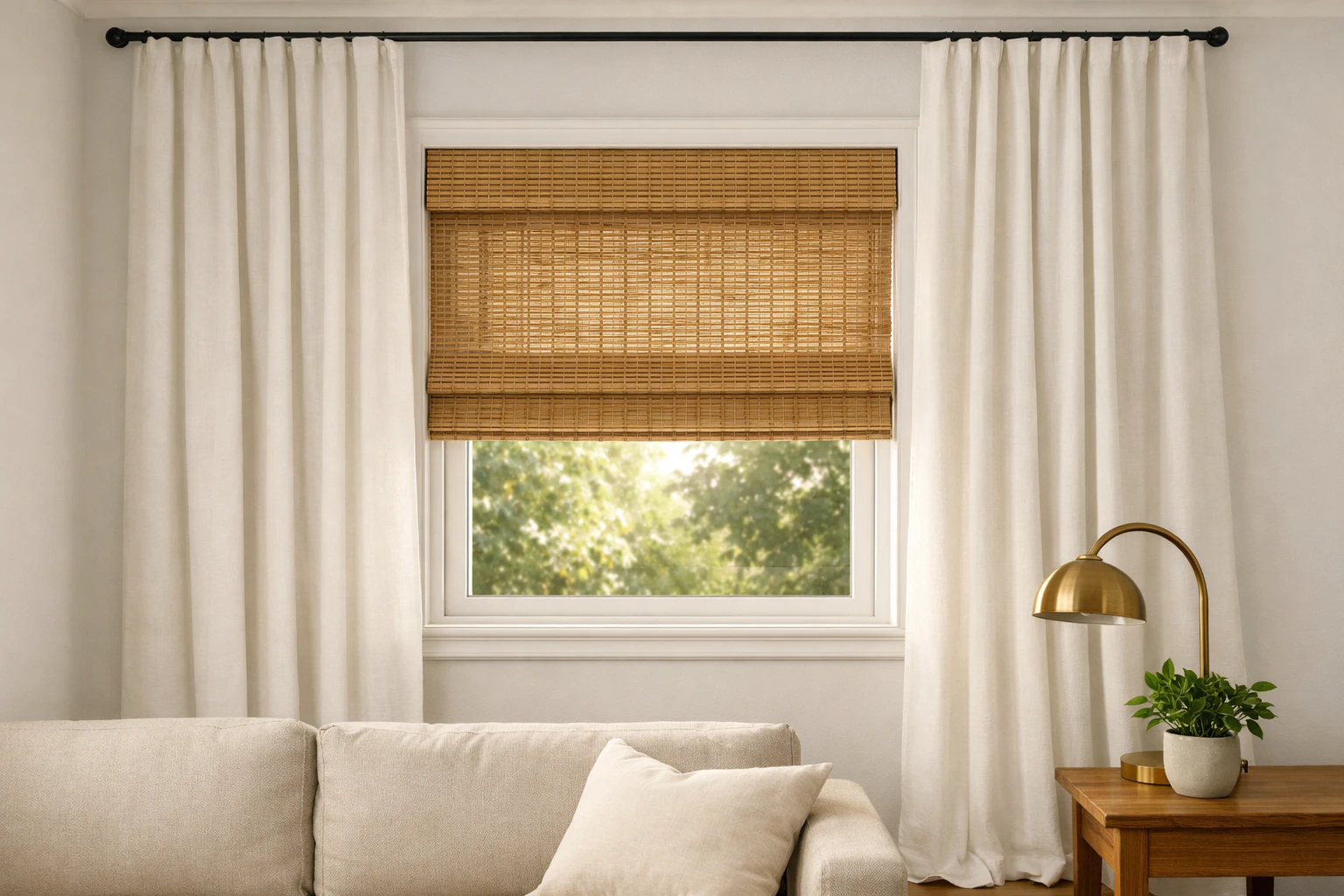 Full window treatments guide
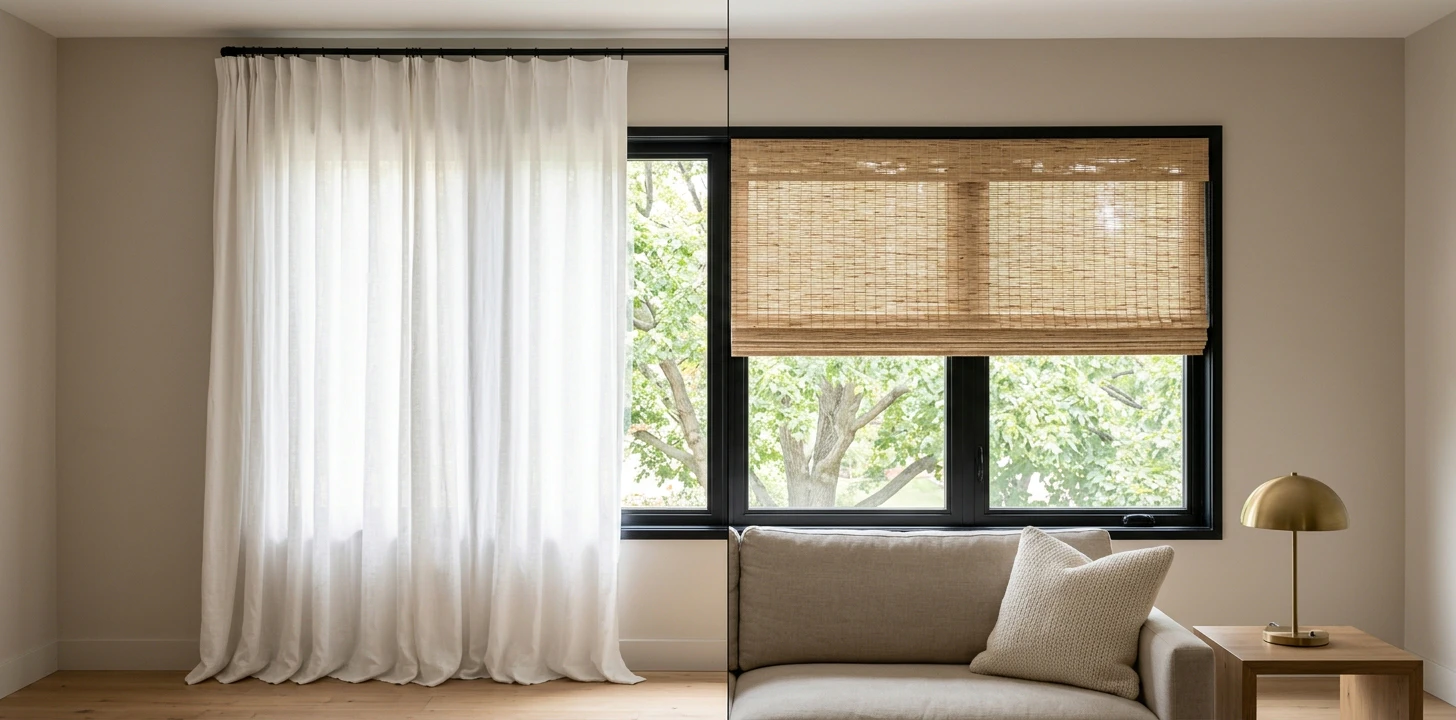 Curtains vs Roman Shades
 Window Film: Static-Cling vs Adhesive
 Home Office Walls: Wallpaper vs Paint