Updated July 2026. Prices reflect US market costs from Amazon, Home Depot and specialty window-treatment retailers. All comparisons based on a standard 36-inch wide bedroom or living room window.
The window decision most apartments get wrong
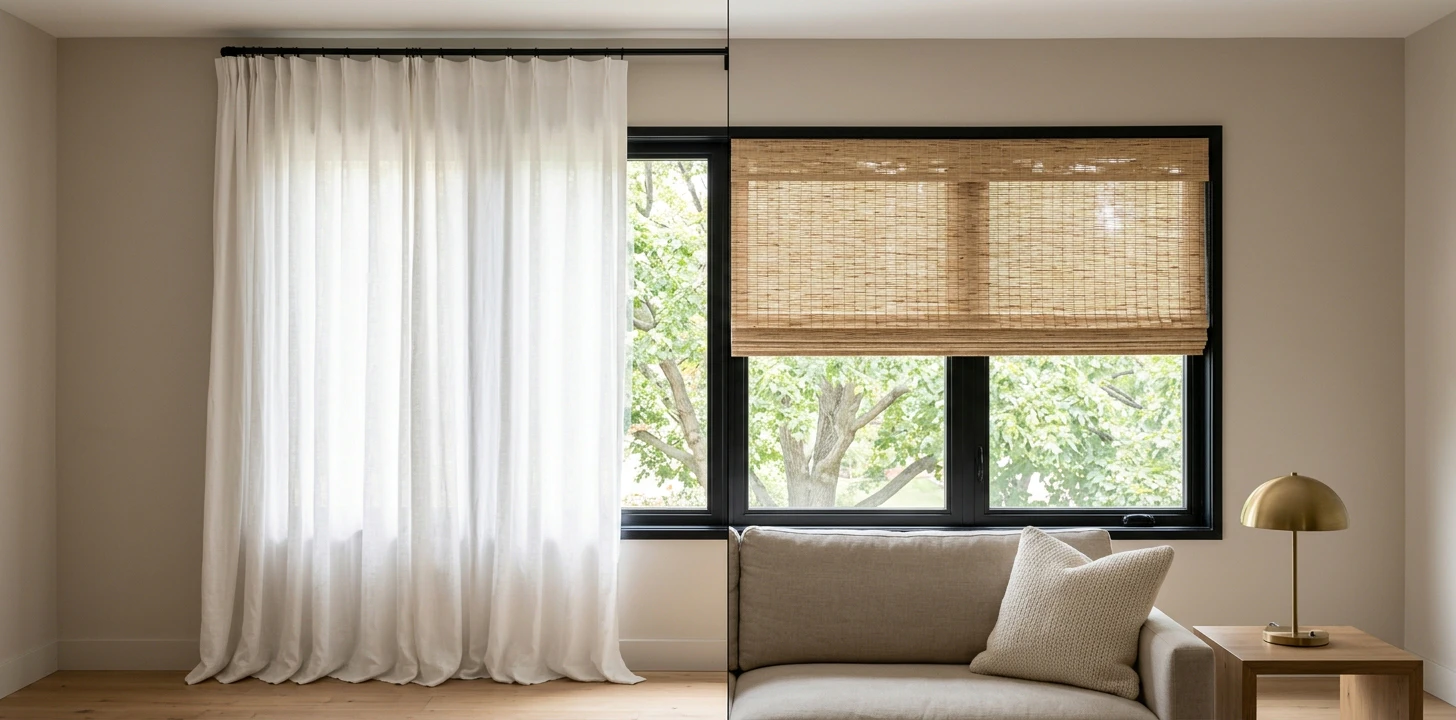
"Should I do curtains or roman shades?" feels like an aesthetic choice — but it's really a question about what job you want the window treatment to do. Curtains are large fabric panels that frame the window from outside the frame, hung from a rod near the ceiling for visual height and warmth. Roman shades mount inside the window frame for cleaner lines, better daytime light control, and a more architectural look. They do different jobs, and the right answer depends on whether you care more about light control, sound dampening, blackout, or pure aesthetics.
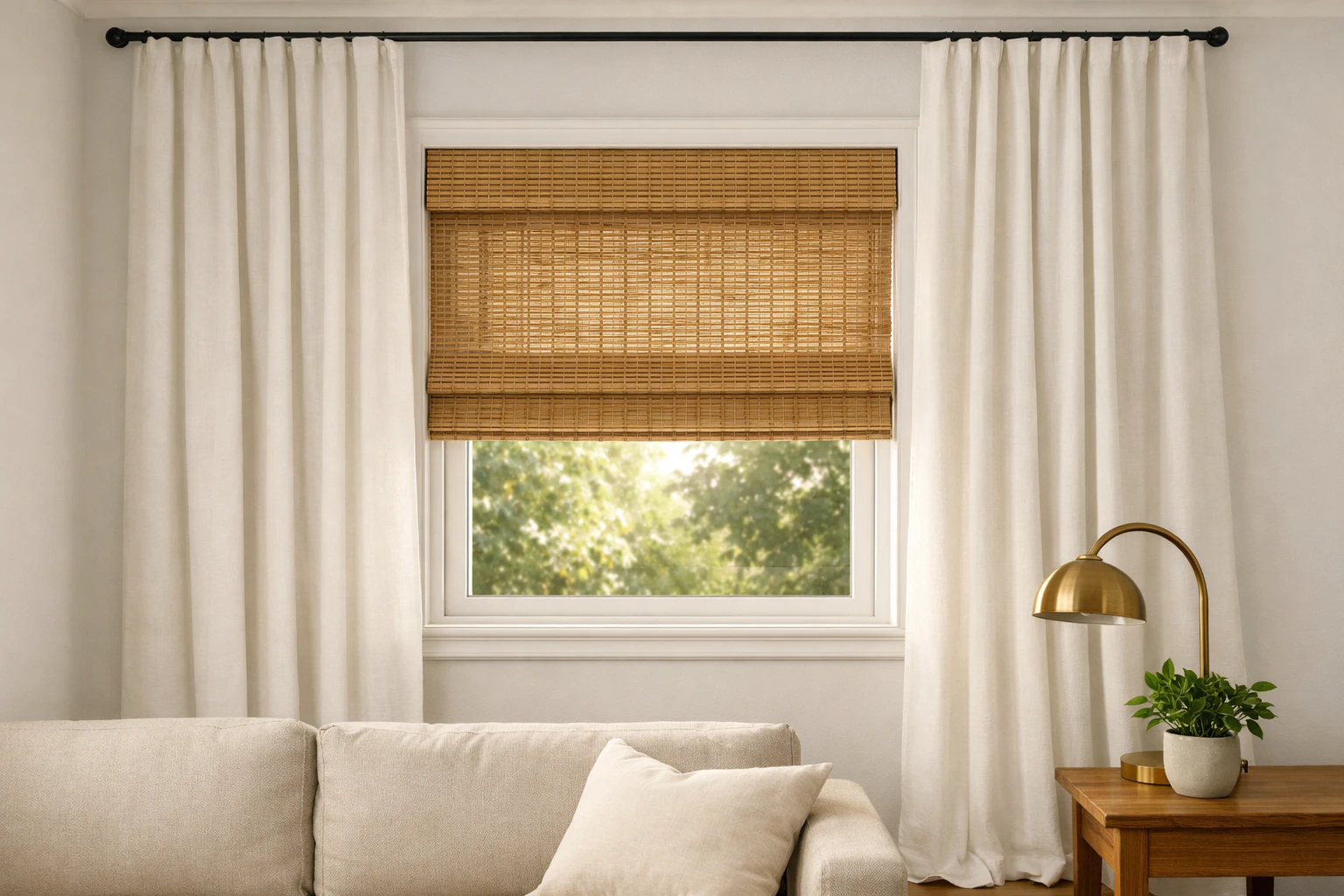
The short version: curtains win on visual height, sound dampening, and full blackout ($30-100 per window, hung high and wide). Roman shades win on cleaner lines, easier daytime light filtering, and small-window suitability ($40-150 per window, inside the window frame). For most apartments, the right answer is actually "both" — layered curtains over a roman shade is the most-Pinterest-saved window composition.
Below: side-by-side table, when each one wins, why most designers actually layer both, install rules for renters, and FAQs.
Side-by-side comparison
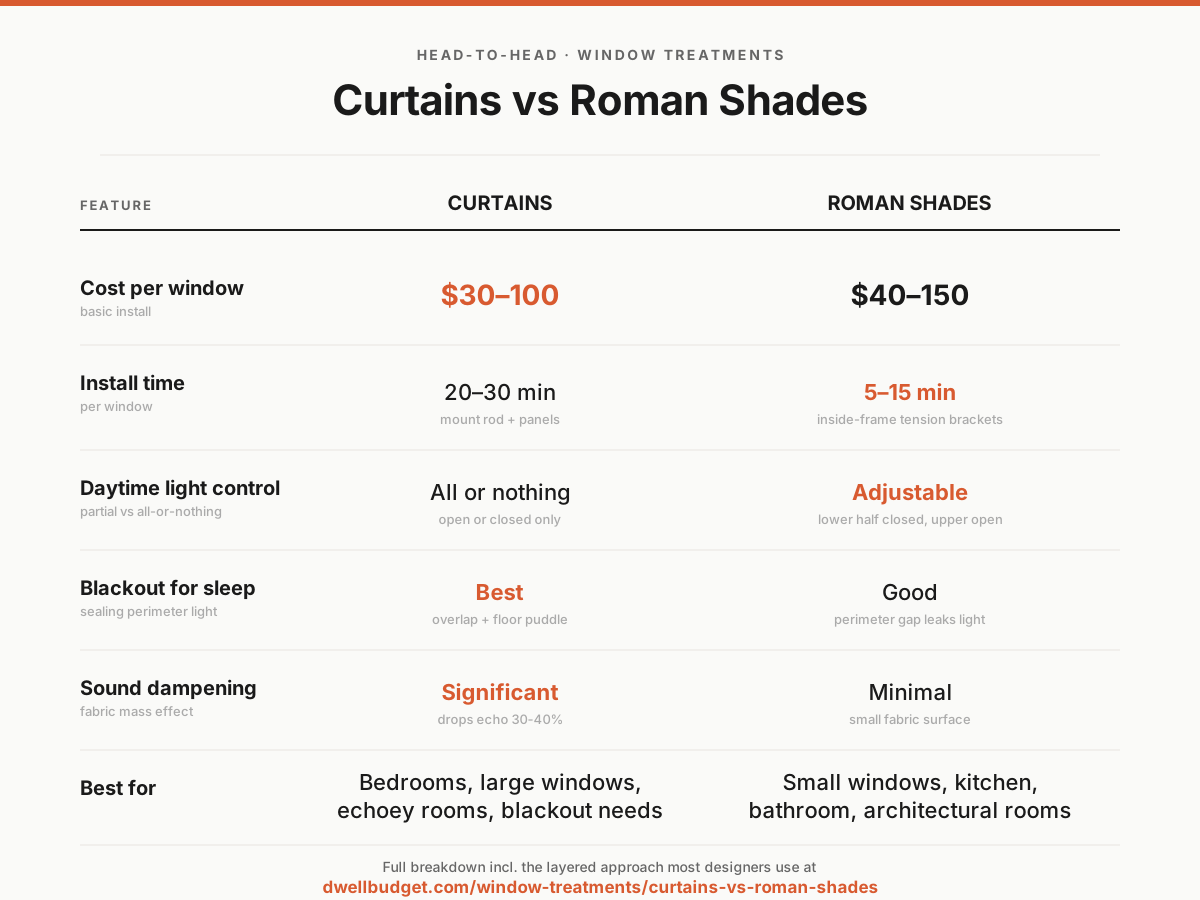
| Curtains (floor-to-ceiling) | Roman shades (inside-mount) | |
|---|---|---|
| Cost per window | $30–100 (panels + rod) | $40–150 (single shade) |
| Install time | 20-30 min (rod + brackets) | 5-15 min (inside-frame tension brackets) |
| Mounting location | Outside the window frame, ceiling-height rod | Inside the window frame |
| Visual effect | Adds visual height, softens room | Cleaner architectural look, doesn't compete with frame |
| Light control | All or nothing (open or closed) | Adjustable height — lower half closed, upper open |
| Blackout (sleep) | Best — true blackout possible with overlap and floor-puddle | Good — perimeter gap leaks light |
| Sound dampening | Significant — fabric mass absorbs sound | Minimal — small fabric surface |
| Renter-safe? | Yes (tension rods or 4 small brackets) | Yes (inside-frame tension brackets) |
| Best for | Bedrooms, large windows, sound issues, blackout needs | Small windows, kitchen, bathroom, architectural rooms |
When to pick curtains
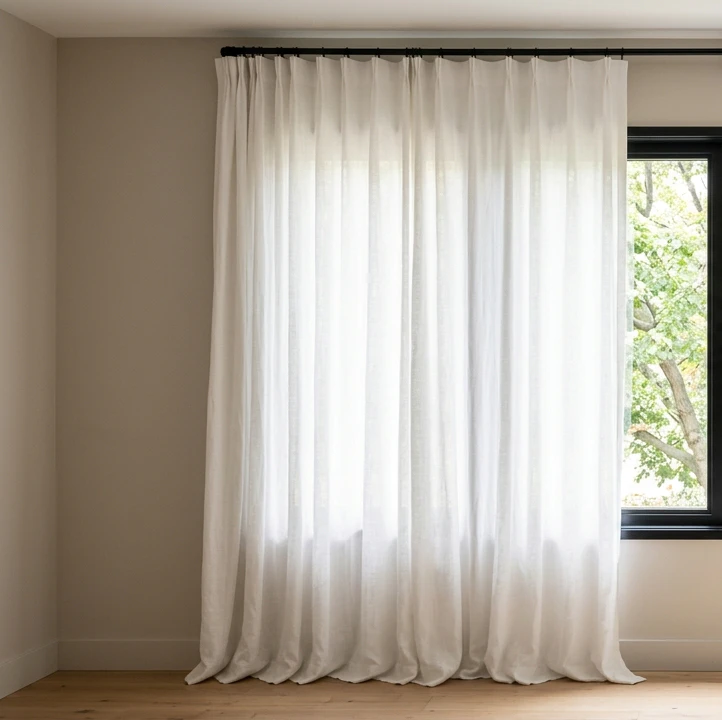
Pick curtains if at least three of these are true:
- The window is in a bedroom and you sleep light (blackout matters)
- The room has hard floors and feels echoey — fabric helps acoustically
- The ceiling is standard or low and you want the illusion of more height
- You want to add fabric warmth to a minimalist room
- The window is large (over 48 inches wide) — roman shades on big windows feel undersized
Curtain panels from NICETOWN (blackout) or basic cotton/linen panels at $30-80 per pair, plus a rod and brackets at $15-40, hit $45-120 per window. The install is straightforward: mount the rod 4-6 inches above the window frame (or near ceiling for max height illusion), let the panels extend 4-6 inches beyond the frame on each side, hem or puddle slightly at the floor.
The honest case for curtains: they're the right answer for any bedroom where blackout matters, any room with sound issues, or any window in a minimalist room that needs softening. The full-coverage fabric does jobs roman shades physically can't.
What you give up: daytime adjustability (curtains are open or closed — no partial light control), clean architectural look (fabric drapes always have presence), and kitchen/bathroom suitability (fabric over a sink or near steam is asking for trouble).
When to pick roman shades
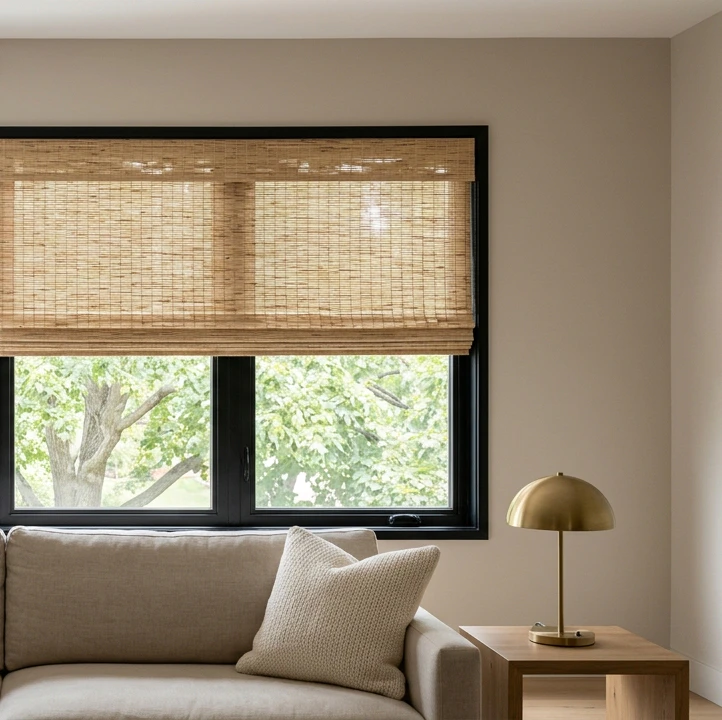
Pick roman shades if at least three of these are true:
- The window is small (under 36 inches) — shades fit it proportionally
- You want partial light control (lower half closed for privacy, upper open for light)
- The window is in a kitchen, bathroom, or near a heat source where fabric panels are impractical
- The room has strong architectural features (built-in shelves, exposed brick) that fabric would compete with
- You want a cleaner, more minimal look
Roman shades from Lewis Hyman bamboo shades (natural texture, $40-80) or Levolor fabric roman shades ($50-150) install with inside-frame tension brackets in 5-15 minutes per window. Cordless-lift mechanisms (now standard on quality shades) operate by lifting the bottom rail — no dangling cords, kid- and pet-safe.
The honest case for roman shades: they're the right answer for small windows that curtains would overwhelm, kitchens and bathrooms where fabric panels are impractical, and rooms with strong architectural detail where you want the window itself to read clearly. The inside-mount placement makes the window an architectural feature rather than a frame for fabric.
What you give up: blackout completeness (perimeter gap always leaks some light), sound dampening (small fabric surface = small acoustic effect), visual height (mounting inside the frame doesn't create the rod-near-ceiling illusion), and large-window suitability (roman shades over 60 inches wide become unwieldy to operate).
The layered approach: why most designers use both
This is the move most window-treatment Pinterest boards converge on, and it's the right answer for most living rooms and bedrooms — not because it's trendy, but because it solves the actual jobs better than either alone.
The functional logic:
- Roman shade (inside mount) handles daytime light filtering and privacy. Lower it halfway in the morning for direct-sun glare control without losing all light. Lower it fully at night for privacy when interior lights are on.
- Curtains (outside mount, ceiling-height rod) handle evening blackout, sound dampening, and visual softness. Pull them closed for sleep or movie nights; pull them open during the day so they just frame the window with fabric.
The combined setup costs $80-200 per window (roman shade + curtain panels + rod). The visual effect is the "designed window" look that magazine spreads and high-end real estate listings always show — and it photographs significantly better than either single approach for Pinterest pins specifically.
The aesthetic logic: The roman shade gives the window architectural definition. The curtains add fabric warmth and visual height. Together they read as intentional and complete. Single-product windows often look slightly under-dressed — either too bare (just blinds/shades) or too heavy (just curtains).
Install reality: mounting and renter rules
Both options can be renter-safe with the right products. The mistake is buying products that require drilling when removable alternatives exist.
Renter-safe curtain install:
- Heavy-duty tension rods ($8-25) wedge inside the window frame — no drilling, holds curtain panels up to 5-7 lbs per side.
- If you need a longer rod for ceiling-height mounting, look for 3M Command-strip curtain rod brackets (work for light panels only, 2 lbs max per side).
- For heavier blackout curtains, drilling 4 small bracket screws (2 per side) creates 4 tiny holes that spackle invisibly on move-out — most landlords don't object to this.
Renter-safe roman shade install:
- Inside-frame tension brackets from Levolor, Bali, and Lewis Hyman wedge inside the window frame with spring pressure. No drilling, no screws.
- Cordless-lift mechanisms are standard on quality shades — no permanent hardware needed.
- Avoid roman shades that require screw-mounted brackets if you rent — those create permanent holes in the window trim.
Both options are about 10 minutes per window with the right hardware. Don't let "I can't drill" stop you from window treatments — tension-mount products exist for both categories specifically because most renters need them.
The short verdict
Pick curtains if blackout matters, sound dampening matters, the window is large, or the room needs fabric softness. Pick roman shades if the window is small, you want partial daytime light control, the room is a kitchen or bathroom, or you want a cleaner architectural look. Pick both (layered) for living rooms and master bedrooms where you want the full "designed window" effect — total cost $80-200 per window, but the result punches well above the budget.
The functional rule: roman shades do daytime jobs (privacy, partial light), curtains do evening jobs (blackout, sound, softness). Layering them is how you get both without compromise.
Comparing more window options? The full window treatments guide also covers peel-and-stick pleated shades and tension-rod-only setups — useful for renters who can't drill anything at all, or budgets under $30 per window.
 Full window treatments guide
 Bedroom Walls: Wallpaper vs Paint
 Living Room Walls: Gallery vs Paint
 Bedroom Floor